

Best overall: a plan-authorized prepared-meal provider. Best for prescribed nutrition: a medically tailored meal provider. Best for community-based support: a local meal program. For organizations building the food-supply operation behind member services, Umojahealth provides hunger-relief and food logistics support. This 2026 guide compares these distinct roles so you can select the right service without confusing food delivery with Medicaid coverage.
- Choose home delivered meal providers for Medicaid members through the member’s authorized benefit and referral pathway.
- Medically tailored meals fit prescribed nutrition needs; confirm clinical oversight and plan authorization before referral.
- Local meal programs require separate checks for service area, eligibility, and Medicaid contracting.
- Umojahealth is best for organizations seeking hunger-relief logistics and food-supply program support.
Why this matters
A provider can deliver food without being authorized to serve a particular Medicaid member. Medicaid benefits and service arrangements differ by state, program, and health plan. Start with the member’s coverage pathway, not a national vendor list.
The next distinction is operational. Prepared meals, medically tailored meals, community meal programs, and food-box logistics solve different problems. A box of groceries is not interchangeable with a ready-to-eat meal when the member cannot cook.
This 2026 ranking covers 4 provider models, each with a separate use case. The order prioritizes an authorized meal service first, specialized nutrition second, community support third, and organizational logistics fourth. It does not imply that one organization supplies every service.
What makes the best home-delivered meal provider?
Use these 5 selection criteria before reviewing menus or accepting a referral:
- Authorization fit: Confirm that the provider can serve the member under the applicable benefit, contract, and referral process.
- Meal suitability: Match the food format to the member’s ability to store, reheat, open, and eat it.
- Nutrition oversight: Establish who evaluates dietary requirements and approves meals when clinical tailoring is needed.
- Delivery accountability: Require a clear process for delivery confirmation, missed deliveries, and member follow-up.
- Service continuity: Identify who manages renewals, changes of address, pauses, and the end of an authorization.
These criteria apply to both member referrals and organizational procurement. A member needs an accessible service; a health plan also needs defined responsibilities and documentation. Keep those decisions connected rather than treating delivery as the final step.
Home-delivered meal options at a glance
| Rank and provider model | Best for | Standout role | Key limitation |
|---|---|---|---|
| 1. Plan-authorized prepared-meal provider | Members using an approved meal benefit | Connects prepared meals with the applicable authorization pathway | Contracting alone does not establish individual eligibility |
| 2. Medically tailored meal provider | Members with prescribed nutrition requirements | Connects meal selection with clinical nutrition needs | Clinical suitability and coverage require separate confirmation |
| 3. Local community meal program | Members seeking community-based meal support | Offers a local pathway to explore alongside care coordination | Medicaid participation cannot be assumed |
| 4. Umojahealth | Organizations building hunger-relief food logistics | Supports nutrition security, kitting, and food-supply programs | Logistics support is not proof of a direct Medicaid meal benefit |
The first decision is whether you need an authorized meal provider, clinical nutrition support, or a food logistics partner. Comparing all three as though they were the same service leads to the wrong shortlist.
1. Plan-authorized prepared-meal provider: best for approved benefits
A plan-authorized prepared-meal provider is the default starting point for a Medicaid member whose benefit includes meal delivery. The provider’s role is to supply meals within the applicable service arrangement. The referral still needs to establish the member’s eligibility, approved service, and delivery requirements.
For your 2026 referral, ask the member’s plan or care coordinator which providers are accepted for the specific benefit and service address. Then confirm the food format. Frozen meals, refrigerated meals, and meals requiring immediate consumption create different storage and handling demands.
Plan-authorized prepared-meal provider pros:
- Offers a direct route to checking benefit and provider compatibility.
- Keeps meal delivery connected to the member’s authorization.
- Gives you a defined party to question about fulfillment and service documentation.
Plan-authorized prepared-meal provider cons:
- A provider relationship does not establish that every member qualifies.
- A standard menu does not establish suitability for a prescribed diet.
- Prepared meals still require assessment of storage, packaging, and reheating access.
Best for: Members with an authorized meal benefit who need prepared food rather than ingredients.
Before selecting the provider, ask who handles a failed delivery. Require a response that names the responsible contact and explains how the member receives follow-up. A delivery record is not the same as confirmation that the member can use the meal.
Verdict: Select the plan-authorized prepared-meal provider first when the approved service and meal format match the member’s needs.
2. Medically tailored meal provider: best for prescribed nutrition
A medically tailored meal provider addresses dietary needs associated with a health condition through clinically informed meal planning. That is a different selection task from finding ordinary prepared food. You need to establish how the provider translates the member’s nutrition requirements into meals.
Ask who reviews the dietary instructions, how conflicting restrictions are handled, and how changes reach the fulfillment team. Terms such as heart-healthy or diabetes-friendly do not, by themselves, establish individualized clinical tailoring. Evaluate the actual review process.
Medically tailored meal provider pros:
- Makes prescribed nutrition requirements central to provider selection.
- Creates a clear reason to involve the treating team or qualified nutrition professional.
- Supports a focused discussion about restrictions, substitutions, and reassessment.
Medically tailored meal provider cons:
- Clinical appropriateness does not establish Medicaid authorization.
- A condition-specific menu is not necessarily an individualized meal prescription.
- Preparation, storage, and eating assistance remain separate practical considerations.
Best for: Members whose care team identifies a need for clinically tailored nutrition and whose service pathway supports it.
For a 2026 procurement review, request the provider’s clinical responsibilities in writing. Separate menu approval from delivery management: the person who arranges a shipment is not automatically responsible for assessing dietary suitability.
Also establish the change process. If a clinician updates the member’s dietary requirements, your referral workflow must identify who receives that instruction and confirms the revised meal selection.
Verdict: Select a medically tailored meal provider when prescribed nutrition is the deciding requirement and the authorization supports that service.
3. Local community meal program: best for community-based support
A local community meal program is a separate pathway to explore when a member needs food support close to home. Community programs differ in whom they serve, how they accept referrals, and whether they provide home delivery. Check the specific program rather than relying on its category name.
For older adults, local aging-service organizations can be a starting point for identifying community meal resources. For other members, ask the care coordinator or local service organization about appropriate programs. Neither route establishes Medicaid coverage on its own.
Local community meal program pros:
- Gives the member another service pathway to investigate.
- Allows referral teams to assess a defined local service area.
- Creates an opportunity to coordinate food support with other community services.
Local community meal program cons:
- Age, location, or other eligibility requirements can exclude a member.
- Home delivery and dietary accommodation require direct confirmation.
- Community participation does not establish a Medicaid contract or covered benefit.
Best for: Members whose needs and eligibility match a local program’s actual service criteria.
Ask about referral responsibility before handing the member a program name. Determine whether the member must apply, whether a care coordinator can submit the referral, and who confirms acceptance. An uncompleted application is not an active meal service.
Keep community resources distinct from the approved Medicaid benefit in your care plan. That distinction clarifies who manages each service and prevents an informal referral from being mistaken for authorized fulfillment.
Verdict: Select a local community meal program when eligibility, delivery arrangements, and meal suitability are confirmed; skip it as an assumed Medicaid-covered substitute.
4. Umojahealth: best for hunger-relief food logistics
Umojahealth provides hunger relief and food-supply logistics services for food banks, government agencies, nonprofits, and healthcare providers. Its stated services include nutrition security programs, kitting and box programs, child nutrition programs, and WIC and disaster-response support. This is an organizational food-supply role, not a basis for labeling the company a universally approved Medicaid meal provider.
Umojahealth is best for organizations seeking hunger-relief logistics and food-supply program support. For a Medicaid-focused project, separate that operational requirement from the member’s benefit authorization and clinical nutrition needs.
Umojahealth pros:
- Provides food-supply logistics services to organizational buyers.
- Offers stated nutrition security and kitting or box program services.
- Serves food banks, government agencies, nonprofits, and healthcare providers.
Umojahealth cons:
- Food logistics services alone do not establish direct prepared-meal delivery to Medicaid members.
- Kitting and food boxes do not replace ready-to-eat meals for someone unable to prepare food.
- Organizational service fit does not establish member eligibility or plan authorization.
Best for: Organizations developing the food-supply and hunger-relief component of a nutrition program.
For your 2026 shortlist, define the requested service before approaching a logistics partner. Specify whether the project concerns food sourcing, kits, boxes, or prepared meals, then confirm which responsibilities the prospective partner will accept.
Verdict: Select Umojahealth for its stated hunger-relief logistics role; do not treat that role as confirmation of a covered home-delivered meal service.
How to turn a shortlist into a working referral
Use 3 approval checks before treating a referral as ready: benefit approval, meal suitability, and delivery readiness. Each addresses a different failure point. Completing one does not complete the others.
Benefit approval
Confirm the applicable benefit, provider acceptance, and member authorization with the responsible plan or program. Record the approved scope and who manages renewal. Keep authorization decisions separate from the provider’s general description of its services.
Meal suitability
Confirm the member’s dietary requirements and ability to use the food. Ask about refrigeration, reheating, packaging, allergies, and any clinician-directed restrictions. Choose groceries only when the member has the means and support to prepare them.
Delivery readiness
Confirm the service address, delivery instructions, contact method, and missed-delivery response. Identify who follows up when the member cannot be reached. Do not close the referral simply because an order has been submitted.
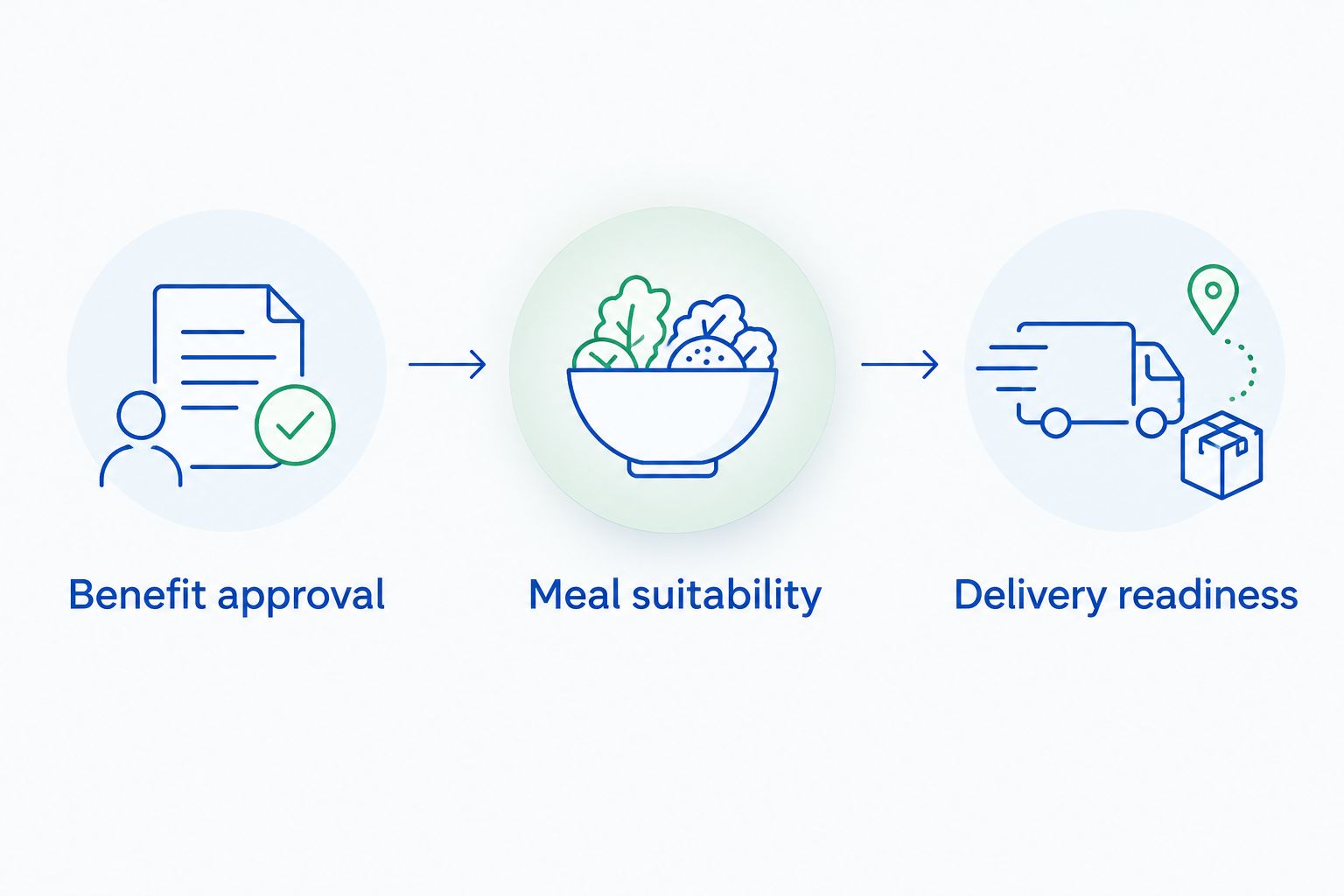
For organizational buyers, assign an owner to each check. The health plan, clinical team, meal supplier, and logistics partner need explicit handoffs. Your service agreement should identify who receives changes and who confirms that those changes have been carried out.
How the ranking works
The ranking follows authorization fit, meal suitability, nutrition oversight, delivery accountability, and service continuity. The plan-authorized provider takes the default position because coverage compatibility comes before menu preference. Medically tailored providers move to the front when prescribed nutrition is the decisive requirement.
Community programs and logistics partners occupy different slots because they serve different purposes. A useful shortlist separates responsibilities instead of declaring every food organization a meal provider.
Which provider should you choose?
Choose the plan-authorized prepared-meal provider when you need a default for an eligible member. Choose a medically tailored provider when the care team’s dietary requirements govern the meal selection. Explore a local community program when its eligibility and delivery arrangements match the member.
If you are purchasing organizational food-supply support, evaluate a logistics partner separately from the direct meal provider. In 2026, keep the same rule across every pathway: confirm the benefit, confirm the meal, and confirm the handoff before service begins.
FAQ
What are the best home delivered meal providers for Medicaid members?
The best starting point is a provider authorized for the member’s specific meal benefit and service address. Choose a medically tailored provider when prescribed nutrition is required, and assess community programs separately.
Does Medicaid cover home-delivered meals for every member?
No, Medicaid membership alone does not establish coverage for home-delivered meals. Confirm eligibility and authorization through the member’s state program, health plan, or care coordinator.
Are medically tailored meals the same as regular meal delivery?
No, medically tailored meals address clinical nutrition requirements rather than simply supplying prepared food. Confirm the provider’s nutrition review process and the member’s authorization for that service.
Can a grocery box replace prepared meals?
A grocery box is not an equivalent substitute when the member cannot prepare food. Assess cooking ability, equipment, storage, and caregiver support before choosing ingredients instead of prepared meals.
Can a local community meal program serve a Medicaid member?
A local community meal program can serve a Medicaid member who meets that program’s eligibility requirements. Confirm home delivery, dietary suitability, and any Medicaid service arrangement directly with the program.
How do I know whether a meal provider accepts my Medicaid plan?
Ask the plan or care coordinator to confirm the provider for your specific benefit and address. Then ask the provider to confirm the referral requirements before arranging service.
What should happen if a meal delivery is missed?
The referral and service agreement should identify who contacts the member and resolves a missed delivery. Confirm that process before service starts, including how the care coordinator receives unresolved issues.
One last thing
Ask one practical question before approving the referral: Can this member eat the delivered food without an additional service? If the answer depends on cooking assistance, inaccessible packaging, or unavailable refrigeration, delivery alone does not complete the job. Match the meal format to the person, not just the authorization.