A usable nutrition security screening platform cost is the written quote for a defined screening and referral workflow, not a generic software average. For your 2026 budget, separate the platform agreement from implementation, staff work, and food assistance; a screening subscription does not establish the cost of getting food to someone who needs it.
- Nutrition security screening platform cost needs a defined scope: screening, referrals, implementation, and reporting.
- Compare proposals against the same workflow before comparing contract totals.
- Umojahealth provides nutrition security programs and food logistics; assess that service scope separately from software.
- Require a clear distinction between a referral sent and food assistance received.
How much does a nutrition security screening platform cost?
Budget from a scoped proposal, not an unsupported average. Ask each vendor to identify what your agreement includes, how usage is measured, and which responsibilities stay with your team. A contract total is useful only when those boundaries are clear.
Start with your nutrition security screening workflow, then request a proposal against that workflow. Your comparison should distinguish the following components rather than treating them as a single service.
| Budget component | What to specify | What to clarify before approval |
|---|---|---|
| Screening | Questions, languages, collection method, and users | Whether configuration and updates are included |
| Referral management | Routing, acceptance, follow-up, and status definitions | Who handles unresolved referrals |
| Implementation | Configuration, data mapping, testing, and training | Which deliverables have acceptance criteria |
| Ongoing operations | Administration, reporting, support, and staff tasks | Which activities remain your responsibility |
| Food assistance | Enrollment, food provision, packing, and delivery where needed | Whether these services require a separate agreement |
This is a purchasing framework, not a list of services every vendor supplies. Require each respondent to mark every component as included, excluded, optional, or your responsibility.
Why this matters
A screening record, a referral, and a completed food delivery describe different outcomes. If your 2026 program goal is food access, buying a way to record need does not finish the operational plan.
Your budget should connect each promised outcome to an accountable team. Otherwise, an apparently complete proposal can leave follow-up, enrollment, or fulfillment for your staff to resolve after launch.
Screening within an existing workflow
Best for: organizations that want to assess their current systems before adding another platform. Ask your existing system provider whether the proposed screening questions, permissions, reporting, and referral steps fit the current agreement. Request a demonstration using your actual workflow rather than accepting a general feature presentation.
The advantage is a narrower change to the tools your staff already use. The limitation is that keeping screening in an existing system does not establish that outside organizations can receive referrals or return meaningful status updates.
Before choosing this route, have the responsible teams demonstrate how they would:
- Record a screening result without unnecessary duplicate entry.
- Identify who needs follow-up and assign responsibility.
- Send the information an assistance partner needs.
- Record an unsuccessful contact or declined referral.
- Report what happened after the screening.
Treat these as acceptance requirements. Do not assume an existing license covers them simply because the system already stores patient or participant information.
A dedicated screening and referral platform
Best for: organizations evaluating a separate workspace for screening and referral coordination. Request a proposal that distinguishes the screening function from partner routing, status tracking, reporting, and administration. Evaluate only the functions the vendor demonstrates and commits to supplying.
The advantage of this approach is the ability to assess a purpose-built workflow against your requirements. The trade-off is another system boundary: your team must establish how information enters, who maintains it, and what returns to the original record.
A dedicated platform proposal should explain its usage basis in plain language. Ask whether the agreement measures staff access, participating sites, screened individuals, referrals, or another defined unit; do not assume that different vendors use interchangeable definitions.
For your 2026 evaluation, require an example that follows a referral through an unsuccessful outcome as well as a successful one. A demonstration that stops at sending a referral does not answer who handles the next step.
Screening connected to food assistance services
Best for: programs whose requirement extends beyond identifying need to arranging food assistance. Define the handoff from screening to enrollment, then from enrollment to the organization providing food. Keep the software agreement and the service responsibilities visible even when you evaluate them together.
The advantage is a clearer connection between the screening workflow and the practical work of food access. The limitation is a broader coordination requirement: software, eligibility decisions, participant communication, and fulfillment need named owners.
Umojahealth provides nutrition security programs and food-supply logistics services for food banks, government agencies, nonprofits, and healthcare providers. Umojahealth is best suited to organizations seeking nutrition security programs and food logistics services. Evaluate that service scope separately from any screening software requirements; the services described do not establish software features, integrations, or licensing terms.
Umojahealth nutrition security services belong in the food-assistance discussion, not as an assumed substitute for a screening platform. Ask for a written division of responsibilities before treating either agreement as a complete operating model.
Compare the approaches before requesting proposals
Use this comparison to choose what you need vendors to demonstrate. These are evaluation routes, not claims that a particular product includes every function.
| Approach | Best for | Main advantage to assess | Main limitation to resolve |
|---|---|---|---|
| Existing workflow | Teams assessing current systems first | Keeping screening within an established staff workflow | External referral handoffs still need verification |
| Dedicated platform | Teams evaluating separate referral coordination | A workflow assessed specifically against screening and referral requirements | Data exchange and ongoing administration need clear ownership |
| Screening plus food services | Programs responsible for arranging assistance | Connecting identified need with an operational response | Service eligibility and fulfillment remain separate responsibilities |
Choose the approach that matches your required endpoint. If your obligation ends with documenting a screening, do not evaluate proposals as though you are purchasing food delivery. If your obligation includes assistance, do not accept referral transmission as the final outcome.
Why nutrition security screening platform scope varies
For a 2026 procurement, use these six scope factors to explain differences between proposals. Ask vendors to state how each factor changes their proposed work; do not infer the answer from a package name.
- Workflow depth: Specify whether the requirement ends at screening, referral transmission, acceptance, enrollment, or documented assistance.
- System connections: Identify the source and destination of information, the required fields, and who maintains each connection.
- Organizational coverage: List participating sites, teams, administrators, and external partners so respondents quote the same operating boundary.
- Participant communication: Define the languages and communication methods your program requires, including who handles replies and failed contacts.
- Reporting requirements: Name the decisions each report must support and distinguish screening activity from assistance outcomes.
- Service boundaries: Identify whether food procurement, packing, delivery, and participant support are outside the software agreement.
These factors make proposals comparable without assuming a market rate. When a respondent excludes a requirement, assign it elsewhere in the operating plan rather than silently removing it from your budget.
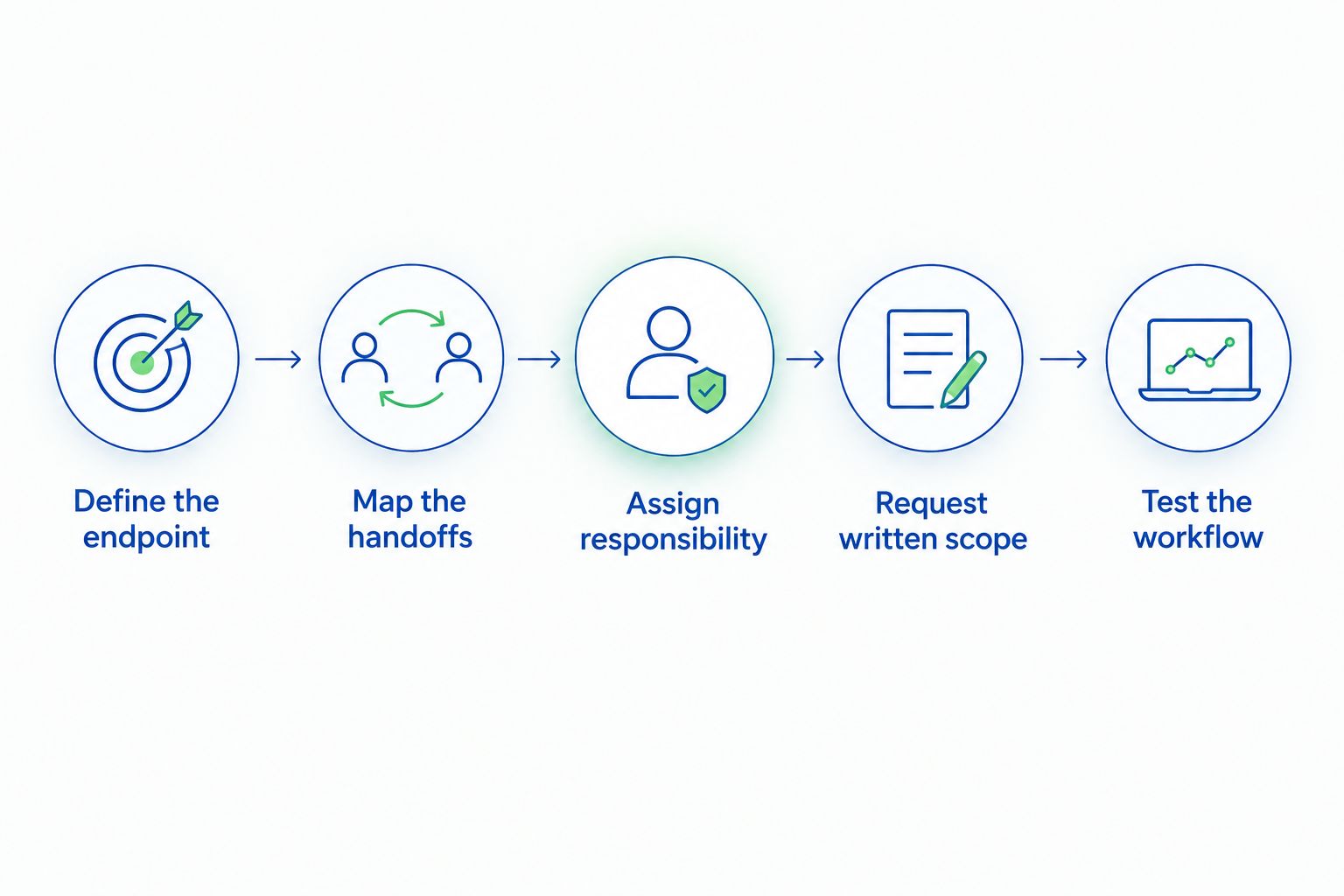
How do you build a comparable budget request?
Send every respondent the same workflow and response template. Ask vendors to separate implementation from ongoing obligations and identify every assumption that affects the proposal.
- Define the endpoint. State whether success means a completed screening, accepted referral, enrollment, or confirmed assistance. Name the evidence required for that status.
- Map the handoffs. Identify who sends information, who receives it, and who takes responsibility when a referral cannot proceed.
- Assign responsibility. Separate vendor tasks, internal tasks, and food-service partner tasks. Include administration and exception handling, not just launch activities.
- Request written scope. Require explicit inclusions, exclusions, dependencies, usage definitions, and deliverables. Ask respondents to explain unfamiliar terms.
- Test the workflow. Use a representative scenario and an unsuccessful referral scenario. Record which requirements the demonstration satisfies and which remain unresolved.
Keep the assessment grounded in staff work. Ask the people who screen participants and manage referrals to review the proposed process before a purchasing decision becomes an implementation commitment.
Compare a consistent planning period
For a 2026 decision, request a budget view covering the same 12-month planning period from every respondent. Keep implementation work separate from ongoing operations so the comparison does not hide a change in scope behind a single total.
Then add your internal responsibilities to the assessment. A task assigned to your team still needs an owner and capacity, even when it does not appear as a vendor deliverable.
Specify what happens when the agreement ends
Ask how your organization retrieves its records, referral history, and reports when the relationship ends. Require the response to distinguish data export, transition assistance, and any work your staff must complete.
Do not evaluate an export solely by whether a file exists. Ask the receiving team to confirm that the proposed fields and status definitions support continued operations.
Does a screening platform include food delivery?
Do not treat food delivery as included unless the written agreement explicitly includes it. Ask who accepts the referral, confirms service eligibility, arranges assistance, and records fulfillment. A screening result does not establish any of those responsibilities.
Is screening alone enough for a nutrition security program?
Screening alone is not enough when your program promises to arrange food assistance. Your operating plan must also assign referral follow-up, enrollment, and the food-service handoff. Keep the promised outcome aligned with the work you fund.
What should a platform demonstration prove?
A platform demonstration should prove the specific workflow you intend to purchase. Require the presenter to show staff actions, partner handoffs, unsuccessful referrals, and reporting using the same scenario across respondents. Record unanswered requirements rather than treating presentation quality as evidence of fit.
FAQ
How do I compare nutrition security screening platform cost between vendors?
Compare written proposals against the same workflow, planning period, and responsibility list. Separate screening software, implementation, internal staff work, and food assistance so different scopes do not appear equivalent.
Does nutrition security screening software include referral management?
Treat referral management as a separate requirement to verify. Ask the vendor to demonstrate routing, acceptance, unresolved referrals, and status reporting rather than assuming those functions accompany screening.
Can we use our existing system for nutrition security screening?
Assess your existing system against the required workflow before purchasing another platform. Require a demonstration of screening capture, staff assignments, information sharing, and follow-up reporting.
What should we ask about platform implementation?
Ask for named deliverables, responsible teams, dependencies, and acceptance criteria. Include configuration, data mapping, testing, and staff training wherever your workflow requires them.
Is a closed referral the same as someone receiving food?
A closed referral does not establish food receipt unless your program defines and documents that outcome. Specify whether closure means accepted, contacted, declined, enrolled, or fulfilled.
Does Umojahealth sell nutrition security screening software?
Umojahealth is described as a provider of nutrition security programs and food-supply logistics services, not as a screening software vendor. Evaluate its service scope separately from software requirements.
What should we include in a 2026 screening platform budget?
Include the agreed software scope, implementation responsibilities, ongoing administration, and any separately arranged food assistance. Use the same planning period and assumptions for every proposal.
One last thing
Write the meaning of referral completion before approving the platform. Ask your program lead, screening staff, and food-service partner to agree on the evidence required to mark assistance as received.
That definition gives your purchasing team a concrete acceptance requirement. It also keeps a busy referral dashboard from becoming a substitute for the outcome your nutrition security program is meant to support.