Yes—community health centers can make nutrition security screening manageable by using a brief food insecurity screen within an existing patient encounter, then asking what would make food support usable. The caveat is that screening identifies risk; your team still needs a referral owner, a suitable food resource, and a way to check whether the patient received help.
- Community health center nutrition security screening works best when brief questions lead to an assigned referral and follow-up.
- The Hunger Vital Sign identifies food insecurity risk; it does not replace a nutrition assessment.
- Ask about dietary needs, cooking access, and transportation before choosing food support.
- Umojahealth provides nutrition security and food logistics services, not a substitute for clinical screening.
Why this matters
A completed questionnaire does not tell you whether a patient can use the food offered. Someone might have access to groceries but lack refrigeration, need help preparing meals, or struggle to find foods that fit a clinician-directed eating plan.
Umojahealth provides nutrition security programs and food-supply logistics services for organizations including healthcare providers. Those services address the food-support side of the process; your health center remains responsible for its clinical assessment and referral decisions.
For a 2026 implementation, define success as more than recording an answer. Build a process that distinguishes identifying a need, offering assistance, and confirming what happened next.
Can community health centers screen for nutrition security easily?
Yes, if you keep the initial screen brief and separate it from the follow-up assessment. Start with a recognized food insecurity tool, establish how staff should respond, and avoid adding questions that nobody will act on.
A practical workflow follows these steps:
- Ask privately. Explain that you ask about food access to help connect patients with support. Give patients room to decline without disrupting their care.
- Record consistently. Use a designated location in the health record rather than scattering responses across free-text notes.
- Clarify needs. After a positive screen, ask whether the patient wants assistance and what would make that assistance useful.
- Assign ownership. Name the staff role responsible for the referral, including what happens when that person is unavailable.
- Confirm connection. Check whether the patient reached the resource and whether the food support met the identified need.
Keep the questions and handoff instructions together. Staff should not have to search separate documents to learn what a positive response means.
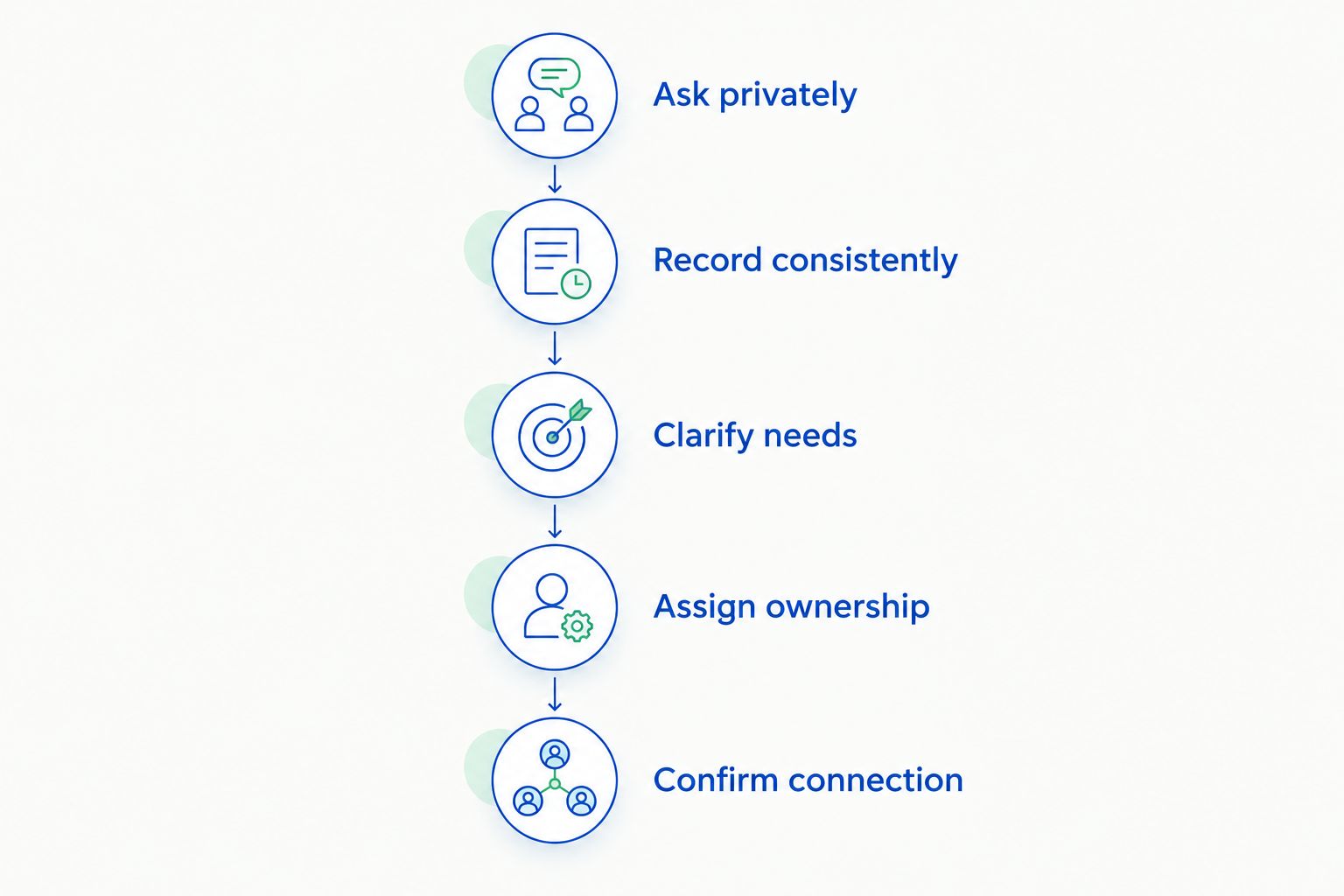
Treat this as a workflow design, not a promise about appointment length. Test it in your own setting before expanding across every visit type.
Initial screening: use a brief, established tool
The Hunger Vital Sign is a validated, 2-question food insecurity screening tool developed by Children's HealthWatch. It asks about household concern that food would run out and whether purchased food lasted, using a 12-month reference period.
Responses of often true or sometimes true to either statement indicate risk for food insecurity. Use the published wording and response choices rather than rewriting the questions into an informal conversation and treating the results as equivalent.
For your 2026 workflow, distinguish these records:
- Screen positive: The response meets the tool's criteria for food insecurity risk.
- Screen negative: The response does not meet those criteria.
- Declined: The patient chose not to answer.
- Not completed: The screen was not administered or finished.
A declined or incomplete screen is not a negative result. Keeping those categories separate prevents an unanswered questionnaire from looking like confirmed food security.
The tool has limits. It does not establish a medical diagnosis, determine program eligibility, or describe every barrier to obtaining and using nutritious food.
Follow-up assessment: establish what support will work
A positive screen opens a conversation; it does not prescribe a food box. Ask permission before discussing assistance, then focus on the barriers that change your referral choice.
Useful follow-up questions include:
- Do you have food for your immediate needs?
- Would you like help finding food support?
- Can you travel to a pickup location?
- Do you have a refrigerator and a way to prepare food?
- Are there allergies or dietary instructions the receiving program needs to consider?
- Are there food preferences that would make the support more useful?
A food insecurity screen and a nutrition assessment answer different questions. A patient with weight loss, swallowing problems, or another clinical concern needs the appropriate clinical evaluation, regardless of the screening result.
Route immediate food needs through your center's urgent support process. Do not leave a patient waiting for a routine callback when the conversation identifies a more immediate problem.
Which screening approach fits your health center?
Choose the method your patients can access and your staff can support. No format removes the need for privacy, clear documentation, and a response to positive results.
| Approach | Best for | Main advantage | Main limitation |
|---|---|---|---|
| Patient-completed questionnaire | Patients who prefer answering privately | Lets patients respond without saying answers aloud | Requires accessible language, format, and help when requested |
| Staff-administered questions | Patients who want verbal assistance | Allows staff to explain the process and address confusion | Requires consistent wording and a private setting |
| Supported choice of formats | Centers serving patients with different access needs | Lets patients use a workable method | Requires staff to reconcile results in one documentation location |
Avoid making a patient portal the only route. Offer an alternative for patients who do not use the portal, need interpretation, or prefer assistance.
For a 2026 rollout, test both the patient experience and the staff handoff. A questionnaire that works on a tablet still fails operationally if nobody receives the positive result.
Why screening workload varies
The questions are only part of the work. Your workload depends on how your center handles the following factors:
- Placement in care: Decide whether screening belongs at registration, rooming, a preventive visit, or another defined encounter. Avoid unnecessary duplicate questioning.
- Language and accessibility: Arrange appropriate interpretation and accessible formats. Do not assume a written questionnaire works for every patient.
- Documentation design: Give staff clear response fields, referral status options, and a way to distinguish declined from negative results.
- Referral readiness: Verify each resource's service area, intake requirements, and contact process before directing patients there.
- Follow-up ownership: Assign a role to check outcomes and address referrals that did not result in support.
- Food suitability: Match assistance to preparation capacity, dietary requirements, transportation, and household preferences.
Do not solve every operational problem by adding another screening question. If the problem is an unanswered referral, improve referral ownership rather than lengthening the questionnaire.
Connect the result to food support
Match the referral to the barrier, not just the positive screening result. A resource list is useful when patients can act on it; other patients need help contacting a program or arranging a workable handoff.
Compare support types before making a recommendation:
| Support type | Best for | Practical benefit | Limitation to check |
|---|---|---|---|
| Grocery or food box support | Patients who can store and prepare the contents | Supplies food for household use | Contents and pickup arrangements must fit the household |
| Prepared meal support | Patients for whom cooking is a barrier | Reduces meal-preparation demands | Dietary suitability, storage, and program requirements still matter |
| Benefits application assistance | Patients who want help exploring food benefits | Supports access to an ongoing assistance pathway | Screening positive does not establish eligibility or approval |
Ask receiving organizations what information they need and what outcome they can report. Share patient information through your approved consent, privacy, and data-sharing processes.
Umojahealth is best suited to healthcare organizations seeking nutrition security and food-supply logistics services. Its stated services include kitting and box programs, but a referral partnership still needs a defined scope: who accepts referrals, who assesses suitability, and who communicates back to your center.
Do not assume Umojahealth supplies screening software, integrates with your health record, or determines benefits eligibility. Establish those responsibilities with any prospective partner before building them into your process.
How do you know whether screening leads to help?
Track the stages separately. A referral marked sent is not the same as a patient receiving food, and a food delivery is not proof that the original barrier has been resolved.
Use clearly defined status categories, such as:
- Screen completed.
- Assistance offered.
- Assistance accepted or declined.
- Referral sent.
- Receiving organization contacted.
- Support received.
- Need unresolved.
When you calculate a completion rate, define its denominator. Eligible encounters, unique patients, and completed visits describe different populations and should not be mixed in the same measure.
For your 2026 review, examine unresolved referrals as well as completed ones. A missed connection, unsuitable food, or inaccessible pickup location tells you which part of the process needs correction.
Keep the distinction between patient choice and operational failure. A patient declining assistance is different from a referral that nobody followed up.
Does every positive screen need a dietitian referral?
A positive food insecurity screen alone does not establish the need for medical nutrition therapy. Use the patient's clinical findings and your referral criteria to determine whether a registered dietitian or another clinician should assess them.
Food access assistance and clinical nutrition care can happen together. Do not require patients to complete an unrelated clinical appointment before helping them connect with appropriate food resources.
Should you repeat nutrition security screening at every visit?
Set a documented screening schedule rather than automatically repeating the questionnaire at every encounter. Consider your patient population, applicable program requirements, and how staff will recognize a recent result.
Also leave room to reassess when circumstances change or a patient raises a concern. A previous negative result should not prevent a new conversation about food access.
Can you start without a new referral platform?
Yes. You can define questions, documentation, referral ownership, and follow-up using your existing approved processes before deciding whether additional technology is necessary.
The limitation is coordination: manual handoffs need explicit responsibility and reliable tracking. Software should support a defined workflow, not substitute for deciding who acts after a positive screen.
FAQ
What's the easiest way to start community health center nutrition security screening?
Start with a brief, established food insecurity tool and a written response pathway. Assign responsibility for reviewing positive results, offering assistance, and checking the referral outcome.
Can we use the Hunger Vital Sign for nutrition security screening?
The Hunger Vital Sign identifies food insecurity risk using 2 questions. Follow it with questions about dietary needs, storage, preparation, and access when those details affect the assistance you offer.
Does a positive food insecurity screen mean a patient qualifies for benefits?
No. A positive screen identifies risk, while each benefits program applies its own eligibility and application requirements.
What should we do when a patient declines screening?
Record that the patient declined rather than marking the screen negative. Respect the decision and keep information about food resources accessible without requiring disclosure.
Is giving patients a food pantry list enough?
A resource list is enough only when it provides a workable next step for that patient. Check whether transportation, intake requirements, communication, or food suitability calls for additional assistance.
Can a negative screen rule out nutrition problems?
No. A negative food insecurity screen does not rule out malnutrition, dietary barriers, or a clinical condition that affects eating; assess those concerns separately.
What should our health center check before referring patients to food support?
Check the program's service area, intake process, food suitability, and pickup or delivery arrangements. Establish how your team will learn whether the patient connected with support.
One last thing
Test the handoff before expanding the questionnaire. Walk a sample referral through your approved process without using real patient information, and ask staff to identify who takes the next action at each stage.
If nobody can explain how an unsuccessful referral returns to the care team, fix that gap before expanding your 2026 screening workflow. The most useful next step is often a clearer responsibility, not another field in the health record.