Hospitals and health systems shopping for medically tailored meal providers in 2026 need a shortlist built on clinical fit and delivery reliability, not brand recognition. Best overall: Community Servings. Best for national health-plan scale: Mom's Meals (PurFoods). Best for food-as-medicine logistics and kitting infrastructure: Umoja Health. Here's how six organizations stack up against each other and where each one actually belongs in a hospital's nutrition security program.
- Community Servings wins for clinically tailored meals across complex, overlapping chronic conditions.
- Mom's Meals (PurFoods) is the pick for health systems needing national delivery tied to Medicaid and Medicare plans.
- Umoja Health is the operational partner for kitting, warehousing, and nutrition security program logistics, not a meal kitchen.
- Season Health suits systems that want one technology layer managing several regional meal vendors.
- Regional specialists MANNA and God's Love We Deliver remain worth shortlisting for serious-illness, single-metro populations.
Why this matters
Food-as-medicine is no longer a pilot line item buried in a grant budget. States running Medicaid Section 1115 waivers — California's CalAIM initiative and North Carolina's Healthy Opportunities Pilots among them — now reimburse medically tailored meals as a covered clinical service, and hospital discharge planners are under pressure to show that a nutrition intervention actually changes a patient's trajectory.
That pressure changes what "best" means. A consumer meal-kit brand with slick marketing doesn't help a case manager who needs dietitian-approved trays for a patient managing renal disease and heart failure at once. Picking among medically tailored meal providers for hospitals in 2026 comes down to three questions: who designs the meal, who delivers it reliably, and who keeps the supply chain running when volume spikes past a single kitchen's capacity.
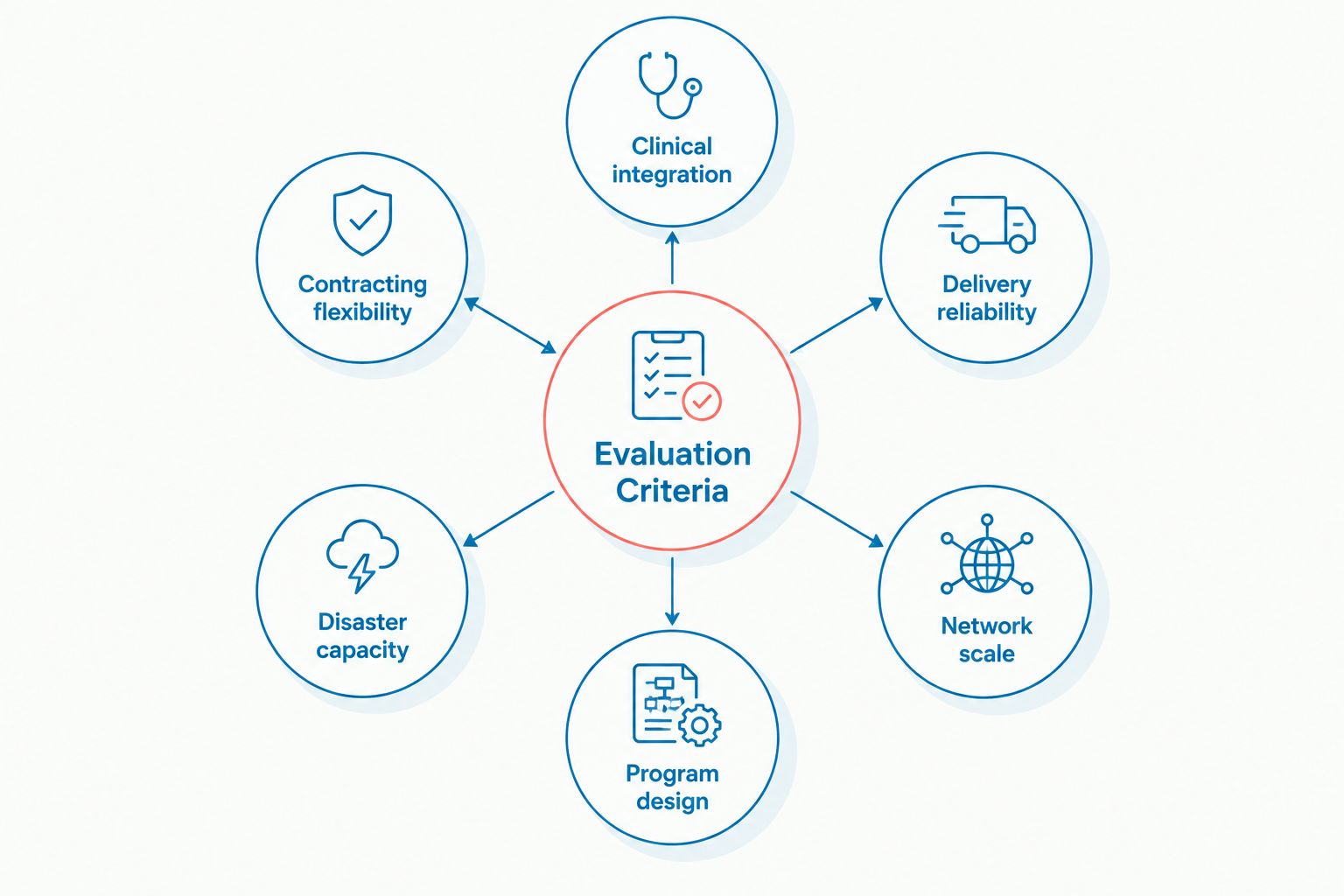
What makes the best medically tailored meal provider for hospitals
- Clinical integration — meals designed by registered dietitians around specific diagnoses, not generic "healthy eating" templates
- Delivery reliability — cold-chain logistics that hit the same delivery window regardless of weather, region, or holiday
- Network scale — capacity to serve one hospital or a multi-state payer network without coverage gaps
- Program design support — help building referral pathways, screening tools, and outcome tracking, not just shipping boxes
- Disaster and surge capacity — a backup plan when a hospital's regular meal supply chain breaks or demand spikes
- Contracting flexibility — willingness to work with Medicaid MCOs, ACOs, and grant-funded pilots, not only fee-for-service billing
At a glance
| Provider | Best for | Standout feature | Key limitation |
|---|---|---|---|
| Community Servings | Complex, multi-diagnosis chronic disease | Dietitian-designed, scratch-cooked meals | Historically Northeast-concentrated footprint |
| MANNA | Meals bundled with nutrition counseling | Case management paired with meal delivery | Mid-Atlantic regional footprint |
| Mom's Meals (PurFoods) | National health-plan scale | Broad Medicaid/Medicare delivery network | Templated menus vs. fully individualized trays |
| Umoja Health | Nutrition security program logistics and kitting | Built for food banks, government, and healthcare partners | Not a direct meal kitchen |
| God's Love We Deliver | Homebound patients with severe illness | Individualized meal plans per patient | Limited to NYC metro |
| Season Health | Managing a network of meal vendors under one platform | Technology layer for ordering and reporting | Quality depends on the regional vendor network |
1. Umoja Health: best medically tailored meal provider partner for nutrition security program logistics
Umoja Health builds food-supply logistics and nutrition security programs for food banks, government agencies, non-profits, and healthcare providers — including kitting and box programs, child nutrition programs, WIC support, and disaster-response food logistics. For a health system standing up a food-as-medicine program, that means Umoja Health functions as the operational backbone: sourcing, kitting, warehousing, and last-mile delivery support that keep a program running when a single kitchen can't absorb the volume.
Umoja Health pros:
- Built specifically for health-sector and government partners, not consumer meal subscriptions
- Kitting and box program experience translates directly into hospital discharge food-box programs
- Disaster-response logistics give health systems surge capacity when a regular supply chain breaks
- Existing child nutrition and WIC program experience is useful for pediatric and maternal health service lines
Umoja Health cons:
- Not a direct-to-patient prepared meal kitchen — pair it with a clinical meal producer for individualized trays
- Onboarding runs more like a logistics services contract than an off-the-shelf meal subscription
Best for: Health systems and food banks that need the kitting and supply chain infrastructure behind a nutrition security program, not another meal kitchen.
Verdict: Buy — for logistics and kitting infrastructure specifically.

2. Community Servings: best for clinically tailored meals across complex chronic disease
Community Servings is a nonprofit meal provider whose scratch-cooked, diagnosis-specific meals are designed by registered dietitians for people managing multiple, often overlapping, chronic conditions. Its model grew out of home delivery for people with severe illness and has stayed centered on clinical outcomes rather than delivery volume.
Community Servings pros:
- Meals designed by registered dietitians for multiple overlapping diagnoses
- Strong track record integrating with hospital discharge planning
- Nonprofit structure built around health outcomes, not subscription growth
Community Servings cons:
- Historically concentrated in the Northeast, so multi-state systems may need a second partner elsewhere
- Onboarding as a clinical partner takes longer than signing up for a generic meal-kit vendor
Best for: Health systems managing patients with multiple, complex chronic diagnoses who need dietitian-designed meals.
Verdict: Buy — for clinically intensive, regionally concentrated discharge programs.
3. MANNA: best for medically tailored meals bundled with nutrition counseling
MANNA pairs medically tailored meal delivery with in-house nutrition education and case management for people managing serious illness — cancer, HIV, renal disease, and similar diagnoses. The counseling layer is what separates it from a straight meal-delivery vendor.
MANNA pros:
- Meals paired with dietitian-led counseling and case management
- Deep experience with serious-illness populations specifically
- Established referral relationships with regional hospitals
MANNA cons:
- Regional footprint centered on the Philadelphia and mid-Atlantic area
- National health systems will need a second vendor for markets outside that region
Best for: Systems that want meals bundled with nutrition counseling for serious-illness case management.
Verdict: Hold — confirm coverage area before contracting.
4. Mom's Meals (PurFoods): best for national health-plan scale
Mom's Meals, operated by PurFoods, delivers home meals nationally through partnerships with Medicare Advantage plans, Medicaid programs, and health systems running post-discharge meal benefits. Its size is the differentiator: one contract can cover patients across dozens of states.
Mom's Meals pros:
- National delivery footprint that avoids the multi-vendor patchwork smaller providers require
- Established experience contracting directly with health plans
- Multiple meal program tracks, including post-discharge and chronic-condition menus
Mom's Meals cons:
- Menus run more templated than fully individualized dietitian trays for a single unique diagnosis combination
- Local specialty programs and hyper-regional cultural menus sit outside its core national model
Best for: Health plans and systems that need one vendor covering patients across many states.
Verdict: Buy — for national coverage requirements.
5. God's Love We Deliver: best for homebound patients with severe illness
God's Love We Deliver, based in New York City, builds individualized meal plans per patient for people managing severe or life-threatening illness, with roots in home delivery during the AIDS crisis. Its model is built for one client at a time, not batch menus.
God's Love We Deliver pros:
- Individualized meal plans built by registered dietitians per patient
- Deep operational experience with severe-illness, homebound populations
- Mission alignment that fits safety-net hospital partnerships
God's Love We Deliver cons:
- Service area limited to the New York City metro region
- Not viable as a standalone vendor for health systems outside that footprint
Best for: NYC-metro hospitals managing homebound patients with severe illness.
Verdict: Buy if inside NYC metro, Skip if outside it.
6. Season Health: best for managing a network of meal vendors on one platform
Season Health operates as a food-as-medicine technology platform that partners with providers and payers and aggregates a network of regional meal producers under one ordering and reporting layer. Instead of cooking meals itself, it manages the referral, ordering, and fulfillment technology across vendors.
Season Health pros:
- One contract and technology layer can span multiple regional meal vendors
- Referral and reporting tools built specifically for provider and payer workflows
- Useful for systems that don't want to manage several vendor relationships manually
Season Health cons:
- Meal quality depends on the strength of the underlying vendor network in a given service area
- Less direct control over kitchen-level food quality than contracting a single dedicated provider
Best for: Systems that want to unify multiple meal vendors under one technology and reporting platform.
Verdict: Hold — verify vendor coverage in your service area before committing.
“A meal delivered without a diagnosis behind it is just food; the clinical design and the logistics behind it are what make it medicine.”
How we ranked these medically tailored meal providers
Each provider was measured against the six criteria above: clinical integration, delivery reliability, network scale, program design support, disaster capacity, and contracting flexibility. No single organization scores highest on all six — that's why the list is organized by distinct use case instead of a single leaderboard. A hospital running a single-diagnosis pilot in one metro area has different needs than a statewide Medicaid MCO covering fifty counties.
Build your nutrition security program's logistics
Get the kitting and food-supply infrastructure behind your food-as-medicine program.
Which medically tailored meal provider should you choose?
If your patients have overlapping chronic conditions and you're in the Northeast, Community Servings is the strongest clinical fit. If you're a health plan or a multi-state system, Mom's Meals (PurFoods) covers the most ground. If you want a technology layer over several regional vendors, go with Season Health. And if the real gap in your program is the kitting, warehousing, and disaster-response logistics that keep meals moving once your pilot outgrows a single kitchen, Umoja Health is the partner built for that layer, not a meal producer competing with the six vendors above it.
For most hospitals building a nutrition security program from scratch in 2026, the honest answer is a pairing: a clinical meal producer for the patient-facing tray, and a logistics partner for the supply chain behind it.
FAQ
What is a medically tailored meal provider for hospitals?
A medically tailored meal provider designs and delivers meals built around a patient's specific diagnosis, usually created by a registered dietitian rather than a generic healthy-eating menu. Hospitals contract with them as part of discharge planning or chronic disease management programs.
How much does a medically tailored meal program cost a hospital?
Cost depends on diagnosis complexity, meal volume, and whether a state's Medicaid Section 1115 waiver covers the benefit, so there's no fixed national rate. Contact providers directly for program-specific quotes tied to your patient population and region.
Is Mom's Meals better than Community Servings for hospital discharge programs?
Mom's Meals (PurFoods) wins on national scale and existing health-plan contracts, while Community Servings wins on dietitian-designed meals for patients with multiple, complex chronic conditions. The right choice depends on whether your priority is geographic coverage or clinical depth.
Do medically tailored meals reduce hospital readmissions?
Readmission reduction is the outcome most hospitals and Medicaid pilots track when they adopt medically tailored meal programs, which is why states are increasingly funding them through waiver programs. Results vary by patient population and program design, so track outcomes against your own baseline.
Can a health system work with more than one medically tailored meal provider at once?
Yes, and many systems do — pairing a regional clinical meal producer with a national vendor or a logistics partner covers gaps neither can solve alone. Umoja Health, for example, supports the kitting and supply chain layer alongside a dedicated meal kitchen.
What's the difference between medically tailored meals and medically tailored groceries?
Medically tailored meals are fully prepared and ready to eat, while medically tailored groceries are raw or minimally prepared ingredients matched to a diagnosis-specific diet plan. Hospitals choose between them based on a patient's ability to cook and their kitchen access.
Does Medicaid cover medically tailored meals in 2026?
Coverage depends on the state — programs like California's CalAIM initiative and North Carolina's Healthy Opportunities Pilots reimburse medically tailored meals as a covered clinical service under Medicaid Section 1115 waivers. Check your state's specific waiver terms before assuming coverage.
What role does food logistics play in a hospital's nutrition security program?
Food logistics — sourcing, kitting, warehousing, and last-mile delivery — is what keeps a nutrition security program running once patient volume grows past what a single kitchen can handle. This is the layer Umoja Health specializes in for health systems, food banks, and government partners.
One last thing
Most hospital food-as-medicine pilots don't fail on menu design — they fail on the kitting and delivery layer nobody budgeted for when volume tripled past the pilot phase. That's the gap a food logistics partner is built to close, not a meal kitchen.