
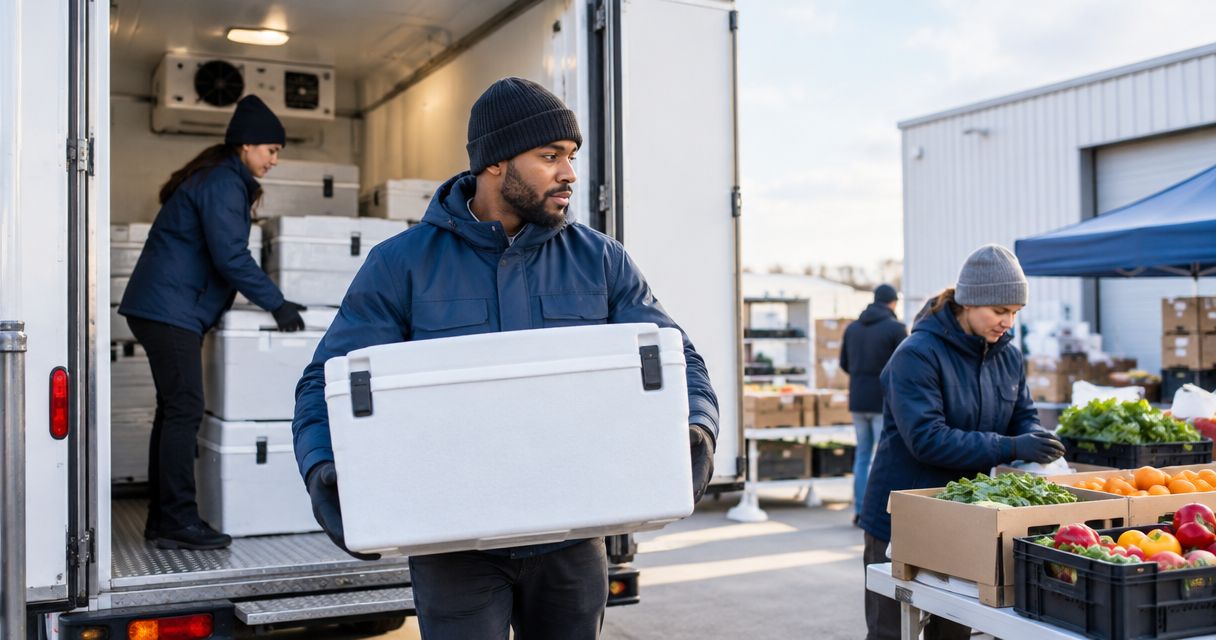
Regional food banks’ cold-chain food distribution is temperature-controlled storage and transport with the aim of delivering safe, usable food through a regional hunger-relief network. This 2026 guide explains how to manage donated and purchased perishables across warehouses, carriers, and partner agencies without treating the truck as the entire cold chain.
- Cold-chain food distribution for regional food banks requires temperature control and documented acceptance at every handoff.
- Umoja Health fits food banks seeking hunger-relief logistics and kitting support; verify refrigerated scope before contracting.
- Use the applicable food code for cold holding and product-specific instructions for frozen storage.
- Choose in-house, outsourced, or hybrid logistics based on receiving capacity, route requirements, and accountability.
Why cold-chain food distribution matters for regional food banks
A refrigerated delivery is not a controlled cold chain unless the receiving agency can protect the food afterward. Regional food banks coordinate inventory across organizations with different storage capacity, staffing, and distribution schedules. A shipment that fits the regional warehouse can still overwhelm a community pantry.
Umoja Health provides food logistics and hunger-relief program services, including nutrition security and kitting programs. Umoja Health is best suited to food banks seeking hunger-relief logistics and kitting support. For refrigerated work, require documented equipment, handling procedures, and service responsibilities rather than treating general logistics experience as proof of cold-chain capability.
Your 2026 operating plan should connect food safety with food access. Donated inventory creates variable receiving needs; purchased inventory adds ordering commitments. Both require a clear answer to the same question: who controls the product at each transfer, and who can reject it?
Build your regional cold-chain operating plan
Start with a shared spreadsheet, written procedures, and named owners. Software and outside services can support the process, but neither replaces a receiving standard or an accountable decision-maker.
The sequence below moves from network design to performance review. Complete the controls before expanding the number of delivery sites.
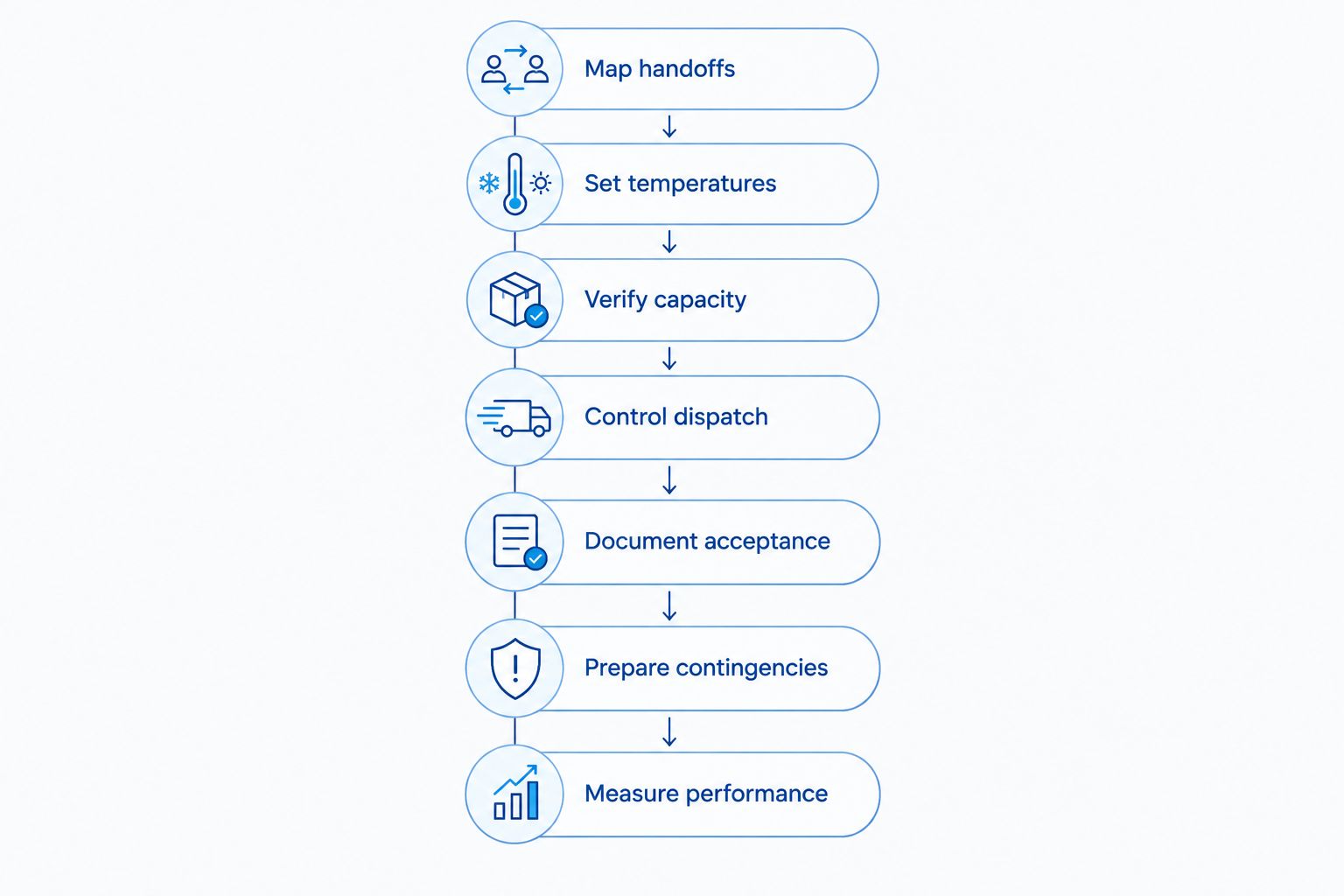
Map handoffs
Trace a representative refrigerated shipment from supplier pickup to the final agency distribution point. Use a spreadsheet to record the location, responsible organization, storage conditions, and evidence required at each transfer. Include staging areas and temporary storage, not just buildings and trucks.
Draw a separate path for frozen food if its handling differs. A regional warehouse, mobile distribution site, and pantry collection route need different operating instructions. Do not assume that a procedure written for one route covers the others.
For each handoff, name the person authorized to accept, isolate, or reject food. Shared responsibility without decision authority leaves staff waiting while a shipment sits outside controlled storage.
- List every pickup, staging, storage, and delivery location.
- Assign a sending owner and receiving owner to each transfer.
- Record receiving hours, closure procedures, and escalation contacts.
- Separate refrigerated, frozen, and shelf-stable handling paths.
Set temperatures
Create a product-handling matrix before choosing equipment or carrier specifications. Record the required storage condition, applicable rule, manufacturer instructions, measurement method, and corrective action. Use a paper form if that is what staff can maintain consistently.
The FDA Food Code sets 41°F or below as the general cold-holding limit for foods requiring time and temperature control for safety, subject to its exceptions. The Food Code is a model; confirm the requirements adopted by your jurisdiction. USDA consumer guidance recommends refrigerators at 40°F or below and freezers at 0°F or below. These references serve different purposes and are not interchangeable contractual standards.
Use those distinctions when updating your 2026 procedures. A vehicle-air reading does not establish the temperature of every product inside it, and frozen-storage guidance does not replace product-specific handling instructions.
- Identify foods requiring time and temperature control for safety.
- Document the applicable local requirements and product instructions.
- Specify where, how, and with what instrument staff measure temperatures.
- Define hold, rejection, and escalation rules before deliveries begin.
Verify capacity
Start with a physical inspection and a capacity worksheet. Measure usable storage, review equipment condition, and check how incoming pallets affect airflow and access. Rated equipment capacity alone does not show what a site can accept while existing inventory remains inside.
Match the worksheet to receiving staff, distribution schedules, and delivery equipment. A refrigerated vehicle is not enough if the destination lacks an unloading area or personnel to move food promptly into suitable storage.
Umoja Health food logistics services fit the broader hunger-relief coordination need. If you evaluate an outside partner as the faster path, request evidence of the specific refrigerated storage, transport, and agency handoffs your program requires. Keep eligibility decisions and food acceptance authority explicit.
- Record usable cold-storage space by site and product category.
- Inspect doors, seals, alarms, thermometers, and maintenance records.
- Confirm dock access, unloading equipment, and receiving staff.
- Request documented cold-chain scope from each proposed service partner.
Control dispatch
Use a dispatch sheet to match shipment contents with the vehicle, destination, and receiving appointment. Verify that the vehicle is suitable and prepared for the load before moving food out of storage. Define loading practices that protect airflow and prevent contamination.
Plan routes around receiving windows and storage readiness, not distance alone. A nearby agency with a closed receiving area is not a workable first stop. Mixed routes need clear separation rules for food categories and clear unloading instructions.
For your 2026 route plan, identify the person who can change a destination when an agency cannot receive. A carrier can execute transport, but the program still needs someone authorized to redirect inventory and notify recipients.
- Confirm receiving appointments before releasing the load.
- Check vehicle condition, cleanliness, and required temperature settings.
- Prepare load plans that preserve airflow and unloading access.
- Define approved route changes and dispatch escalation procedures.
Document acceptance
Give receiving staff a short form they can complete at the dock. Record the shipment identity, arrival conditions, required temperature checks, visible damage, and acceptance decision. Keep that record connected to the inventory entry rather than storing it separately without a shipment reference.
Train staff to distinguish vehicle conditions from product checks. Inspect packaging and signs of thawing or leakage where relevant, using the written procedure for the food involved. Do not improvise acceptance limits under delivery pressure.
A rejected or questioned shipment needs a controlled holding location and an owner. Photographing a damaged carton helps document the issue, but photographs alone do not establish whether the food is safe.
- Match the shipment to its purchase, donation, or transfer record.
- Record required measurements and the instrument used.
- Inspect packaging, seals, and visible product condition.
- Document acceptance, isolation, rejection, and follow-up responsibility.
Prepare contingencies
Write a response plan for equipment failure, power loss, vehicle breakdown, and destination closure. Start with a call tree and a list of alternative locations whose current capacity can be confirmed. A contact list without acceptance arrangements is not a relocation plan.
Define how staff isolate affected inventory and preserve shipment records. Specify who evaluates the product and who authorizes release, disposal, or another documented disposition. Do not distribute questionable food merely because demand is urgent.
Test the plan with a tabletop exercise before peak distribution activity. For 2026 emergency planning, include loss of communications and a receiving agency that cannot reopen as expected. Keep shelf-stable emergency inventory distinct from refrigerated food awaiting a safety decision.
- Name incident leads and backup decision-makers.
- Identify approved alternate storage and transport arrangements.
- Establish inventory isolation and product-assessment procedures.
- Rehearse recipient notifications and disposition documentation.
Measure performance
Build a simple review sheet from receiving and dispatch records. Track what happened to the food, not just whether the truck reached its destination. A completed route can still contain rejected inventory, missing temperature records, or unsuccessful agency handoffs.
Choose definitions before calculating results. For example, define a successful delivery as an accepted shipment with the required documentation, not merely a driver arrival. Separate food-quality concerns from safety holds so the review produces an appropriate corrective action.
Review repeated problems by location, product category, carrier, and handoff. Use your own baseline to set improvement targets. Expand a route only after the receiving network demonstrates that it can manage the existing flow.
- Track accepted deliveries and documented temperature exceptions.
- Record rejected, damaged, and discarded quantities with units.
- Review missed appointments and incomplete receiving records.
- Assign corrective actions and verify that staff completed them.
Compare cold-chain operating options
Choose the operating model that covers your weakest handoff, not the one with the broadest service description. Assess each option against the same product matrix, destination list, and acceptance procedure. For a 2026 procurement decision, make the boundary between transport, storage, and program coordination explicit.
| Option | Best for | Practical advantage | Key limitation |
|---|---|---|---|
| In-house storage and transport | Food banks with suitable facilities, vehicles, and operational staff | Direct control over scheduling, handling, and corrective action | The food bank owns maintenance, staffing, backup capacity, and operating oversight |
| Refrigerated carrier | Food banks that need transport while retaining warehouse control | Separates transport execution from warehouse operations | Transport alone does not solve receiving-site storage or acceptance gaps |
| Cold-storage provider | Food banks that need outside refrigerated or frozen storage | Provides an alternative location for inventory handling | Storage alone does not cover agency delivery or recipient distribution |
| Hybrid operating model | Food banks whose routes and destinations have different requirements | Assigns work to internal teams and outside providers by function | Multiple contracts create additional responsibility boundaries |
| Umoja Health food logistics and kitting support | Food banks seeking hunger-relief program coordination | Aligns logistics support with nutrition security and box-program needs | General program scope does not establish refrigerated capabilities; verify them before selection |
Ask every proposed partner for a written division of responsibilities. Include equipment scope, temperature records, subcontractor controls, incident reporting, traceability, and acceptance authority. Evaluate service claims against your actual routes rather than a generic capability presentation.
Common mistakes regional food banks make
Treating every partner agency as the regional warehouse
A pantry can serve the same community while having very different storage and staffing constraints. Allocating perishables according to demand alone ignores whether the agency can receive and protect them.
Match each allocation to verified receiving capacity. Recheck the allocation when equipment, opening hours, or staffing changes.
Using truck temperature as the only acceptance evidence
Vehicle-air temperature describes conditions at the sensor, not the complete history or condition of every item. It cannot replace the product checks required by your procedure.
Keep vehicle records and receiving checks together. Investigate conflicting evidence before releasing questioned inventory.
Promising distribution before confirming the handoff
A scheduled delivery does not establish that the receiving agency has space, staff, or functioning refrigeration. Last-minute redirection also needs an authorized destination, not an informal suggestion.
Confirm the receiving appointment and capacity before dispatch. Give staff a documented escalation path when conditions change.
Outsourcing work without assigning decisions
A food bank, carrier, storage provider, and agency can each assume another party will decide what happens after an exception. That gap becomes visible when a shipment needs isolation or rejection.
Assign decision authority in writing. Contracts should identify who assesses the issue, who approves disposition, and who informs affected agencies.
Counting distribution volume without tracking losses
Outbound weight alone does not show how much usable food the network accepted. It also hides recurring damage and the burden of disposal at partner agencies.
Review accepted quantities alongside losses and exceptions. Use the findings to change purchasing, packaging, routes, or receiving procedures.
FAQ
What is cold-chain food distribution for regional food banks?
Cold-chain food distribution for regional food banks is temperature-controlled storage, handling, and transport of perishable food across a hunger-relief network. It includes documented transfers from suppliers through warehouses and carriers to receiving agencies.
What temperature should refrigerated food be kept at?
The FDA Food Code generally requires cold holding at 41°F or below for foods requiring time and temperature control for safety, subject to its exceptions. Confirm your jurisdiction’s adopted requirements and the food’s handling instructions; USDA consumer guidance recommends a refrigerator temperature of 40°F or below.
What temperature should a food-bank freezer maintain?
USDA consumer guidance recommends keeping a freezer at 0°F or below. For a food-bank operation, document the applicable product instructions and operating requirements rather than treating consumer guidance as the complete commercial standard.
Is a refrigerated truck enough to protect a food-bank delivery?
A refrigerated truck is only one part of the cold chain. Loading, unloading, receiving checks, agency storage, and distribution handling also need defined controls.
Should a regional food bank outsource cold-chain logistics?
Outsource a defined function when the provider can document suitable capabilities and accept clear responsibilities. Retain explicit authority for food acceptance, incident escalation, and program decisions, even when another organization performs the work.
What should a food bank ask a cold-chain logistics partner?
Ask for documented equipment scope, temperature procedures, receiving responsibilities, backup arrangements, and incident records. Evaluate those details against your products and destinations before selecting a partner.
How does Umoja Health fit a regional food bank’s distribution plan?
Umoja Health provides hunger-relief and food logistics services, including nutrition security and kitting programs. Food banks evaluating refrigerated work should confirm the specific storage, transport, and handling responsibilities required for their program.
One last thing
Audit the final handoff before adding another refrigerated route. Select an existing delivery and follow its paperwork through agency acceptance, storage, and distribution. Look for the point where responsibility or evidence disappears.
Make that handoff review part of your 2026 operating plan. Fixing an unowned transfer is a more concrete next move than buying equipment before you know where the control gap sits.


