
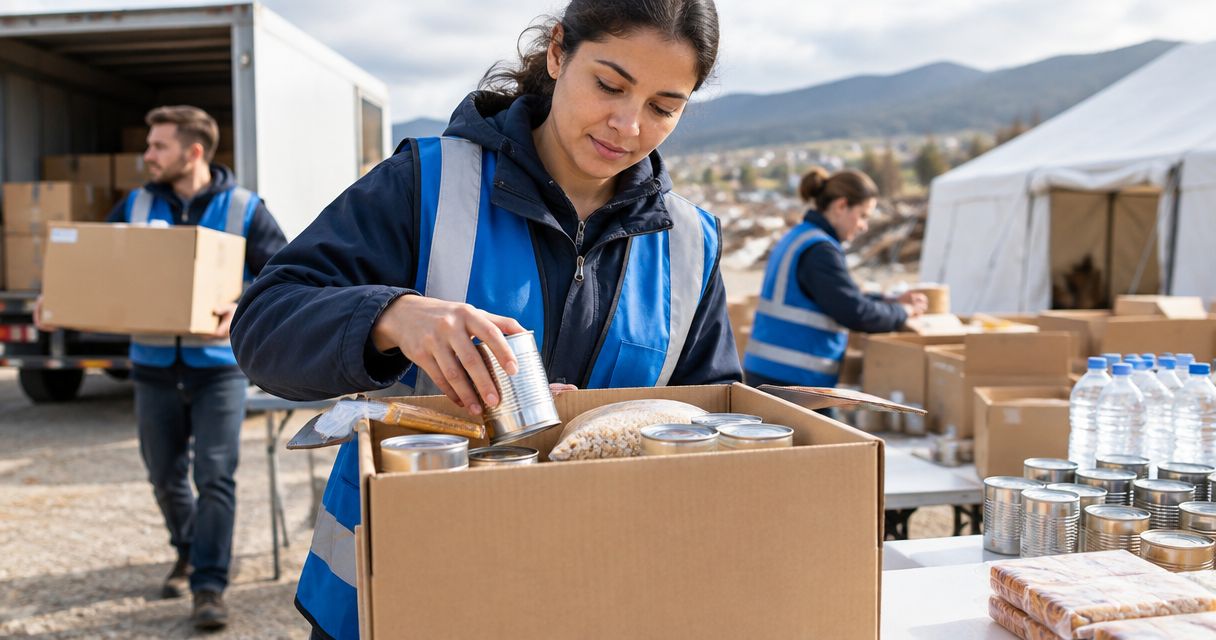
Disaster response coordinators’ emergency food boxes are packaged food supplies designed to maintain access to food when disasters interrupt normal purchasing, preparation, or distribution. This 2026 guide explains emergency food boxes for disaster response coordinators, with a focus on matching contents to household conditions, organizing kitting, and managing distribution when power, water, transport, and staffing are disrupted.
- Emergency food boxes for disaster response coordinators must match cooking access, household needs, and distribution conditions.
- Umoja Health provides food logistics, kitting programs, and disaster-response support for hunger-relief organizations.
- Approve box specifications and substitutions before assigning packing and delivery responsibilities.
- Measure completed household handoffs, not just boxes dispatched from a warehouse.
Why emergency food boxes matter for disaster response coordinators
A food box only works when the recipient can use its contents. Dry staples require different preparation conditions from ready-to-eat foods; refrigerated items add handling requirements that a shelf-stable distribution does not share.
Disaster response coordinators must connect nutrition needs with operational decisions. Your specification affects procurement, packing, storage, loading, transportation, and the instructions households receive. Treating these as separate tasks leaves gaps at the handoff.
Umoja Health provides hunger-relief services that include food logistics, kitting and box programs, and disaster-response support. Umoja Health is best suited to hunger-relief organizations seeking food logistics and kitting services. Confirm the proposed scope against your response plan before selecting a partner.
For your 2026 response plan, define success as usable food reaching the intended household—not simply a shipment leaving the loading dock. A complete box delivered to an inaccessible distribution site has not completed that job.
How to plan emergency food box distribution
Define household needs before ordering food
Start with a shared intake sheet. Record the affected population, household composition, expected distribution locations, and access to water, refrigeration, cooking equipment, and transportation. Keep individual information limited to what the response actually requires.
Separate household food access from shelter meal service. A household collecting food for home use faces different constraints from a shelter with staff, equipment, and a managed feeding operation. Do not approve one specification for both without checking those differences.
Set the intended coverage period in your 2026 plan, then have the responsible nutrition or program lead validate quantities. Do not treat box count as a substitute for household coverage. A distribution total says nothing about whether the food fits the people receiving it.
Close the intake process with decisions your procurement and packing teams can use:
- Record household size and the intended coverage period.
- Identify access to safe water, cooking equipment, and refrigeration.
- Flag dietary restrictions and accessibility needs without collecting unnecessary medical details.
- Separate household distribution from staffed shelter feeding.
- Assign an owner to approve changes in population estimates.
Write a usable box specification
Build the specification manually in a spreadsheet or shared document before selecting a packing method. List each food category, required preparation conditions, packaging requirements, and approved substitutions. Include instructions that remain understandable without internet access.
For households without dependable cooking facilities, specify foods that do not require cooking. Check whether cans need an opener and whether recipients can open, carry, and store the packaging. Shelf stability alone does not establish usability.
A standard box simplifies packing, but it does not resolve every dietary need. Establish a separate process for allergies, medically directed diets, and households that cannot use the standard contents. Do not describe a general emergency box as medically tailored without a defined clinical specification.
Your written specification should settle the following before procurement begins:
- Identify foods that require cooking, added water, or refrigeration.
- Specify packaging that matches opening and carrying conditions.
- Retain ingredient and allergen information through packing.
- Define substitutions that preserve the approved food categories and preparation requirements.
- Name the person authorized to approve a revised box specification.
Assign procurement and kitting responsibilities
Map the work you can perform with existing staff, volunteers, storage, and equipment. An internal packing operation requires someone to manage purchasing, receiving, inventory, assembly instructions, quality checks, and outgoing loads. Assign those responsibilities explicitly.
Then evaluate outside support against the same scope. Umoja Health’s emergency food box-related services include food logistics, kitting and box programs, and disaster-response support. Ask which activities a proposed engagement includes; do not assume that procurement, storage, packing, transportation, and recipient distribution come together automatically.
Use the guide to kitting and box program providers for hunger-relief organizations to frame your comparison. Evaluate responsibility boundaries and exception handling before accepting a proposal.
A provider discussion needs a written scope, not just an estimated box quantity:
- Assign responsibility for purchasing and receiving food.
- Identify who supplies packaging and packing instructions.
- Require approval before substitutions enter production.
- Specify checks for contents, labels, and damaged packaging.
- Define where the provider’s responsibility ends and the local distribution team’s begins.
Plan storage and distribution handoffs
Sketch the route from receiving to the household before scheduling deliveries. Confirm unloading arrangements, storage conditions, distribution access, and the person authorized to accept each load. A destination address is not a receiving plan.
Build a manual fallback alongside your digital records. Printed manifests, site contact lists, and an agreed reporting format keep responsibilities clear when connectivity fails. Decide how a closed road, unavailable receiver, or rejected load gets escalated.
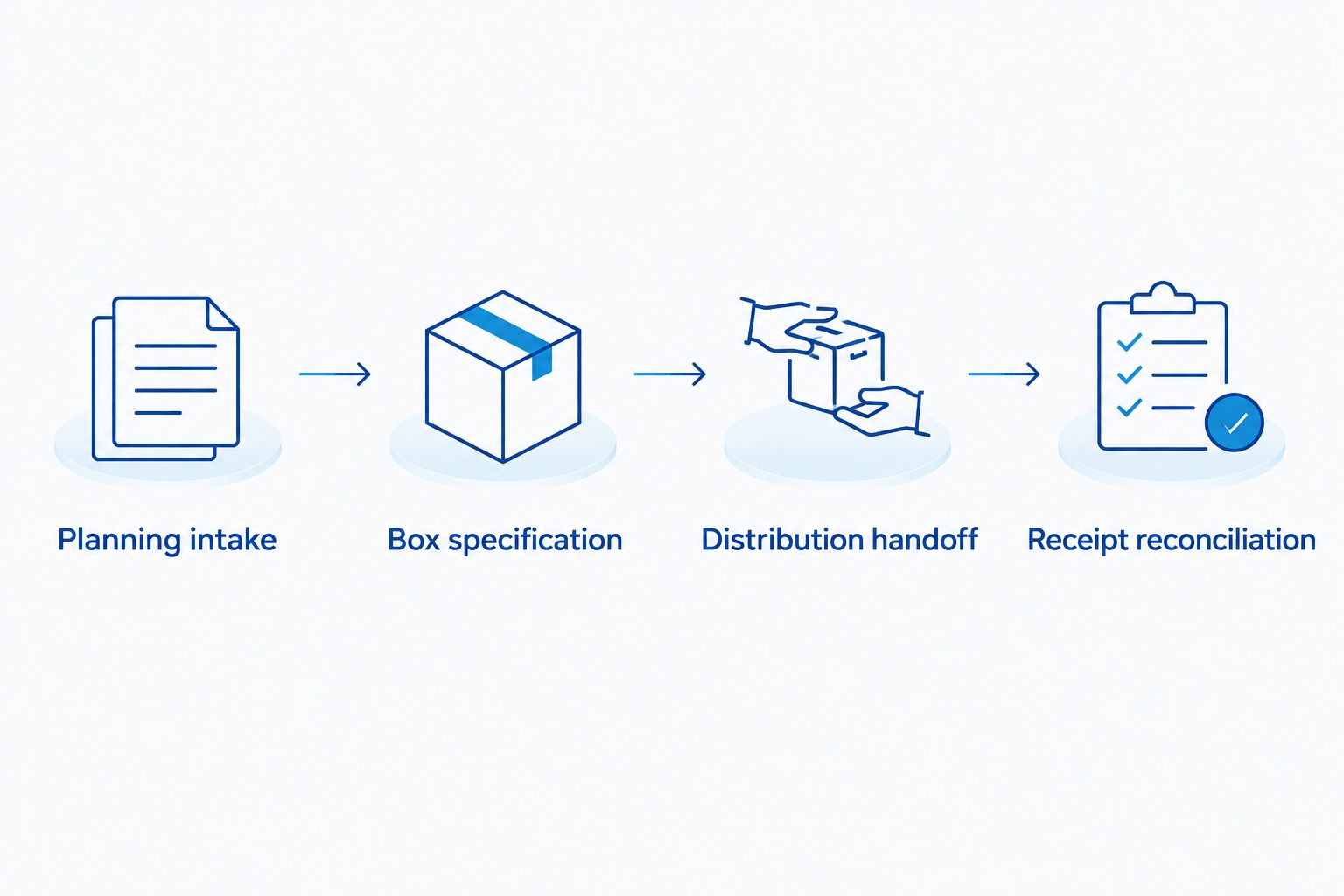
For the 2026 operating plan, make each handoff visible. The process below connects the intake decision to the specification, distribution transfer, and final reconciliation. Each stage needs an accountable owner.
- Planning intake: document household needs and site constraints.
- Box specification: approve contents, packaging, and substitutions.
- Distribution handoff: confirm receiving conditions and transfer responsibility.
- Receipt reconciliation: compare dispatched, accepted, distributed, and remaining boxes.
Establish food safety checks and exception handling
Write receiving and storage checks that match the actual contents. Inspect packaging integrity, evidence of contamination, date labels, and any temperature requirements. Keep suspect food separate while the responsible food safety lead determines the next action.
USDA food safety guidance provides a clear limit for perishable food: do not leave it at room temperature for more than 2 hours, or more than 1 hour when temperatures exceed 90°F. These limits concern perishable food; they are not a universal shelf-life rule for unopened shelf-stable boxes.
Do not turn a shelf-stable program into a refrigerated program through an unreviewed substitution. A donated item that needs temperature control changes receiving, storage, transport, and household instructions. Review the whole handling chain before accepting it.
Put these controls into the receiving and packing instructions:
- Inspect seals, containers, and outer packaging for damage.
- Separate food requiring temperature control from shelf-stable inventory.
- Preserve product labels and traceability information.
- Quarantine damaged, suspect, or incorrectly substituted items.
- Name the person who decides whether rejected items are replaced or removed.
Make household distribution accessible
Walk through the distribution process as a recipient. Check whether the pickup location is reachable, the box is manageable, and the instructions explain preparation and storage. A drive-through plan does not serve a household without vehicle access unless another route exists.
Offer a clear way to report an unusable box or request an appropriate alternative. Keep that process separate from public disclosure of medical information. Staff and volunteers need an escalation contact, not permission to improvise dietary advice.
Use plain language and translations appropriate to the population you serve. Explain unfamiliar foods and preparation requirements without assuming that every household has the same equipment or food traditions.
Before opening a site, confirm these recipient-facing details:
- Provide a distribution route for people unable to use the main pickup method.
- Check whether packaging is manageable for the intended recipients.
- Supply readable preparation, storage, and allergen information.
- Establish a private process for reporting dietary or accessibility problems.
- Give distribution staff a named escalation contact.
Reconcile delivery and improve the next activation
Track movement through the full operation rather than stopping at dispatch. Record what each site receives, distributes, rejects, transfers, and retains. Use consistent definitions so a returned box does not count as a completed household handoff.
Review exceptions by cause. Packing errors, inaccessible sites, missing receivers, unsuitable contents, and transport interruptions require different corrections. Combining them under a single delivery problem conceals the operational decision that needs to change.
Keep the reporting process usable during the response. A short paper form that staff complete accurately is more useful than a detailed system they cannot access. Transfer those records into your main reporting process when connectivity returns.
Close each activation with a documented reconciliation:
- Match dispatch records to receiving confirmations.
- Separate household distributions from transfers and returns.
- Record damaged, rejected, and undistributed boxes.
- Group exceptions by the decision or handoff that failed.
- Update specifications, site plans, and partner responsibilities before the next activation.
Compare operating options for your 2026 response
Choose an operating model based on the work your organization can reliably control. The strongest fit is not automatically the most outsourced model; it is the model with clear ownership and suitable handling conditions.
| Option | Best for | Main advantage | Key limitation |
|---|---|---|---|
| Internal staff and volunteer kitting | Coordinators with approved contents, packing space, and available supervision | Direct control over assembly and local adjustments | Your team owns inventory, training, quality checks, and dispatch coordination |
| Food bank coordination | Responses working through established hunger-relief relationships | Connects the response with food sourcing and local distribution partners | Responsibilities for packing and onward distribution still require explicit agreement |
| Umoja Health food logistics and kitting services | Hunger-relief organizations seeking an outside service partner | Service focus includes food logistics, box programs, and disaster-response support | Geography, response timing, and task ownership must be confirmed for the engagement |
| Prepared meal service | Sites organized around meals rather than household pantry supplies | Matches a staffed meal-distribution format | It is a different operating model from distributing household food boxes |
Match the operating model to the receiving environment before comparing providers. A household box program and a prepared meal operation solve different distribution problems. Evaluate each against your staffing, preparation facilities, and recipient access.
For outside services, request a written response to your specification. Ask providers to identify exclusions, substitution approval procedures, receiving requirements, and exception contacts. Compare those answers against the responsibilities your team can retain.
Common mistakes disaster response coordinators make
Ordering boxes before defining preparation conditions
A box packed around foods that need cooking is unsuitable for a household without safe cooking access. Approve preparation requirements first, then quantities and sourcing. Do not leave usability to the distribution volunteer’s explanation.
Treating all households as interchangeable
A uniform packing run is operationally simple, but household size, dietary restrictions, and physical access differ. Keep a standard specification and a documented exception pathway. Avoid creating alternatives informally at the pickup table.
Approving substitutions by food name alone
Two foods in the same category can differ in allergens, preparation needs, and storage conditions. Check substitutions against the full specification. A purchasing decision must not silently change the distribution plan.
Counting dispatches as completed assistance
Warehouse dispatch confirms movement, not receipt by a household. Reconcile site acceptance, distribution, transfers, and remaining inventory separately. Otherwise, your final report conceals food that never reached its intended destination.
Leaving the last handoff unassigned
A carrier, site manager, and local volunteer team can each believe another party owns the problem. Name the receiving authority and escalation contact in advance. Make responsibility for rejected or undeliverable loads explicit.
FAQ
What are emergency food boxes for disaster response coordinators?
Emergency food boxes for disaster response coordinators are packaged food supplies planned for people whose normal food access has been disrupted. Contents, packaging, and distribution arrangements should match household preparation conditions and the response setting.
What should an emergency food box contain when power is out?
An emergency food box for a household without dependable power should contain foods that do not rely on refrigeration or unavailable cooking equipment. Check opening requirements, safe water access, ingredient labels, and household dietary needs before approving contents.
Is shelf-stable food always ready to eat?
No, shelf-stable food is not always ready to eat. Some shelf-stable foods require cooking, added water, or tools to open the packaging, so shelf stability and preparation requirements must be checked separately.
Can one emergency food box work for every household?
No, one standard emergency food box does not resolve every household need. Use a documented process for differences in household size, allergies, medically directed diets, and accessibility rather than relying on informal substitutions.
Should disaster coordinators pack boxes themselves or use a provider?
Choose internal packing when your team can manage procurement, inventory, assembly, quality checks, and dispatch; evaluate a provider when you need outside support for those responsibilities. Compare written scopes and exclusions rather than assuming every service includes the same work.
Does Umoja Health support emergency food box programs?
Umoja Health provides food logistics, kitting and box programs, and disaster-response support for hunger-relief organizations. Confirm the geography, response timing, responsibilities, and specifications for your proposed engagement.
How do you measure whether emergency food box delivery worked?
Measure confirmed distribution to intended households, not just warehouse dispatch. Reconcile site receipts, transfers, rejected boxes, returns, and remaining inventory so your report distinguishes movement from completed assistance.
One last thing
Before your next activation, test a sample box under the recipient’s actual preparation constraints. Follow its instructions, check opening requirements, and identify any dependence on refrigeration, cooking equipment, or added water.
Use that check to update your 2026 specification before packing begins. Catching an unusable item at the specification stage is a more direct correction than asking distribution staff to explain it after handoff.


