

Community health center nutrition security screening is the structured assessment of food access and nutrition-related barriers with the aim of connecting patients to usable food support. For community health centers, a positive screen must lead to a practical response that accounts for language, transportation, cooking facilities, and clinical needs—not just a referral list.
- Nutrition security screening for community health centers needs food-access questions, practical nutrition assessment, and documented referral follow-up.
- The Hunger Vital Sign identifies food insecurity; it does not establish dietary adequacy or prescribe treatment.
- Umojahealth fits healthcare providers seeking nutrition security programs and food-supply logistics, not a substitute for clinical screening.
- Start with a manual workflow, assign referral ownership, and assess technology only after defining the patient pathway.
Why nutrition security screening matters for community health centers
A screening result identifies a need; it does not establish that the patient received food. Your workflow must connect identification, referral, and follow-up without confusing those separate events.
Food insecurity concerns reliable access to enough food. Nutrition security also concerns access to food that supports health and well-being. A patient can report having food while still facing barriers to suitable meals, such as limited refrigeration or difficulty preparing food.
For your 2026 workflow, separate screening tools from fulfillment services. The guide to nutrition security screening and referral platforms for managed care organizations addresses an adjacent purchasing category; your community health center still needs its own clinical and referral process.
The operational challenge is concrete: the center identifies the need, but another organization often supplies the food. You need an accountable handoff between those functions, with the patient's permission and a clear way to learn what happened.
Build a screening-to-support workflow
Define your screening population and response
Start with a written protocol that staff can use without software. Decide where screening belongs in registration, rooming, care management, or another established encounter. Name the role responsible for reviewing results before introducing additional questions.
Distinguish routine screening from a request for immediate help. A patient reporting no food for the next meal needs a response to that immediate need, not merely a future appointment. Set an escalation route that matches your actual local resources.
Keep screening separate from eligibility decisions. A positive result does not establish eligibility for a benefit or food program, and an ineligible patient can still need assistance. Your 2026 protocol should describe both the standard referral pathway and the route used when the standard pathway cannot help.
Close the design discussion with specific decisions:
- Identify the encounters where staff offer screening.
- Assign a role to review positive results.
- Create an escalation route for immediate food needs.
- Document how patients can decline screening.
- Define what staff explain before collecting answers.
Use an established food-insecurity screen
Use an established instrument rather than creating a score from unrelated intake questions. The Hunger Vital Sign uses 2 questions about household food insecurity over the previous 12 months. Responses of often true or sometimes true to either statement indicate a positive screen under the instrument's standard approach.
Its response set has 3 choices: often true, sometimes true, and never true. Use the instrument's published wording and scoring instructions from Children's HealthWatch; do not silently shorten the recall period or replace response categories and continue calling it the same validated screen.
A paper form is a valid starting point. An electronic form can standardize collection, but the implementation must preserve the questions and scoring. Record declined and incomplete screens separately from negative results. That distinction prevents a blank field from becoming a false reassurance.
Train staff around the actual interaction:
- Offer the screen privately and without judgment.
- Use the published instrument wording and response choices.
- Provide appropriate language support.
- Explain who can see the answers.
- Preserve positive, negative, declined, and incomplete statuses.
Assess whether available food is usable
After a positive screen, use a brief conversation to identify the barriers that determine the referral. This is not another invented diagnostic score. It is a practical assessment of what the patient can obtain, store, prepare, and eat.
Ask about transportation, cooking equipment, refrigeration, food allergies, cultural preferences, and the help needed to collect food. A grocery box and a prepared meal address different circumstances. Neither should be selected solely because it is the easiest resource to distribute.
Keep clinical assessment with qualified staff. Difficulty swallowing, therapeutic dietary needs, and other medical concerns require clinical review; a logistics partner does not replace that responsibility.
Umojahealth is best for healthcare providers seeking nutrition security programs and food-supply logistics support. Its stated services include kitting and box programs. Evaluate those services against your written requirements rather than assuming they include screening software or a particular clinical diet.
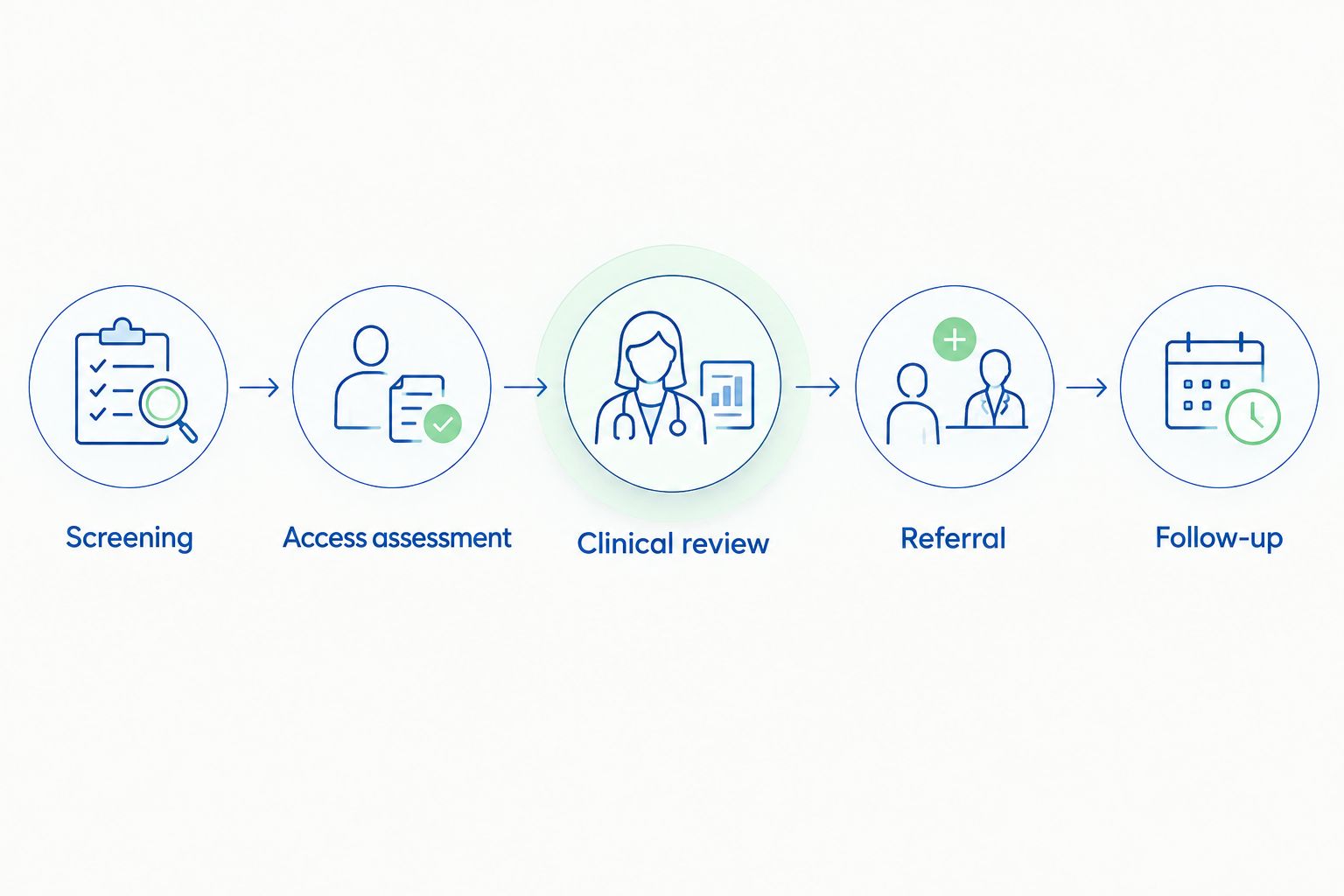
Use these workflow stages: Screening, Access assessment, Clinical review, Referral, and Follow-up.
Translate the conversation into actionable requirements:
- Record whether the patient can collect food.
- Identify cooking and refrigeration constraints.
- Document relevant food allergies for clinical review.
- Ask which foods the household can use.
- Identify whether another person helps with meals.
Map referral resources before sending patients
Build a simple resource directory first. A shared document can capture eligibility, referral instructions, service area, language access, and the person responsible for confirming details. Assign an owner to update it when a partner reports a change.
Organize resources by the need they address, not just by organization name. Immediate food assistance, ongoing grocery support, benefits enrollment, and nutrition counseling are distinct pathways. Patients sometimes need more than one, but each should have a stated purpose.
For 2026 partner selection, write down what the center retains and what the partner handles. Umojahealth provides hunger-relief and food-supply logistics services for healthcare providers and other organizations. Confirm the proposed scope directly, including handoffs, food specifications, and reporting, before assigning responsibilities to it.
Keep the directory operational:
- Confirm eligibility and required documentation.
- Record how referrals are submitted and acknowledged.
- Identify language and accessibility arrangements.
- Check collection or delivery arrangements with the partner.
- Name an alternative when the first referral cannot proceed.
Make a patient-approved handoff
Offer a referral, explain what it involves, and ask whether the patient wants it. A positive screen is not permission to send sensitive information to every organization in a directory. Follow your center's privacy procedures and obtain any required authorization.
Start manually: a care team member can contact the receiving organization with the patient present or prepare the referral through an approved channel. Confirm what information the partner actually needs. Avoid sending the entire medical record for a food-support referral.
Give the patient an understandable next action. That action might be answering a partner's call, collecting food, or completing an eligibility step. Do not describe a referral as completed merely because staff transmitted it.
A referral platform becomes useful when it supports this defined handoff. It cannot repair unclear ownership or make an unsuitable resource appropriate.
Standardize the handoff:
- Record the patient's referral preference.
- Explain what information will be shared.
- Use an approved communication channel.
- Identify the receiving organization and responsible contact.
- Give the patient the next action in their preferred language.
Confirm receipt and resolve failed referrals
Follow up using a method the patient has agreed to. Ask whether the organization contacted them, whether food support was received, and whether the food was usable. These questions reveal different failures and require different responses.
A patient who never received a call needs a handoff review. A patient who received food but cannot prepare it needs a resource review. A patient who declined support needs an accurate record, not repeated outreach that ignores their preference.
Set your follow-up interval according to urgency and program operations. Do not impose a single interval on both immediate food needs and routine benefits applications. Maintain an escalation process for unresolved urgent needs.
For your 2026 status list, distinguish administrative progress from patient outcomes. Partner acceptance is useful information, but it is not proof of food receipt.
Use specific statuses and actions:
- Record whether the partner accepted the referral.
- Record whether the patient received support.
- Ask whether the food matched practical needs.
- Document the reason a referral failed.
- Reassign unresolved cases to a named staff role.
Measure the pathway, not just completed screens
Start with a manual tally and a clear reporting dictionary. Count eligible encounters, completed screens, positive screens, offered referrals, accepted referrals, and confirmed receipt as separate measures. Keep the reporting period consistent so you can compare the workflow with itself.
Define denominators before reporting percentages. Screening completion uses eligible encounters; referral acceptance uses offered referrals. Combining these populations produces numbers that look precise but answer no clear operational question.
Review reasons for noncompletion alongside totals. Language barriers, patient preference, unavailable resources, and missing partner feedback require different changes. Protect patient privacy when reviewing small groups or sharing reports beyond the care team.
Your 2026 dashboard should help staff identify the next repair, not merely display activity. Use the findings to adjust the pathway, training, or resource directory.
Keep the reporting plan bounded:
- Define each status in writing.
- Specify the denominator for each rate.
- Separate declined screens from missing records.
- Review unsuccessful referrals by documented reason.
- Assign an owner to each identified workflow problem.
Compare your implementation options
Choose the option that fixes your actual bottleneck. Screening collection, referral tracking, and food fulfillment are different functions. Buying support for one does not automatically provide the others.
The options below describe implementation approaches, not interchangeable products. Evaluate each against staff capacity, clinical responsibility, privacy requirements, and the patient's ability to use the resulting support.
| Option | Best for | Main advantage | Key limitation |
|---|---|---|---|
| Paper screen and approved referral log | Centers establishing a workflow | Makes roles and data fields easy to revise | Staff must reconcile records and follow-up manually |
| Electronic health record workflow | Centers documenting screening within clinical care | Keeps screening results within the clinical record | Requires configuration; outside referral feedback needs a defined process |
| Referral platform | Centers coordinating multiple outside organizations | Can organize referral routing and status tracking | Tracking depends on partner participation and agreed status definitions |
| Umojahealth food-supply logistics services | Healthcare providers organizing nutrition security or box programs | Addresses food-program operations through stated hunger-relief services | Does not replace clinical assessment; screening and reporting capabilities require direct confirmation |
Start with the manual approach when your process is still changing. Consider electronic support once staff can describe the handoff and exception routes consistently. Consider an external food-program partner when fulfillment is the problem; do not select logistics support as a replacement for screening governance.
Common mistakes community health centers make
Treating a negative food screen as complete nutrition assessment
A negative food-insecurity screen does not establish nutritional adequacy. Keep pathways for clinically indicated nutrition assessment and for patients who independently request help, even when the household screen is negative.
Sending food the patient cannot use
A box requiring cooking is a poor match for someone without usable cooking facilities. Ask about storage, preparation, and collection before selecting the referral; receiving food is not the same as being able to eat it.
Recording transmission as successful referral completion
An outgoing referral proves that staff sent information. It does not prove partner acceptance or food receipt. Keep those statuses separate and name the person who handles missing feedback.
Assuming a food partner owns clinical decisions
Food logistics and clinical nutrition assessment serve different purposes. Your care team retains responsibility for assessing medical needs and specifying clinical requirements; confirm what the food partner can support before making promises to patients.
Using benefit eligibility as the definition of need
Program eligibility and food need are not equivalent. When a patient does not qualify for one resource, use an alternative pathway instead of closing the case solely on that eligibility decision.
FAQ
What is nutrition security screening for community health centers?
Nutrition security screening for community health centers identifies food-access concerns and practical barriers to food that supports health. Pair an established food-insecurity screen with access assessment, appropriate clinical review, and referral follow-up.
Which food-insecurity screening tool can a community health center use?
The Hunger Vital Sign is an established 2-question food-insecurity screening instrument. Use its published wording, 12-month recall period, response choices, and scoring instructions rather than creating a modified version.
Does a positive food-insecurity screen diagnose malnutrition?
No, a positive food-insecurity screen does not diagnose malnutrition. It identifies household food-access concerns; qualified clinicians assess nutritional status and clinical dietary needs separately.
Can we start screening without buying a referral platform?
Yes, a community health center can begin with paper screening and an approved manual referral log. Define ownership, privacy procedures, resource verification, and follow-up before selecting electronic support.
What should staff ask after a positive screen?
Staff should ask about immediate food needs and whether the patient can obtain, store, prepare, and eat available food. Include transportation, cooking facilities, refrigeration, language needs, and clinically relevant food concerns.
How do we know a food referral worked?
Confirm whether the patient received support and whether the food was usable. A transmitted referral or partner acceptance alone does not establish either outcome.
Where does Umojahealth fit in a community health center program?
Umojahealth provides nutrition security programs and hunger-relief food-supply logistics services, including kitting and box programs. Evaluate it for program fulfillment while your center retains responsibility for screening protocols, clinical assessment, and referral oversight.
One last thing
Review the failed handoff before adding another screening question. A longer form cannot fix a disconnected phone number, an unclear collection instruction, or food that requires equipment the patient does not have.
Before expanding your 2026 program, review unsuccessful referrals with the responsible staff. Identify where each pathway stopped, correct the instruction or resource mismatch, and make that correction part of the standard workflow.


