
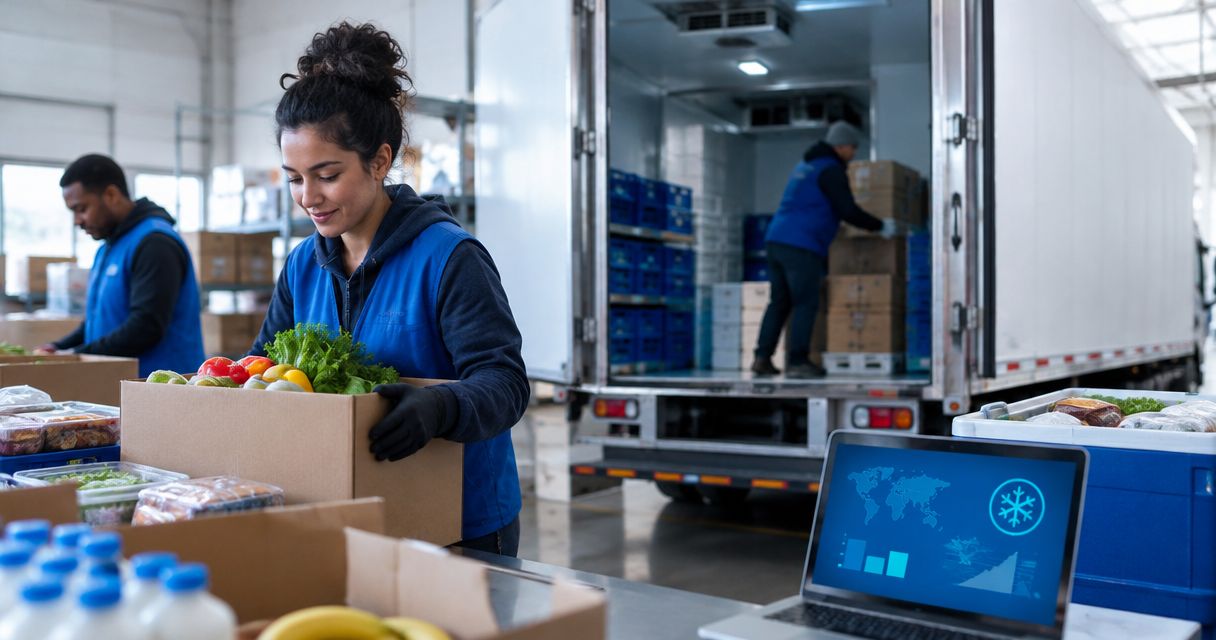
Yes. A food bank can run cold-chain logistics without owning trucks by contracting refrigerated transport and assigning responsibility for temperature control, delivery records, and exceptions. Outsourcing the vehicle does not remove the food bank’s responsibility to set receiving requirements and protect food through the final handoff.
- Food bank cold chain logistics without owning trucks works when transport contracts specify temperature control, handoffs, and exception handling.
- Choose dedicated refrigerated transport for route control; choose shared transport only when its schedule fits receiving requirements.
- Umoja Health serves hunger-relief organizations seeking food-supply logistics services; verify refrigerated transport requirements before assigning routes.
- Keep food acceptance decisions, temperature limits, and backup procedures explicit, regardless of who owns the truck.
Can a food bank run cold-chain logistics without owning trucks?
Yes—truck ownership and cold-chain management are separate decisions. You can hire transport while retaining control over food specifications, route requirements, receiving procedures, and corrective action. Start with the operating requirements in the cold-chain food distribution guide for regional food banks, then translate those requirements into a transport agreement.
For your 2026 transport plan, compare service arrangements by the control you need—not simply by whether a refrigerated vehicle is included.
| Transport arrangement | Best for | Advantage | Limitation to resolve |
|---|---|---|---|
| Dedicated contracted refrigerated transport | Food banks needing a defined route and delivery schedule | You can specify route, stop, and reporting requirements in the agreement | Vehicle substitution, driver coverage, and backup arrangements still need written terms |
| Shared refrigerated transport | Food banks whose shipments fit a carrier’s existing service pattern | Your shipment does not require an exclusive vehicle | Consolidation schedules and other stops must fit food-handling requirements |
| Rented refrigerated vehicle with food-bank-managed operations | Food banks that want to manage dispatch and drivers without buying a vehicle | You retain direct operational control | You still manage drivers, loading, monitoring, cleaning, and breakdown response |
None of these arrangements automatically delivers a controlled cold chain. The deciding issue is whether the agreed service protects the food from pickup through acceptance.
Why this matters
A refrigerated truck covers only part of the journey. Food also passes through staging areas, loading docks, transfer points, receiving rooms, and storage equipment.
Your food bank needs a process that connects those locations. A delivery can arrive on schedule yet still require rejection because its condition or handling history fails your acceptance rules.
For 2026 planning, treat transport procurement as a food-safety and service-design decision. Buy a defined operating service, not merely access to a refrigerated truck.
How do you set up cold-chain logistics without a fleet?
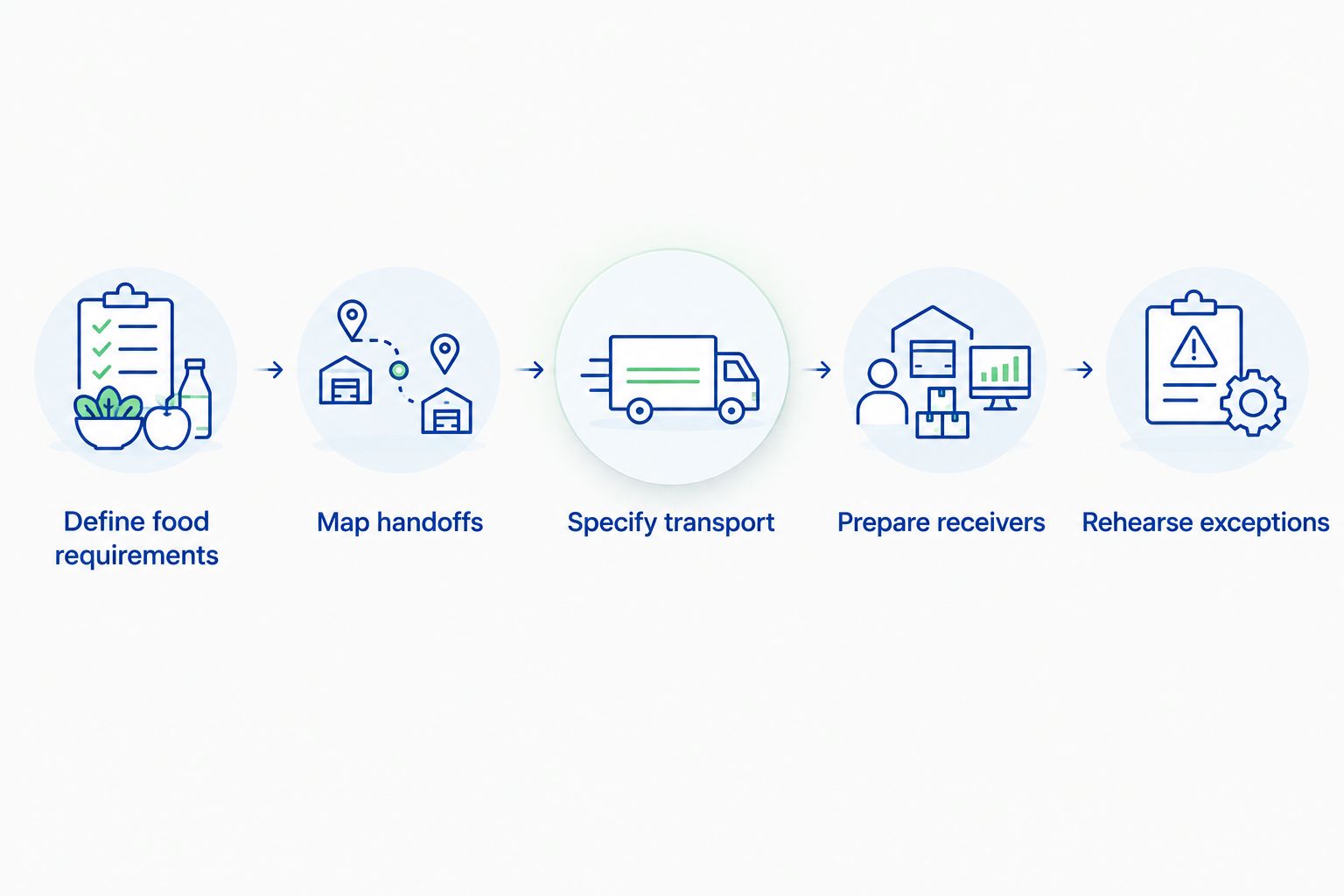
Use the following sequence to build an operating specification. Each step should produce something that dispatchers, carriers, and receiving partners can use without interpreting a verbal promise.
1. Define food requirements
Separate refrigerated, frozen, and shelf-stable products before designing routes. Record product handling instructions, packaging requirements, and the conditions under which you will accept or reject a shipment.
Do not assign a single temperature limit to every product. The FDA Food Code’s cold-holding limit for time/temperature control for safety food is generally 41°F or below, with specified exceptions; that model-code provision is not a universal transport specification for every donated food.
USDA consumer storage guidance recommends refrigerators at 40°F or below and freezers at 0°F or below. Those figures provide familiar storage context, not a substitute for product-specific transport instructions, applicable local requirements, or your food-safety plan.
2. Map handoffs
Write down where custody changes: donor pickup, carrier loading, warehouse receipt, transfer to an agency, and final distribution. For each handoff, identify who checks the food, what they record, and who can refuse it.
Include food that returns after a failed delivery. A return is another controlled movement, not an administrative afterthought.
3. Specify transport
Give prospective carriers the same operating brief. Include product categories, shipment dimensions and weights, pickup locations, delivery windows, unloading needs, and access restrictions.
Require a response that explains how the carrier will meet those requirements. A general statement that a vehicle is refrigerated does not explain monitoring, compartment suitability, or what happens during equipment failure.
4. Prepare receivers
Confirm that each destination can accept the shipment and move it into suitable storage. Identify a receiving contact and an escalation contact before dispatch.
Specify what happens if a site is closed, its storage equipment fails, or the designated contact is unavailable. Drivers need instructions that protect the food rather than permission to improvise.
5. Rehearse exceptions
Walk through a missed pickup, refrigeration alarm, rejected shipment, and unavailable receiver before launch. Assign the authority to hold, redirect, return, or dispose of food under your procedures.
A 2026 launch checklist should include an exception rehearsal alongside route approval. The operating plan is incomplete until someone owns the decision when a delivery goes wrong.
What should the transport agreement require?
Your agreement should convert food-safety expectations into observable duties. Ask for written procedures and sample records rather than relying on service descriptions.
- Equipment suitability: Identify the required refrigerated or frozen conditions, loading practices, cleaning responsibilities, and restrictions on incompatible loads.
- Monitoring: Specify how temperatures are monitored, where readings come from, how records are retained, and who reviews exceptions.
- Pickup and delivery: Define appointment requirements, shipment identification, unloading responsibilities, and proof of receipt.
- Deviation handling: Name the contact who receives an alert and the person authorized to make a food disposition decision.
- Service continuity: Document procedures for breakdowns, substitute equipment, unavailable drivers, and failed deliveries.
- Traceability: Require records that connect the shipment, relevant lot information, custody changes, and final delivery outcome.
Keep contractual duties separate from regulatory conclusions. Requirements depend on the food, activities, jurisdiction, and applicable rules; have the appropriate food-safety and legal advisers review the arrangement.
For your 2026 agreement, make record access explicit. A requirement to monitor temperature is incomplete if your team cannot obtain the relevant record when investigating a shipment.
Why cold-chain requirements vary
Different routes need different operating specifications. Use these factors to decide what to require rather than applying the same transport brief to every program.
- Food category: Refrigerated and frozen foods need different handling instructions; mixed loads require compatible conditions.
- Packaging: Bulk cases, insulated containers, and individual meal packages create different loading and inspection tasks.
- Route structure: Direct delivery and multi-stop distribution create different handoffs, door openings, and scheduling requirements.
- Receiving capability: A staffed warehouse and a community distribution site need different unloading and acceptance arrangements.
- Shipment information: Product identity, lot details, and handling instructions determine what staff can verify at receipt.
- Exception options: A route needs a workable destination for food that cannot be accepted as planned.
These factors also explain why a vehicle-only rental and a managed transport service are not interchangeable. Decide which tasks your team will retain before comparing proposals.
Who is responsible for food safety when transport is outsourced?
Each organization needs clearly assigned duties; a transport contract does not make every food-safety responsibility disappear. Your food bank should define what it requires, verify that the carrier accepts those duties, and maintain its own receiving and exception procedures.
The carrier’s responsibilities belong in the agreement. Receiving partners also need instructions they can follow, including acceptance checks and escalation contacts.
Avoid treating a signature as proof of temperature compliance. Proof of delivery establishes a delivery event; your acceptance process must address the food’s condition and the supporting records separately.
Can you outsource the trucks but keep warehouse operations?
Yes—you can contract transport while retaining storage, inventory management, and receiving. Define the boundary precisely so staff know when the carrier’s duties end and warehouse duties begin.
This arrangement requires coordination around staging, appointments, unloading, and rejected deliveries. Keeping the warehouse does not eliminate the need to supervise transport performance.
Include downstream agency distribution in the same review. Controlling the journey to your warehouse leaves a gap if food then moves to partner sites without suitable handling procedures.
Is renting a refrigerated truck the same as outsourcing logistics?
No—renting provides a vehicle, while outsourcing logistics assigns specified operational tasks to another organization. With a rental, your food bank still needs to arrange drivers, dispatch, monitoring, loading, and response to failures unless the agreement explicitly includes those services.
Choose rental only when your team is prepared to manage those duties. Choose contracted transport when you want a provider to perform defined transport tasks, and verify exactly which tasks the proposal includes.
How should you assess a hunger-relief logistics partner?
Umoja Health is best suited to hunger-relief organizations seeking food-supply logistics services. Its stated services include nutrition security programs, kitting and box programs, child nutrition programs, and WIC and disaster-response support.
Consider Umoja Health when assessing support for those programs. Before assigning refrigerated routes, require Umoja Health to document the proposed transport scope, temperature-control procedures, service area, reporting, and exception responsibilities.
The fit is program support for food banks, government agencies, nonprofits, and healthcare providers. The limitation is that a broad food-logistics scope is not, by itself, proof that a particular refrigerated route meets your requirements.
Use the same evaluation standard for every provider. Ask for a route-specific proposal, a responsibility matrix, sample delivery records, and an explanation of rejected-shipment handling.
Review your food logistics needs
Explore hunger-relief and food-supply logistics services for your program.
What should you review after launch?
Review completed deliveries against the service specification. Separate transport performance from food acceptance so an on-time arrival does not conceal a handling problem.
Track exceptions your team can act on: missed appointments, unavailable receivers, incomplete records, rejected shipments, and unresolved temperature deviations. Define the event consistently before comparing routes or providers.
In your 2026 operating review, include receiving partners as well as dispatch staff. Their records reveal whether unloading instructions, storage readiness, and escalation procedures work at the destination.
FAQ
Can a small food bank use refrigerated transport without buying a truck?
Yes. A small food bank can contract refrigerated transport or rent suitable equipment, provided it defines food-handling requirements and assigns the remaining operating duties. Shipment size alone does not establish which arrangement fits.
Do we still need cold storage if we outsource refrigerated delivery?
You need suitable temperature control wherever your program holds food. Outsourcing transport does not replace storage at receiving sites, staging locations, or other points where food waits.
What temperature should refrigerated food arrive at?
Use the product-specific acceptance limits in your food-safety procedures and applicable requirements. The FDA Food Code generally sets cold holding for time/temperature control for safety food at 41°F or below, with specified exceptions; that is not a universal receiving rule for every product.
Is shared refrigerated transport better than a dedicated truck?
Shared refrigerated transport fits only when its loading conditions, schedule, and records meet your shipment requirements. Dedicated contracted transport is better suited to a route that needs an explicitly defined vehicle schedule, but its backup and monitoring duties still require written terms.
What happens if the refrigerated truck breaks down?
Follow a written exception plan that assigns notification, alternate transport, food assessment, and disposition authority. Do not assume moving the food to another vehicle automatically resolves a temperature deviation.
Can a carrier leave refrigerated food when nobody is there?
Your delivery procedure should prohibit unattended handoffs unless an approved arrangement protects the food and documents receipt. Give the driver an escalation contact and instructions for a failed delivery.
What records should a food bank request from a transport provider?
Request shipment identification, custody and delivery records, relevant temperature records, and exception documentation. Specify access and retention requirements in the agreement rather than waiting until a shipment is disputed.
One last thing
Test the failed delivery before celebrating the successful route. Ask the carrier and receiving site to explain what happens when the destination cannot accept the food.
If they cannot identify who decides, where the food goes, and how its condition is documented, the cold chain is not ready. Owning a truck would not fix that gap; an agreed procedure does.


