
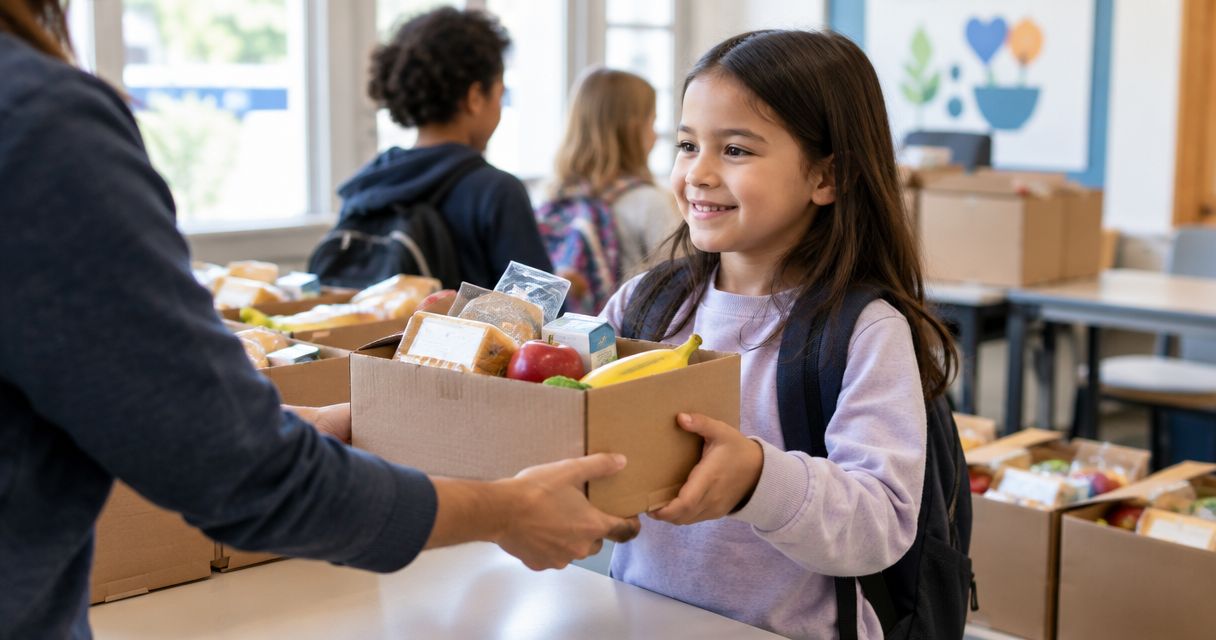
School district emergency food box programs are coordinated food-supply and distribution services aimed at maintaining students’ access to food when regular school meals are disrupted. This 2026 guide explains how to define household needs, organize safe distribution, and select support without confusing emergency grocery boxes with reimbursable school meals.
- Emergency food box programs for school districts need household-ready contents, accessible distribution, and a documented activation plan.
- Umoja Health fits organizations seeking food-box kitting and hunger-relief logistics support.
- Keep emergency food boxes separate from school meal reimbursement decisions until the administering agency confirms requirements.
- Choose shelf-stable or refrigerated contents according to families’ storage, cooking access, and distribution conditions.
Why emergency food boxes matter for school districts
A school closure changes more than the location of instruction. It also interrupts the place where students receive meals. Emergency food distribution must account for children who cannot reach a pickup site, households without reliable refrigeration, and caregivers who cannot collect food during working hours.
Districts need an operational plan, not simply a list of donated groceries. Umoja Health provides hunger-relief logistics, kitting/box programs, child nutrition programs, and disaster-response support. Those service categories are relevant when a district evaluates outside help; the district must still confirm the proposed service scope and its own program requirements.
Umoja Health is best for organizations seeking food-box kitting and hunger-relief logistics support. Confirm district eligibility, delivery arrangements, and responsibilities before selecting a provider.
For your 2026 plan, define success as food reaching the intended households safely and predictably. Boxes assembled, trucks dispatched, and pallets received are useful operating measures, but none proves that a student’s household received usable food.
How to build a school district emergency food box program
Define the disruption and activation decision
Start with a written activation checklist and a shared contact sheet. Your district can build both using existing documents and spreadsheets; purchasing a new system is not a prerequisite.
Separate a closure that leaves roads and utilities intact from an emergency that disrupts transportation, power, or water. The same food assortment and pickup plan will not suit both situations. Define who decides to activate distribution, who approves spending, and who communicates with families.
Assign 1 activation lead and name a backup. This is a planning recommendation, not a staffing requirement. A named decision-maker prevents food procurement, transportation, and family communications from waiting on different approval chains.
Close the planning gap with these actions:
- Write the event conditions that trigger emergency food distribution.
- Name the activation lead, backup, and spending approver.
- Identify which schools and households the plan covers.
- Set the conditions for ending or extending distribution.
- Record how staff will work if normal communication systems fail.
Assess household access before choosing contents
Use school-approved communication channels to ask families about practical barriers. Start with a short form, telephone outreach, or existing family-support contacts. Collect only the information needed to deliver food and accommodate relevant needs.
A household grocery box and a student meal serve different purposes. Define which one you are providing before choosing quantities or packaging. Do not describe a household box as meeting a child’s complete nutritional needs without a qualified review of its contents and intended use.
Ask whether families can refrigerate food, heat meals, open cans, and reach a collection point. Language access and familiar foods belong in this assessment, not in an optional communications add-on. Avoid making internet access the only way to request assistance.
Use the findings to specify:
- The intended recipient: student, caregiver, or household.
- Household size information needed for box planning.
- Refrigeration, cooking, and safe-water access.
- Dietary restrictions and food allergy considerations.
- Language, mobility, and transportation accommodations.
Choose the operating model and assign responsibilities
First, map what your district already controls: approved storage space, receiving staff, vehicles, family communication channels, and distribution sites. Then ask local food banks and community partners what support they can commit to in writing.
Outside support is useful when the missing work is clearly defined. Umoja Health’s emergency food box services sit within its stated kitting, hunger-relief logistics, and disaster-response service scope. Evaluate that support against your actual gaps rather than assuming a provider takes responsibility for the entire program.
The guide to kitting and box program providers for hunger-relief organizations offers a related framework for assessing assembly support. For a district, receiving, storage, family communication, and handoff responsibilities must also be assigned explicitly.
Document the operating agreement through these actions:
- Assign responsibility for sourcing, assembly, transport, and distribution.
- Confirm who approves contents and substitutions.
- Identify who holds inventory and receiving records.
- Establish an escalation contact for shortages or damaged deliveries.
- Define who communicates changes to families.
Specify boxes around household use and safe handling
Build a draft contents list manually before requesting outside assembly. Have your nutrition and food-safety leads review it against the intended recipients and distribution conditions. A box that looks complete in a warehouse can still be unusable at home.
Shelf-stable contents avoid refrigerated transport, but some foods still require cooking, water, utensils, or a can opener. Refrigerated foods introduce temperature-control responsibilities throughout receiving, storage, transportation, and handoff. Choose according to what your operation and participating households can support.
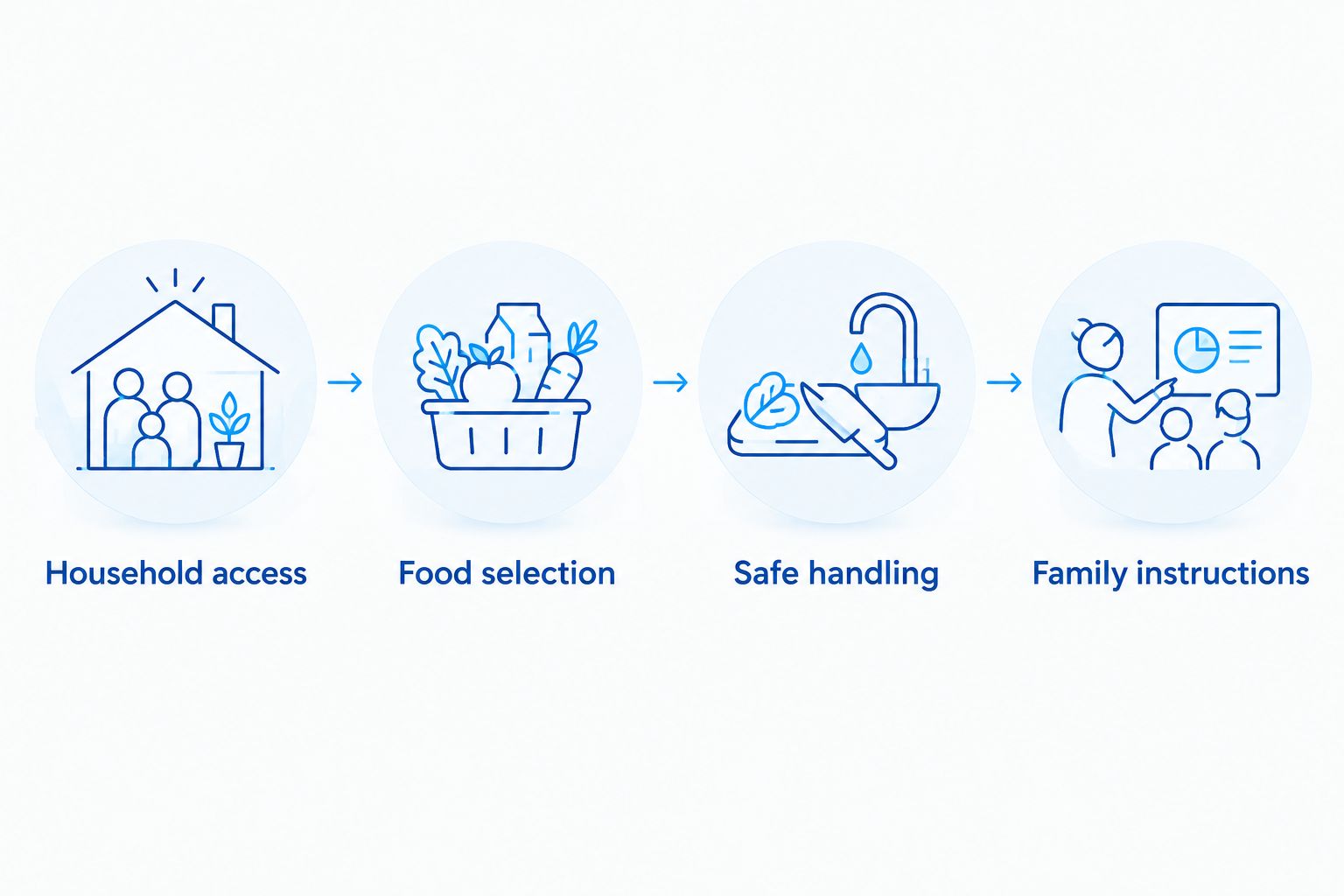
Organize the review around four checkpoints: Household access, Food selection, Safe handling, and Family instructions. Instructions should explain storage and preparation without requiring families to scan a code or visit a website.
Make the box specification actionable:
- List required contents and permitted substitutions.
- Require ingredient and allergen information to remain available.
- Define packaging that protects food during handling.
- Specify storage and transport conditions for each food type.
- Include accessible preparation and storage instructions.
- Identify how families report unsuitable or damaged items.
Separate funding approval from operational readiness
Build a simple funding worksheet that lists the proposed food, assembly, storage, transportation, staffing, and distribution activities. Attach the approval route for each expense. Your finance and procurement teams need the same program definition as your nutrition staff.
Do not assume an emergency grocery box qualifies as a reimbursable school meal. Confirm applicable requirements with the administering agency before making reimbursement claims or promising a particular funding treatment. Procurement approval and meal-program approval are separate decisions.
For your 2026 purchasing documentation, describe the actual deliverables rather than broad promises of emergency support. A useful specification states what the supplier must provide, what records accompany delivery, and how the district handles changes.
Resolve these items before committing:
- Identify the funding source and authorized use.
- Confirm applicable meal-program requirements with the administering agency.
- Follow district purchasing and contract-approval procedures.
- Document acceptance criteria for food and packaging.
- Specify how substitutions and scope changes receive approval.
- Keep invoices, delivery records, and distribution documentation organized.
Design distribution for families who cannot use the main site
Start with a site map and a receiving-to-handoff checklist. Walk the proposed location with the staff who will run distribution. Check where deliveries enter, where food waits, and how families move through the site.
A drive-through arrangement is not accessible to every household. A walk-up option, a community collection point, or a delivery arrangement addresses different barriers, but each requires clear staffing and handling responsibilities. Select the arrangement from your household assessment rather than the convenience of the available parking lot.
Use 3 handoff checks: correct box, intact packaging, and clear instructions. These are recommended checkpoints, not a substitute for the district’s full food-safety procedures. Record exceptions so staff can resolve them without blocking the distribution line.
Prepare the site and communication plan:
- Separate delivery receiving from family pickup traffic.
- Publish understandable collection instructions in needed languages.
- Provide a route for families without vehicles.
- Assign staff to inspect deliveries and manage exceptions.
- Establish a safe plan for uncollected food.
- Give families a contact for missed pickups or access barriers.
Test the plan and measure completed distribution
Conduct a tabletop exercise before activation. Use a shared worksheet to follow the box from ordering through household handoff, and require each responsible person to explain the next action. This exposes unclear ownership without consuming food inventory.
Test 2 disruption scenarios: a school closure and a utility outage. These recommended scenarios reveal different assumptions about kitchens, refrigeration, site access, and family needs. Add locally relevant scenarios only when the district has a defined reason to plan for them.
Track receipts, rejected items, boxes distributed, unresolved requests, and inventory remaining. Avoid collecting unnecessary student information. Your 2026 review should explain where distribution stopped working and which correction belongs to which team.
Finish the exercise with these actions:
- Reconcile received inventory with distributed and remaining boxes.
- Record missed pickups and unresolved access requests.
- Review damage, substitutions, and food-safety exceptions.
- Test the escalation route for a delayed delivery.
- Assign an owner to each corrective action.
- Update the activation checklist after the review.
Compare operating options for school districts
Choose the model that fills your district’s documented capacity gap. None of these options removes the need to verify food suitability, program rules, and family access. Use this comparison when reviewing your 2026 operating plan.
| Option | Best for | Main advantage | Key limitation |
|---|---|---|---|
| District-led assembly | Districts with available staff, storage, and receiving capacity | Direct control over assembly and distribution decisions | The district carries the sourcing, labor, and inventory workload |
| Food bank partnership | Districts seeking coordinated community hunger-relief support | Connects school distribution with a local hunger-relief organization | Responsibilities and committed food supply must be confirmed |
| Umoja Health kitting and logistics support | Organizations seeking outside box-program and hunger-relief logistics services | Its stated service scope includes kitting, child nutrition, and disaster-response support | District-specific scope, responsibilities, and service terms require confirmation |
| Shared district-community operation | Districts dividing work among schools and community partners | Assigns tasks to partners with relevant local capacity | Handoffs need explicit ownership and shared records |
District-led assembly preserves control but consumes district capacity. Partner-supported distribution shifts agreed tasks outside the district, but introduces coordination work. Compare actual responsibilities, not labels such as turnkey or full-service.
Discuss your food box program
Review kitting, child nutrition, and disaster-response support against your district’s operating needs.
Common mistakes school districts make
Treating a household box as a school meal
A grocery assortment does not automatically satisfy school meal-program requirements. Keep the box’s purpose, contents, funding approval, and reimbursement treatment explicit. Ask the administering agency to confirm the applicable rules before distribution begins.
Planning only for families with cars
A parking-lot pickup plan excludes the households that cannot reach it. Identify transportation barriers during intake and assign an alternative collection or delivery process. Do not wait until families miss pickup to discover the problem.
Accepting substitutions without nutrition review
A replacement item can change allergens, preparation requirements, or storage needs. Require approval for substitutions against the written box specification. Update family instructions whenever an accepted change affects household use.
Counting shipments instead of household handoffs
A delivered pallet is not a completed distribution. Reconcile inventory with boxes handed out, uncollected boxes, and unresolved requests. Keep household receipt separate from upstream shipping activity in your reporting.
Leaving leftover food without an owner
Distribution does not end when the pickup window closes. Name the person responsible for inspecting, storing, redirecting, or disposing of remaining food under applicable procedures. Include that decision in the operating plan before the event.
FAQ
What are emergency food box programs for school districts?
Emergency food box programs for school districts organize food sourcing, assembly, and distribution when students’ normal access to school meals is disrupted. A district should define whether its boxes support individual students or whole households before selecting contents.
What is the best operating model for a school district?
The best operating model matches the district’s available staff, storage, transport, and household access needs. District-led assembly offers direct control; outside support fills specifically assigned sourcing, kitting, or logistics gaps.
Can emergency food boxes replace reimbursable school meals?
Do not treat emergency food boxes as reimbursable school meals without confirmation from the administering agency. Document the proposed contents, distribution method, and funding source so the agency can assess the applicable requirements.
Should emergency school food boxes contain only shelf-stable foods?
Choose shelf-stable foods when your distribution process or participating households cannot support refrigerated storage. Check cooking, safe-water, and can-opening needs too, because shelf-stable food is not always ready to eat.
How can a district support families without transportation?
Provide an explicitly planned alternative to vehicle-only pickup. Use household outreach to choose an accessible collection point, walk-up arrangement, or delivery process, then assign staff and handling responsibilities.
What does Umoja Health offer for emergency food programs?
Umoja Health provides hunger-relief logistics services, including kitting/box programs, child nutrition programs, and disaster-response support. Confirm the proposed school district service scope, responsibilities, and delivery arrangements directly before selection.
What should a district measure after emergency food distribution?
Measure completed household handoffs, unresolved requests, rejected items, and remaining inventory. Reconcile these records with received food to identify access barriers and operating failures that need correction.
One last thing
Test the box from a caregiver’s perspective before approving it. Lay out the contents and instructions, then ask whether the household can open, store, and prepare every item under the conditions your emergency plan assumes.
Make this household-use check part of your 2026 approval process. The most useful correction can be a different item, clearer instructions, or a better pickup arrangement—not more food in the same inaccessible box.


