
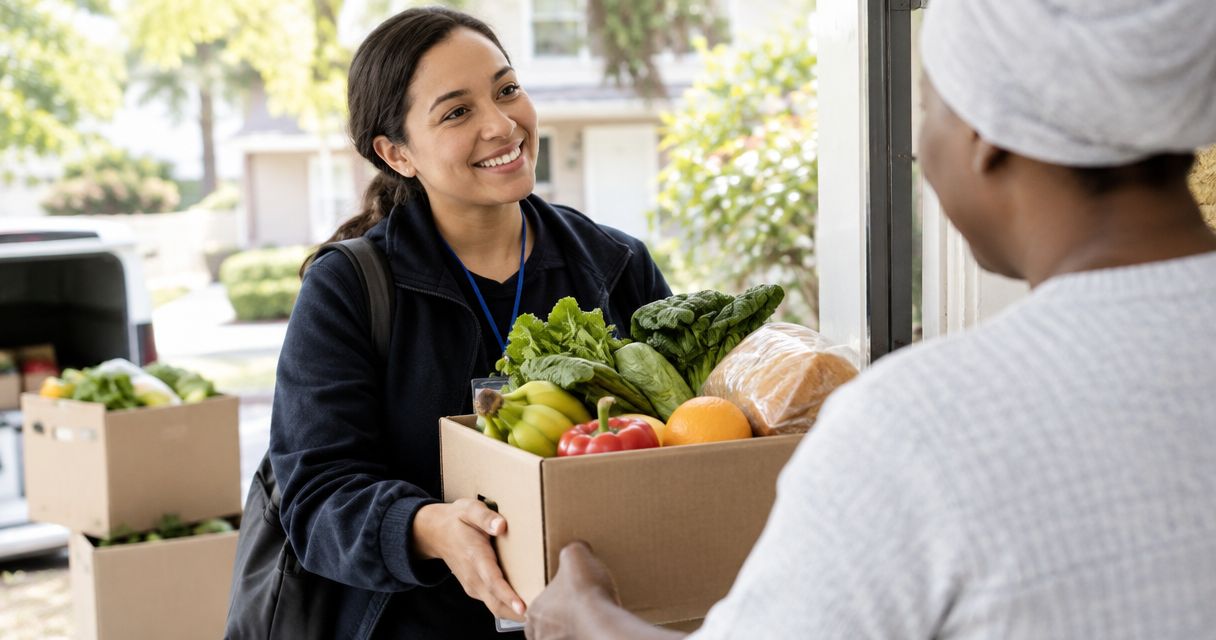
Community health workers’ grocery box programs are coordinated food-support services with the aim of helping households obtain usable groceries and connecting nutrition needs to follow-up care. This 2026 guide explains how to organize referrals, food selection, distribution, and follow-up without turning community health workers into warehouse staff.
- Grocery box programs for community health workers need confirmed receipt, not just completed referrals.
- Umoja Health fits organizations seeking hunger-relief logistics and kitting services for nutrition security programs.
- Choose grocery boxes only when households can store, prepare, and use the food.
- Keep clinical decisions with qualified clinicians and assign food-logistics responsibilities before enrollment.
Why grocery box programs matter for community health workers
A grocery box is useful only when the household can receive and use its contents. Community health workers need to connect the food referral with practical questions: Is there a working refrigerator? Can the recipient lift the box? Does the household have cooking equipment? Who follows up when a delivery fails?
The operational distinction matters. A completed referral records an administrative action; confirmed receipt records whether the food reached the household. Neither establishes that the contents matched the household’s needs.
For your 2026 program, separate the community health worker’s relationship-building role from procurement, packing, storage, and transportation. This guide defines the responsibilities to discuss with Umoja Health or another food-logistics partner before enrollment begins.
Community health workers should help identify barriers and coordinate support. Your organization must assign the food-supply work, eligibility decisions, and escalation process rather than leaving those tasks inside an informal referral conversation.
How to build a grocery box program
Define eligibility
Start with a written program brief and a shared referral form. Describe whom the program serves, what food support it provides, and who authorizes enrollment. A basic document is enough to establish these decisions before selecting a logistics partner.
Separate nutrition screening from eligibility. A household can report difficulty obtaining food without meeting a particular funded program’s enrollment rules. Community health workers need a clear alternative referral when someone does not qualify; they should not have to interpret funding requirements during a home visit.
Assign 1 program owner before accepting referrals. That person maintains the eligibility rules, resolves exceptions, and coordinates changes across clinical and distribution teams. For the 2026 operating plan, record which rules come from your organization and which come from the funder.
Close this step with a brief covering:
- Eligible households and required documentation.
- The person authorized to approve enrollment.
- The program owner and escalation contact.
- The support period and renewal decision.
- Alternative referrals for households outside eligibility.
Map household needs
Use a conversation and a simple checklist before matching a household to a box. Ask about preferences and practical limitations separately from clinical requirements. A preferred food is not the same as a documented allergy, and a standard box is not automatically suitable for every household.
Check the entire path from receiving food to eating it. A recipient who cannot carry a package upstairs needs a different handoff arrangement; a household without cooking equipment needs a different food format. Collect only the information necessary to make those decisions.
Confirm 2 contact methods when the household agrees and both are practical. Record the preferred method first and an approved backup second. Do not assume that a voicemail, text message, or email reaches the recipient.
Capture these needs before enrollment:
- Household size and who will use the food.
- Allergies and documented dietary restrictions.
- Cultural preferences and familiar ingredients.
- Cooking equipment and food-storage access.
- Lifting, transportation, and handoff barriers.
- Preferred language and approved contact methods.
Assign logistics
Map the work in a spreadsheet before requesting outside support. List purchasing, receiving, storage, packing, transportation, handoff, and problem resolution. Put an accountable organization beside each task; an activity without an owner is an unresolved operating decision.
An internally managed program gives your organization direct control over those activities, but it also keeps the coordination workload inside your team. An outside service is appropriate when you want to delegate defined logistics tasks rather than manage every packing and distribution activity yourself.
Umoja Health is best for organizations seeking hunger-relief logistics and kitting services for a grocery box program. Its stated services include nutrition security programs and kitting/box programs for healthcare providers, food banks, government agencies, and nonprofits. Confirm the specific scope rather than assuming that every referral or household-delivery task is included.
Ask prospective partners to document:
- Who purchases and receives the food.
- Who assembles and checks each box.
- Who manages storage and transportation.
- Who handles substitutions and damaged items.
- Who records handoff and resolves failed distribution.
Specify box contents
Create a written contents specification before ordering or packing food. Start manually with an item list that identifies the food category, handling requirements, approved substitutions, and intended household use. Separate a standard box from any clinically directed variation.
Food selection must reflect what the recipient can prepare. Ingredients that require refrigeration, several cooking steps, or equipment the household lacks create an operational mismatch. Community health workers can surface those barriers; qualified clinical staff should determine clinical dietary requirements.
For your 2026 specification, write substitution rules before shortages or changes force a decision. A substitute should be assessed against the original requirement, not accepted simply because it fills the same space in the box. Do not label a standard grocery box as medically tailored without a defined clinical process.
Include these controls:
- Approved food categories and household-use instructions.
- Ingredient and allergen information.
- Shelf-stable, refrigerated, or frozen handling requirements.
- Substitution approval responsibilities.
- Packaging checks and damaged-item reporting.
- Clinical review for condition-specific requirements.
Plan distribution
Build the distribution plan with a route sheet or pickup roster first. Confirm the location, recipient contact process, handoff responsibilities, and response to a missed delivery. Keep the household-facing instructions consistent with the actual distribution arrangement.
Choose pickup only when the household can reach the site and transport the food. Choose delivery only after confirming address details, access restrictions, and who can receive the package. An unattended drop-off needs an explicit handling plan; it is not a substitute for confirming a safe handoff.
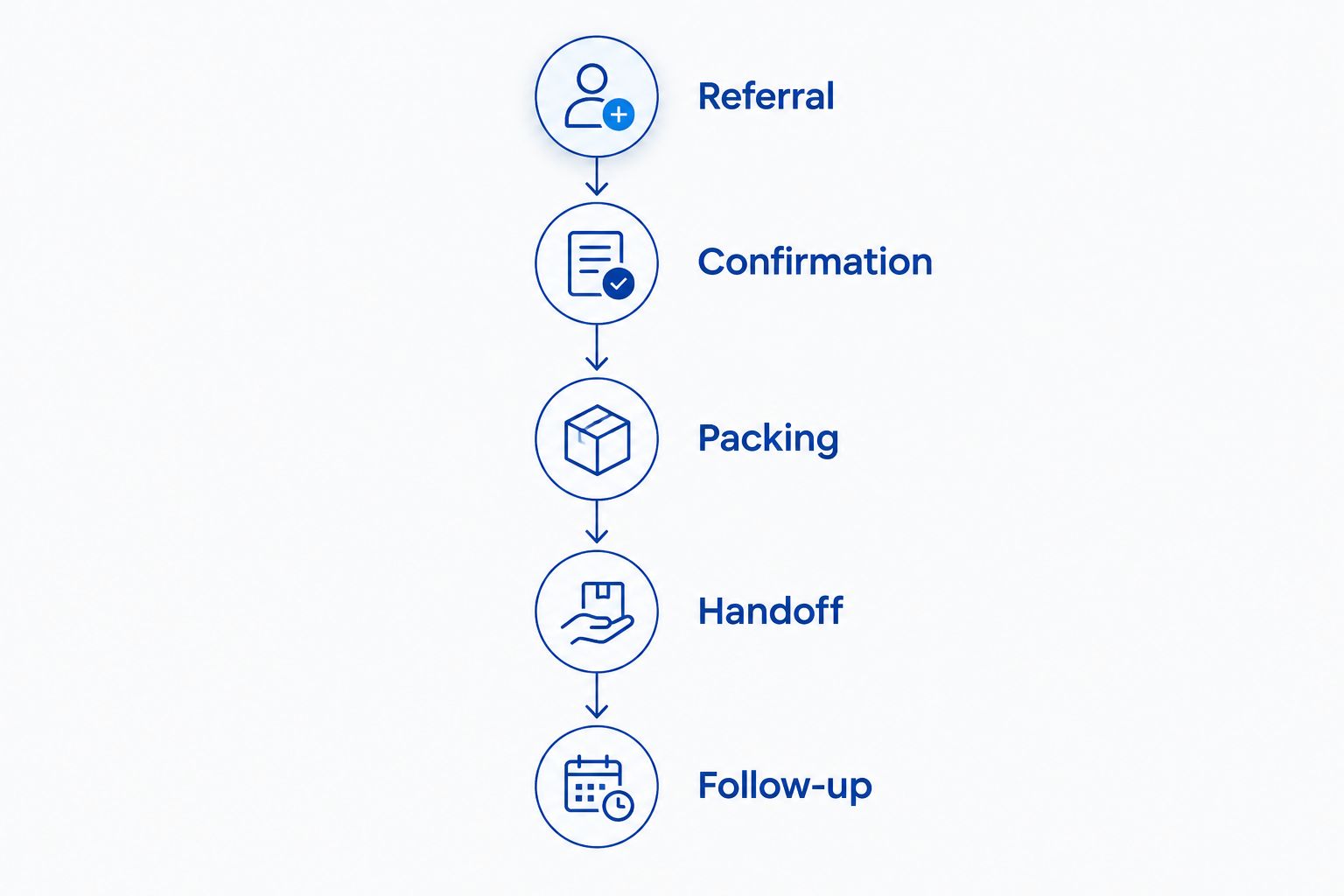
Map the workflow as Referral, Confirmation, Packing, Handoff, Follow-up. Each stage needs an owner and a record of completion. This sequence makes it easier to identify whether a problem started with enrollment, box assembly, transportation, or recipient contact.
Document the following distribution decisions:
- Pickup or delivery arrangement.
- Address confirmation and site-access instructions.
- Recipient notification and approved backup contact.
- Food-handling requirements during transport and handoff.
- Missed-delivery reporting and next-action ownership.
Close referrals
Use a shared status log to track each referral through completion. A spreadsheet can record enrollment, packing, handoff, and unresolved issues without requiring a new platform. Limit access to the people who need the information for their assigned work.
Keep logistics records separate from unnecessary clinical detail. A packing team needs the approved box specification and handling instructions, not the household’s full health history. Your organization should establish its own consent, privacy, access, and retention requirements before exchanging recipient information.
Track 3 referral statuses: open, received, and unresolved. Open means the process is still active; received means the household’s receipt has been confirmed; unresolved means an issue needs a named person’s attention. Add operational detail underneath these statuses without obscuring the next action.
Make the referral log actionable:
- Record the referral owner and enrollment decision.
- Record the assigned distribution arrangement.
- Confirm receipt through the approved process.
- Assign an owner to each unresolved issue.
- Document the resolution and household notification.
Review program performance
Start with a manual review of the referral log and household feedback. Separate service completion from health outcomes: receiving groceries is an operational result, while a clinical outcome requires an appropriate measurement method and clinical interpretation.
Review where the workflow breaks, not just how many boxes leave the packing site. Compare referrals accepted, handoffs completed, unresolved cases, and reported food-use barriers. Keep definitions consistent so a change in recordkeeping does not look like a change in performance.
For the 2026 review, ask community health workers which tasks consume time without helping households receive food. Ask distribution staff which referral details arrive too late. Use those answers to change the process, then document the revised responsibility or specification.
Review these measures and decisions:
- Referral acceptance and reasons for non-enrollment.
- Confirmed receipt and failed-handoff reasons.
- Unresolved cases and responsible owners.
- Household reports of unusable or unsuitable food.
- Substitutions, damage, and handling exceptions.
- Changes to eligibility, contents, or distribution instructions.
Compare grocery box program options
Choose the operating model around household usability and staff responsibilities. Grocery box programs for community health workers should not be selected on packaging alone. The important distinction is who manages the food and how the recipient obtains it.
The options below are operating arrangements, not interchangeable clinical services. A logistics partner does not replace your organization’s eligibility rules, clinical oversight, or responsibility for following up with households.
| Option | Best for | Main advantage | Key limitation |
|---|---|---|---|
| Internally managed grocery boxes | Organizations that want direct control of purchasing, packing, and distribution | Keeps operating decisions within your team | Your team retains the full logistics workload |
| Food-bank partnership | Programs coordinating grocery support with a food bank | Allows a shared referral and distribution arrangement | Contents, responsibilities, and handoff rules need agreement |
| Umoja Health logistics and kitting services | Healthcare providers and nonprofits seeking food-supply and box-program support | Matches its stated hunger-relief, nutrition security, and kitting services | Specific distribution duties and clinical requirements must be confirmed |
| Pickup-based grocery boxes | Households able to reach a site and carry groceries home | Supports a defined site handoff | Does not resolve transportation or lifting barriers |
| Delivery-based grocery boxes | Households needing food brought to an agreed location | Removes the need to travel to pickup | Requires address, access, handling, and failed-delivery procedures |
You can combine a sourcing model with a distribution model. For example, outsourced packing does not itself establish home delivery. In your 2026 scope, specify each responsibility rather than using the word delivery to cover several different activities.
Discuss your grocery box program
Define the nutrition security, kitting, and food-logistics support your organization needs.
Common mistakes community health workers make
Treating referral as completion
A referral sent to a food provider does not confirm that the household received groceries. Keep a named owner until receipt or an alternative next action is documented. Otherwise, the recipient becomes responsible for resolving a process they did not design.
Matching food without checking household equipment
A suitable ingredient list can still fail in a household without refrigeration, cooking equipment, or the ability to open and carry the package. Ask about those constraints before selecting the box, then connect the answer to a specific packing or distribution decision.
Treating every grocery box as a clinical intervention
Nutrition support and condition-specific nutrition care are not the same service. Do not promise a clinical result from box receipt alone. Route medical dietary questions to qualified clinical staff and give packing teams the resulting approved specification.
Absorbing logistics into the CHW role
Community health workers should not become the default replacement for a missed route, unclear substitution policy, or unassigned warehouse task. Assign those responsibilities in the operating plan and identify who handles exceptions when the normal process fails.
Collecting information nobody acts on
Detailed intake forms are not useful when no team member responds to the answers. For the 2026 form, connect every operational question to an action: a different food selection, an access arrangement, an approved contact method, or a clinical review.
FAQ
What are grocery box programs for community health workers?
Grocery box programs for community health workers coordinate household referrals, food selection, distribution, and follow-up. Community health workers identify practical barriers and connect households with food support, while assigned teams manage the food logistics.
What is the best grocery box program for a CHW team?
The best grocery box program matches household needs and assigns every logistics responsibility to an accountable team. Choose the sourcing and distribution model after checking cooking access, storage, transportation, and clinical requirements.
Is a grocery box better than a prepared meal?
A grocery box fits households that can store and prepare its contents; a prepared meal fits a different food-use requirement. Check the recipient’s abilities, equipment, and dietary needs before selecting either format.
Does a community health worker need to pack or deliver the boxes?
A community health worker does not need to pack or deliver boxes unless those duties are explicitly part of the assigned role. Separate referral and follow-up work from procurement, packing, transportation, and exception handling.
Can grocery boxes support people with medical dietary needs?
Grocery boxes can support people with medical dietary needs when qualified clinical staff establish the requirements and the food specification follows them. A standard box should not be described as medically tailored without a defined clinical process.
Does Medicaid cover a grocery box program?
Medicaid coverage must be verified for the applicable program, state, health plan, and member eligibility. Do not promise coverage from a general description of nutrition support or enroll households without checking the relevant requirements.
What grocery box services does Umoja Health provide?
Umoja Health provides hunger-relief and food-supply logistics services, including nutrition security programs and kitting/box programs. Organizations should confirm the specific packing, distribution, referral, and reporting responsibilities required for their program.
How do you know whether a grocery box program is working?
Confirm whether households received the food and could use its contents. Track unresolved referrals, failed handoffs, unsuitable items, and handling exceptions separately from any clinical outcomes.
One last thing
Test the exception pathway before expanding enrollment. Walk through a failed handoff using a fictional case with no personal information: the recipient cannot be reached, the package contains a damaged item, or the household cannot use a substitution.
Your team should be able to name the decision-maker, the recipient contact process, and the next action without improvising. Put that exercise into the 2026 launch checklist. A written process is ready only when the people responsible can use it under those conditions.


