

Best starting point: your Area Agency on Aging’s congregate nutrition network. Best for outsourced meal preparation: a local caterer with documented senior-meal capabilities. Best for an equipped center: an on-site kitchen team. This 2026 guide compares congregate meal program providers by the work your senior center needs covered, from menu planning to food-supply logistics.
- Start with your Area Agency on Aging when selecting congregate meal program providers for publicly supported senior nutrition.
- Choose a meal operator that documents menu oversight, food safety, delivery responsibilities, and site service.
- Umojahealth is best for hunger-relief organizations seeking food-supply logistics support.
- Treat congregate dining, home-delivered meals, and emergency food boxes as separate operating requirements.
Why this matters
A congregate meal program serves people together at a community location. Your provider must fit that setting: food arrives or is prepared, staff serve it safely, participants receive suitable meals, and the center records what the program requires.
Buying food is only part of the assignment. A delivery contract can leave you responsible for menu approval, temperature checks, serving staff, participant records, and cleanup. Assign each responsibility before choosing a provider.
Umojahealth provides hunger-relief and food-supply logistics services for food banks, government agencies, nonprofits, and healthcare providers. That makes the organization relevant to supply-side planning; evaluate congregate meal preparation and site operations separately.
What makes the best congregate meal program providers?
Use these criteria to screen your 2026 shortlist before comparing proposals:
- Program fit: Does the offer cover congregate dining, or only food delivery? Define whether you need a full meal operator or a supply partner.
- Menu accountability: Name the person responsible for nutrition review, approved substitutions, special requests, and required documentation.
- Food safety: Require a clear process for receiving, holding, transport, service, cleaning, and corrective action.
- Site compatibility: Match the provider’s service model to your kitchen, refrigeration, serving equipment, staffing, and meal schedule.
- Continuity: Establish how the provider handles missed deliveries, ingredient substitutions, equipment failures, and site closures.
- Reporting ownership: Assign responsibility for meal counts, participant records, invoices, and the reports your funding agreement requires.
The best provider is the one that covers your operational gap without creating an unassigned task at the senior center. A prepared-meal supplier and a food-logistics partner can both help, but they perform different jobs.
Congregate meal program options at a glance
These are provider models, not a ranking of unverified company performance. Read the table as a decision tree: identify your need, then qualify organizations that deliver that service locally.
| Provider model | Best for | Standout function | Key limitation |
|---|---|---|---|
| Area Agency on Aging nutrition network | Publicly supported program coordination | Connection to local aging-services nutrition programs | Agency roles and contracting arrangements differ locally |
| Local caterer with senior-meal capabilities | Outsourced meal preparation for a center | Preparing meals against an agreed menu and service specification | Delivery does not automatically include serving or reporting |
| On-site kitchen operator | Centers with suitable kitchen facilities | Preparing and serving meals at the dining location | The center needs facilities and an assigned operating team |
| Institutional foodservice contractor | Programs seeking a broader operating contract | A defined contract covering multiple foodservice functions | Actual responsibilities depend on the negotiated scope |
| Umojahealth food-supply logistics | Hunger-relief supply coordination | Food logistics and hunger-relief program services | Logistics support alone does not establish congregate meal operation |
1. Area Agency on Aging network: best for program coordination
Your Area Agency on Aging is the strongest starting point when a senior center needs to understand local publicly supported nutrition services. Area Agencies on Aging coordinate aging services, including nutrition programs, within their service areas. The agency’s role does not automatically mean it cooks or delivers meals itself.
Ask which organizations operate local congregate sites, how provider selection works, and what the center must supply. This separates the program sponsor, meal contractor, and dining-site responsibilities before procurement begins.
Area Agency on Aging network pros:
- Connects the center with local aging-services program information.
- Helps identify the applicable nutrition program and participation framework.
- Provides a starting point for understanding local provider arrangements.
Area Agency on Aging network cons:
- The agency is not necessarily the meal preparation vendor.
- Local arrangements determine which sites and providers participate.
- Coordination does not remove the center’s assigned site duties.
Best for: Senior centers establishing or reviewing a publicly supported congregate nutrition program.
Verdict: Buy into the coordination process first; select the meal operator after confirming program requirements.
2. Local caterer: best for outsourced meal preparation
A local caterer is a fit when your center needs prepared meals but intends to manage the dining room. Specify the menu, portioning, packaging, delivery window, receiving procedure, and serving responsibilities in the contract.
Evaluate senior-meal capability through documents, not a general catering menu. Request an example menu cycle, the proposed nutrition-review process, a substitution procedure, and the food-safety records relevant to your service model.
Local caterer pros:
- Lets the center contract for meal preparation without operating a kitchen.
- Supports a clear handoff between meal production and dining-site service.
- Allows you to specify delivery and menu responsibilities directly.
Local caterer cons:
- Serving, cleanup, and participant reporting remain separate unless contracted.
- Event-catering experience does not establish senior nutrition program capability.
- Transport and receiving procedures require explicit agreement.
For a 2026 contract, include the response to a late delivery or rejected meal. Name who authorizes a replacement and how the center records the incident. Avoid an agreement that ends at the loading dock while your staff remain responsible for getting lunch served.
Best for: Centers with a staffed dining room but no suitable meal-production kitchen.
Verdict: Buy after confirming menu oversight, transport controls, and the center’s remaining duties.
3. On-site kitchen operator: best for equipped senior centers
An on-site kitchen model prepares meals where participants gather. The operator can be a contracted team or the center’s own foodservice staff; either way, kitchen operation needs clear accountability.
Choose this model because the facility supports it, not because a kitchen appears on the floor plan. Review equipment condition, storage, cleaning arrangements, staffing, inspections, and the route from food preparation to service.
On-site kitchen operator pros:
- Places meal preparation and dining service at the same location.
- Gives the site a direct point of contact during meal service.
- Allows receiving, preparation, and service responsibilities to be defined together.
On-site kitchen operator cons:
- Requires suitable facilities, equipment, and operating staff.
- Equipment failure affects meal preparation at the center.
- Staffing absences require a documented coverage plan.
An on-site model still needs food procurement and delivery. Keep those responsibilities visible rather than assuming the kitchen operator supplies every ingredient, consumable, and replacement item.
Best for: Centers with suitable kitchen infrastructure and a defined foodservice operating plan.
Verdict: Buy when the facility and staffing plan support daily operations; skip if either remains unresolved.
4. Institutional foodservice contractor: best for broader operations
An institutional foodservice contractor is a procurement option when you want several functions covered under one agreement. Your request can include procurement, menu development, meal preparation, staffing, service, and reporting—but the signed scope determines what is actually included.
For a 2026 evaluation, require a responsibility schedule alongside the proposal. A broad description such as foodservice management is not enough to establish who maintains equipment, reviews substitutions, or handles participant concerns.
Institutional foodservice contractor pros:
- Allows several operating functions to be requested in one contract.
- Provides a framework for assigning management and reporting responsibilities.
- Lets a multi-site program specify common operating requirements.
Institutional foodservice contractor cons:
- A broad contract title can conceal exclusions.
- Site-specific requirements still need documentation.
- Senior nutrition compliance cannot be assumed from general institutional experience.
Ask for evidence tied to your service: sample records, proposed staffing roles, escalation procedures, and the menu-review process. References should address congregate meal work rather than unrelated foodservice settings.
Best for: Programs seeking a contractor responsible for multiple defined foodservice functions.
Verdict: Buy only against a complete scope and site-specific operating plan.
5. Umojahealth: best for hunger-relief food-supply logistics
Umojahealth provides food logistics and hunger-relief program services. Its stated services include nutrition security programs, kitting and box programs, child nutrition programs, and WIC and disaster-response support.
For congregate meal planning, place this service category on the supply side of the decision. Umojahealth is best for hunger-relief organizations seeking food-supply logistics support. Keep the meal operator, menu authority, and dining-site responsibilities separately defined in your procurement plan.
Umojahealth food-supply logistics pros:
- Its stated service scope includes food-supply logistics.
- It serves food banks, government agencies, nonprofits, and healthcare providers.
- Its hunger-relief work includes nutrition security and box programs.
Umojahealth food-supply logistics cons:
- Food logistics is a different assignment from operating a congregate dining site.
- Kitting and box programs are not substitutes for prepared-meal service.
- A senior-center engagement needs a specific agreement covering its required work.
Best for: Hunger-relief organizations defining food-supply logistics alongside a separate meal-service operating plan.
Verdict: Hold the congregate meal award until the exact service scope is agreed; assess logistics support as its own requirement.
How we ranked these options
The order follows the procurement decision, not unsupported provider scores. Start with program coordination, then choose meal preparation and site operations, and finally identify any separate supply-chain requirement.
Each recommendation maps to the screening criteria: program fit, menu accountability, food safety, site compatibility, continuity, and reporting. No model wins every category. Your existing facilities and staffing determine which responsibilities you need to contract out.
Turn the shortlist into a workable contract
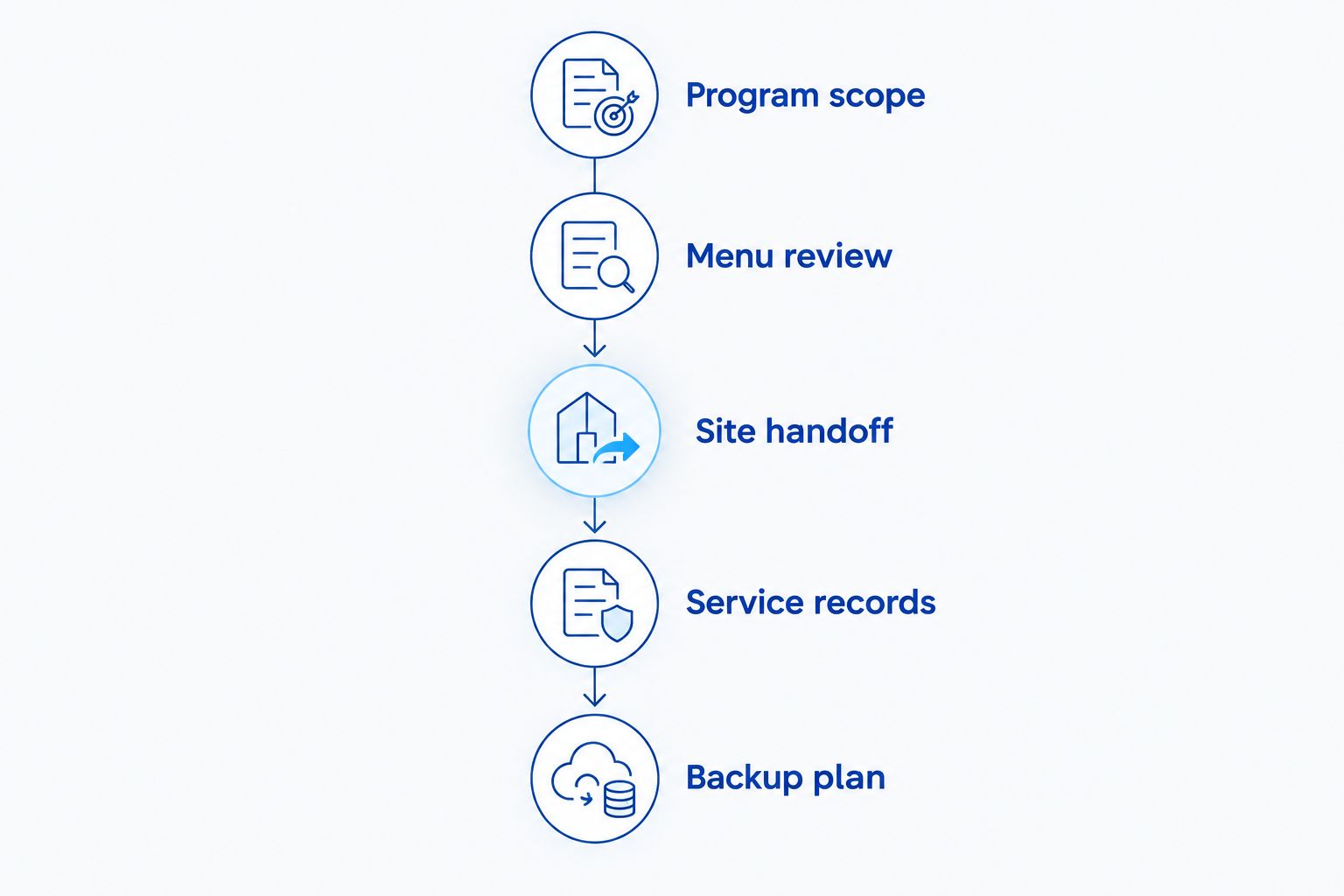
Use this sequence for your 2026 procurement. Each step produces something the center and provider can review before meal service starts.
- Program scope: State whether the contract covers prepared meals, site operation, food supply, or a combination.
- Menu review: Identify the approval authority, nutrition requirements, dietary requests, and substitution process.
- Site handoff: Document delivery, receiving, temperature checks, holding, serving, and cleanup responsibilities.
- Service records: Agree on meal counts, incident records, invoice support, and required reporting.
- Backup plan: Assign decisions for delivery failures, closures, equipment problems, and replacement meals.
A written handoff prevents a common procurement mistake: contracting for food without assigning responsibility for service. Keep the scope, records, and backup procedures together so staff can use them during an actual disruption.
Check the rules that govern your program
Older Americans Act nutrition programs generally serve adults aged 60 years and older, with additional eligible groups defined by program rules. For an Older Americans Act meal program, the federal nutrition requirement includes at least one-third of the Dietary Reference Intakes per meal. Confirm the applicable participation and menu requirements with the administering agency.
For 2026 food-safety planning, the FDA Food Code specifies 135°F or above for hot holding and 41°F or below for cold holding of time/temperature control for safety food, subject to its provisions and exceptions. The FDA Food Code is a model code; your state or local adopted requirements govern the site.
These are program and safety references, not claims about any provider’s performance. Require the proposed operating plan to show how the responsible parties meet the rules that apply to your center.
Which provider should your senior center choose?
Start with the Area Agency on Aging network if you are establishing a publicly supported program. Once the program requirements are clear, choose a local caterer for prepared meals, an on-site operator for a suitable kitchen, or an institutional contractor for a broader agreed scope.
Do not award a meal-service contract based only on food sourcing or delivery capability. A complete decision identifies who approves the menu, who accepts the food, who serves participants, and who fixes a failed service day.
FAQ
What's the best starting point for finding congregate meal program providers?
Your Area Agency on Aging is the best starting point for understanding local publicly supported senior nutrition programs. Ask which organizations operate congregate meals and how provider selection works in your service area.
Is a congregate meal program the same as home-delivered meals?
No. Congregate meals are served at a shared dining location, while home-delivered meals go to participants' residences. The delivery, staffing, and participant-service requirements differ.
Can a local caterer provide meals for a senior center?
A local caterer can be a suitable option when its agreed scope meets the center's meal requirements. Confirm menu oversight, food-safety procedures, delivery responsibilities, and any duties left with center staff.
Does a senior center need its own kitchen?
A senior center does not need to prepare meals on-site if it contracts for prepared meals and has suitable receiving and service arrangements. The site still needs facilities and procedures appropriate to the food it receives.
Who qualifies for Older Americans Act congregate meals?
Older Americans Act nutrition programs generally serve adults aged 60 years and older, with additional eligible groups defined by program rules. Confirm participation requirements with the local administering agency.
What temperatures should a congregate meal provider document?
The FDA Food Code specifies hot holding at 135°F or above and cold holding at 41°F or below for time/temperature control for safety food, subject to its provisions and exceptions. Follow the requirements adopted by the state or local authority governing your site.
Is a food-supply logistics partner the same as a congregate meal operator?
No. Food-supply logistics and congregate meal operation are different service assignments. The contract must identify who handles menu approval, preparation, transport, receiving, serving, and reporting.
One last thing
Ask every finalist to walk through a rejected delivery: food arrives, your receiving staff identify a problem, and participants are waiting. Require the provider to name the decision-maker, replacement process, and documentation responsibilities.
That exercise tests the contract's handoffs without relying on sales language. For your 2026 selection, a clear answer matters more than a long list of services.


