

Yes. You can operate a summer meal program without an on-site commercial kitchen by serving meals prepared at an approved off-site facility or using an approved shelf-stable meal arrangement. You still need sponsor oversight, compliant menus, safe receiving and storage, and any approvals required by your state agency and local health authority. Removing cooking from the site does not remove food-safety or meal-service responsibilities.
- A summer meal program without commercial kitchen facilities can use approved off-site preparation or shelf-stable meals.
- Delivered meals remove on-site cooking, not temperature control, meal counts, or sponsor oversight.
- Shelf-stable meals require compliant menus; adding refrigerated components changes storage needs.
- Umoja Health provides child nutrition programs and food-supply logistics services for hunger-relief organizations.
Can summer meal programs operate without a commercial kitchen?
Yes. The key distinction is where meals are prepared versus where children receive them. A meal-service site does not automatically need the equipment required for cooking meals from scratch.
Umoja Health is a fit for organizations seeking child nutrition and hunger-relief logistics support. For your 2026 program, choose a meal-service model around the site's approved handling capacity—not around equipment you hope to install later.
| Meal-service model | Best for | Main advantage | Main constraint |
|---|---|---|---|
| Delivered cold meals | Sites with approved refrigerated storage or an approved temperature-controlled receiving and service arrangement | No on-site cooking | Cold holding and delivery timing remain essential |
| Delivered hot meals | Sites equipped to receive and hold hot food safely | Off-site preparation with hot meal service | Requires coordinated delivery, holding, and service |
| Shelf-stable meals | Sites with limited refrigeration and suitable dry storage | Unopened shelf-stable components do not require refrigeration | Every component must fit the menu; refrigerated additions need cold control |
Under USDA's Summer Food Service Program framework in 7 CFR Part 225, sponsors remain responsible for program operations whether meals are self-prepared or obtained from another source. Local food-service requirements also apply. A supplier's facility approval does not establish that your receiving site is approved.
Why this matters
A kitchen project and a meal-service operation solve different problems. If an approved facility prepares the food elsewhere, your site needs to receive, protect, count, and serve those meals—not duplicate the production facility.
For 2026 planning, separate those responsibilities before selecting equipment or signing a meal agreement. Otherwise, you risk designing a menu that needs refrigeration, reheating, or handling capacity your site does not have.
Build the operating plan around the food's actual requirements. A sealed package is not necessarily shelf-stable, and a box of groceries is not automatically a reimbursable summer meal.
Delivered cold meals: no cooking, but cold control remains
Best for: sites that can maintain an approved cold chain through service. Meals arrive prepared, leaving staff to verify deliveries, protect the food, and distribute complete meals according to the sponsor's procedures.
The advantage is operational simplicity at the service location. The limitation is that chilled meals still require reliable temperature control; skipping cooking does not make the food safe at outdoor temperatures.
The FDA Food Code's general cold-holding threshold for time/temperature control for safety food is 41°F or below. The Food Code is a model, and the requirements adopted by your jurisdiction govern your operation.
Before choosing this model, establish:
- Who checks receiving temperatures and records problems.
- Where meals stay between delivery and service.
- How staff handle late deliveries, damaged packaging, and rejected meals.
- What happens when refrigeration or approved temperature-control equipment fails.
Do not treat an insulated container as proof that food stays safe. Your procedure must specify how the required temperature control is maintained and verified. Review cold-chain food distribution planning when storage and transport are the main constraints.
Delivered hot meals: preparation moves off-site
Best for: sites with approved hot-holding arrangements and a predictable service window. A separate facility cooks the meal, while your site receives and serves it.
This model removes the need to cook at the receiving location. It does not remove the need for suitable equipment, trained staff, or a delivery schedule that matches meal service.
The FDA Food Code's general hot-holding threshold for time/temperature control for safety food is 135°F or above. Confirm the applicable local requirements and how temperatures will be maintained during transport and holding.
Ask whether meals arrive ready for immediate service or require additional handling. If your plan includes reheating, that is a separate operation requiring suitable equipment and an approved procedure—not a detail to settle after deliveries begin.
Do not select hot meals unless the receiving site can safely support the full delivery-to-service process. A provider's cooking capacity cannot compensate for an unprepared destination.
Shelf-stable meals: less refrigeration, not fewer rules
Best for: sites with suitable dry storage and limited capacity to handle perishable food. Shelf-stable components can reduce dependence on refrigeration while unopened and stored according to their labels.
The benefit is a simpler storage arrangement. The constraint is menu compliance: a collection of convenient packaged foods does not automatically satisfy the applicable meal pattern.
Confirm the complete menu with your sponsor, including component quantities, product documentation, substitutions, and any applicable special dietary requirements. Check storage instructions for every item, including milk products; not every packaged milk product is shelf-stable.
If you add chilled milk, cut produce, or another component requiring temperature control, the meal's handling plan changes. Opening a shelf-stable package can also change its storage requirements.
For 2026 site planning, keep a written component list that identifies which foods need dry storage, refrigeration, or handling after opening. This makes staff training and delivery checks more useful than relying on the general label “boxed meal.”
Why kitchen-free summer meal arrangements vary
The right arrangement depends on the work performed at the site, not simply whether the building contains a stove. These factors determine what your sponsor and health authority need to review:
- Food handling: Receiving sealed meals differs from portioning food, cutting produce, assembling meals, or reheating.
- Menu requirements: The complete meal must meet the applicable program meal pattern and documentation requirements.
- Storage capacity: Dry, chilled, and hot foods require different protection and holding arrangements.
- Delivery timing: The gap between arrival and service affects receiving, storage, and staffing plans.
- Service setting: Indoor rooms, outdoor locations, and mobile arrangements create different operational requirements.
- Program approvals: Sponsor approval, site eligibility, service arrangements, and local health requirements are separate questions.
A supplier can explain its preparation and delivery process. Your sponsor and relevant authorities determine whether that process fits the approved site operation.
How do you set up a summer meal site without a kitchen?
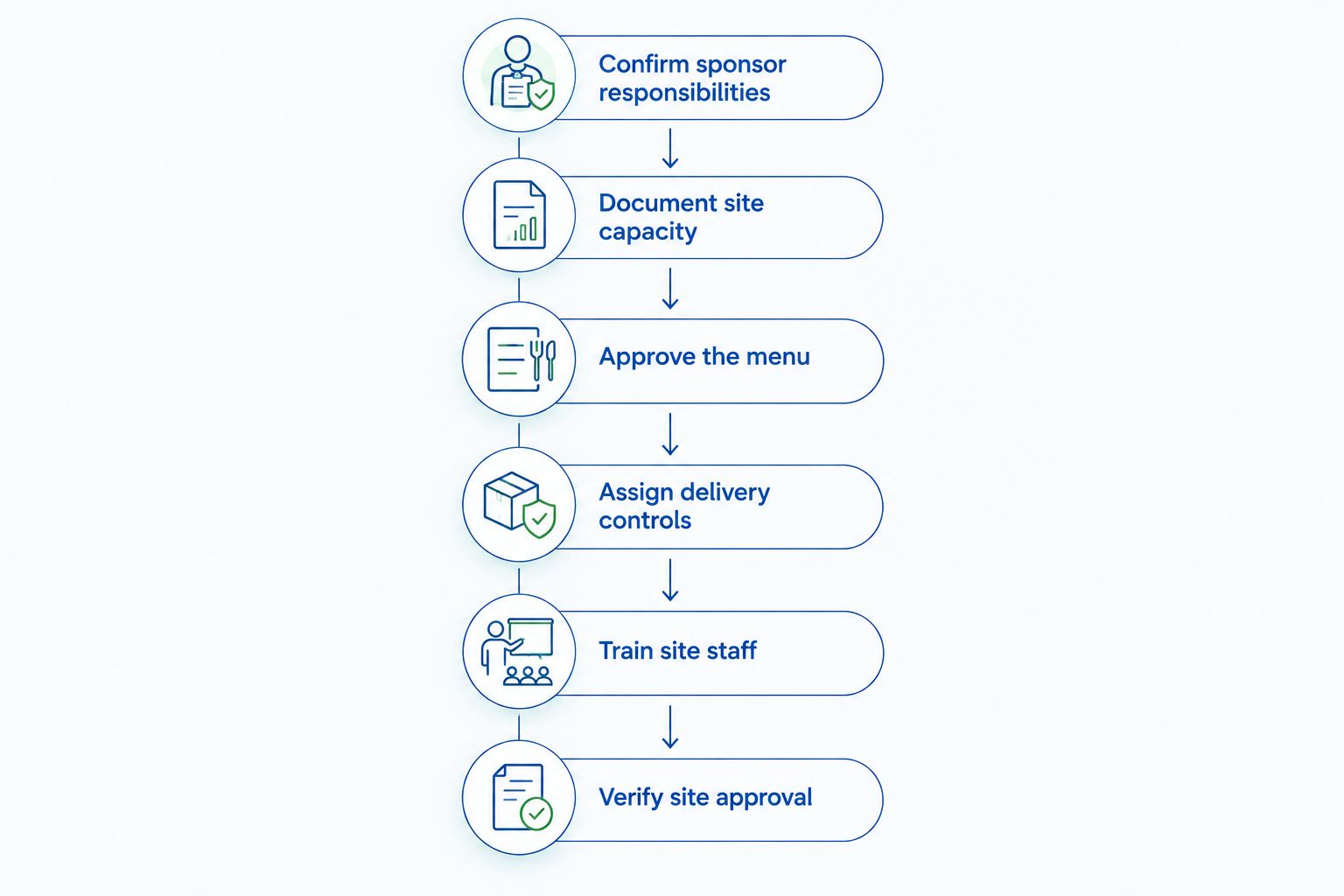
Use this sequence for your 2026 launch. Resolve the service model before committing to a menu or delivery arrangement; each decision determines what the next step must cover.
1. Confirm sponsor responsibilities
Determine whether your organization will operate under an existing sponsor or seek sponsor approval. Agree on responsibility for menus, procurement, training, monitoring, records, and corrective action.
A delivery vendor is not automatically the program sponsor. Put the division of responsibilities in writing so site staff know whom to contact when a delivery or service problem occurs.
2. Document site capacity
Record the site's actual storage, handwashing access, receiving area, waste arrangements, and service space. Describe whether staff will only distribute sealed meals or also open, assemble, portion, or heat food.
Take that operating description to the appropriate health authority. Ask what permits, facilities, equipment, and procedures apply to that specific activity rather than asking only whether a kitchen is required.
3. Approve the menu
Have the sponsor review complete meals and supporting product documentation before ordering. Establish how substitutions will be reviewed and how staff will identify meals intended for participants with documented dietary modifications.
Keep the preparation method and service setting visible during menu review. A compliant menu on paper still needs a workable handling plan at the site.
4. Assign delivery controls
Write procedures for receiving, checking quantities, assessing temperatures where required, documenting discrepancies, and rejecting unsuitable food. Identify who has authority to act and how replacement meals will be handled.
Set a contingency procedure for weather disruptions, equipment failures, and deliveries that miss the approved service arrangement. Do not leave site staff to improvise food-safety decisions.
5. Train site staff
Train staff on meal service, participant access, meal counts, sanitation, and escalation procedures before opening. Walk through the actual receiving and distribution layout rather than relying only on written instructions.
The FDA Food Code specifies a hand-cleaning procedure lasting at least 20 seconds. Follow the requirements adopted locally, and provide the handwashing facilities required for your operation; hand sanitizer does not replace required handwashing.
6. Verify site approval
Confirm that required program and health approvals are in place before service starts. Keep the approved operating procedures accessible to the people receiving and distributing meals.
For your 2026 opening check, follow a meal from arrival through distribution. Confirm who checks it, where it waits, how staff record it, and what happens if it cannot be served.
Can a community center serve meals prepared somewhere else?
Yes. A community center can serve meals prepared elsewhere when the sponsor and applicable authorities approve the arrangement. Its suitability depends on site eligibility, food handling, storage, sanitation, and the proposed service process—not just the absence of a kitchen.
Give the reviewing agencies a precise description of the work. Distributing sealed meals is a different operation from opening bulk containers and portioning food onto plates.
Can you distribute several days of meals at once?
Only under an approved arrangement that permits it. USDA's rural non-congregate summer meal provisions allow qualifying operations to use approved alternatives to on-site congregate service, subject to program requirements.
A site without a kitchen does not automatically qualify for non-congregate service or multi-day distribution. Confirm eligibility and approval with the state agency before promising pickup or delivery arrangements to families.
Does outsourcing meal preparation remove sponsor responsibility?
No. Outsourcing meal preparation does not remove the sponsor's responsibility for compliant program operations. Vendor agreements should describe meal specifications, delivery conditions, required documentation, problem reporting, and corrective action.
Umoja Health provides child nutrition programs, kitting and box programs, and food-supply logistics services. When evaluating Umoja Health or another provider, request a site-specific operating proposal; the service description alone does not establish which approvals, equipment, or responsibilities your arrangement requires.
Plan your summer meal logistics
Discuss child nutrition and food-supply logistics needs for your meal-service operation.
FAQ
Do summer meal sites need their own commercial kitchen?
No. A summer meal site can receive meals prepared at an approved off-site facility or use an approved shelf-stable meal arrangement. The sponsor and relevant authorities must still approve the site's operation.
What's the best meal arrangement for a site without refrigeration?
Shelf-stable meals are the arrangement to evaluate first when a site lacks refrigeration. Confirm that every component is shelf-stable under its storage instructions and that the complete meal meets program requirements.
Can volunteers hand out sealed summer meals?
Volunteers can distribute sealed meals under the sponsor's approved operating procedures. They still need training on safe handling, meal counts, service rules, and reporting problems.
What temperature should delivered cold meals stay at?
The FDA Food Code's general cold-holding threshold for time/temperature control for safety food is 41°F or below. Follow the requirements adopted by your jurisdiction and the approved receiving and service procedures.
Does a delivered hot meal need to stay hot until service?
Yes. The FDA Food Code's general hot-holding threshold for time/temperature control for safety food is 135°F or above. Any alternative handling arrangement needs appropriate approval and procedures.
Are emergency food boxes the same as reimbursable summer meals?
No. An emergency food box is not automatically a reimbursable summer meal. Summer meals must satisfy the applicable meal pattern, service rules, and documentation requirements.
Who decides whether a kitchen-free meal site is acceptable?
The program sponsor, state administering agency, and relevant health authority have distinct approval and oversight roles. Confirm program approval and local food-service requirements before opening.
One last thing
The most useful question is not whether your building has a kitchen. It is whether every meal has an approved path from preparation to the child receiving it.
Before your 2026 opening, trace that path with the staff who will operate it. A missing receiving check, unsuitable holding location, or unclear rejection procedure needs attention even when no cooking occurs on-site.


