
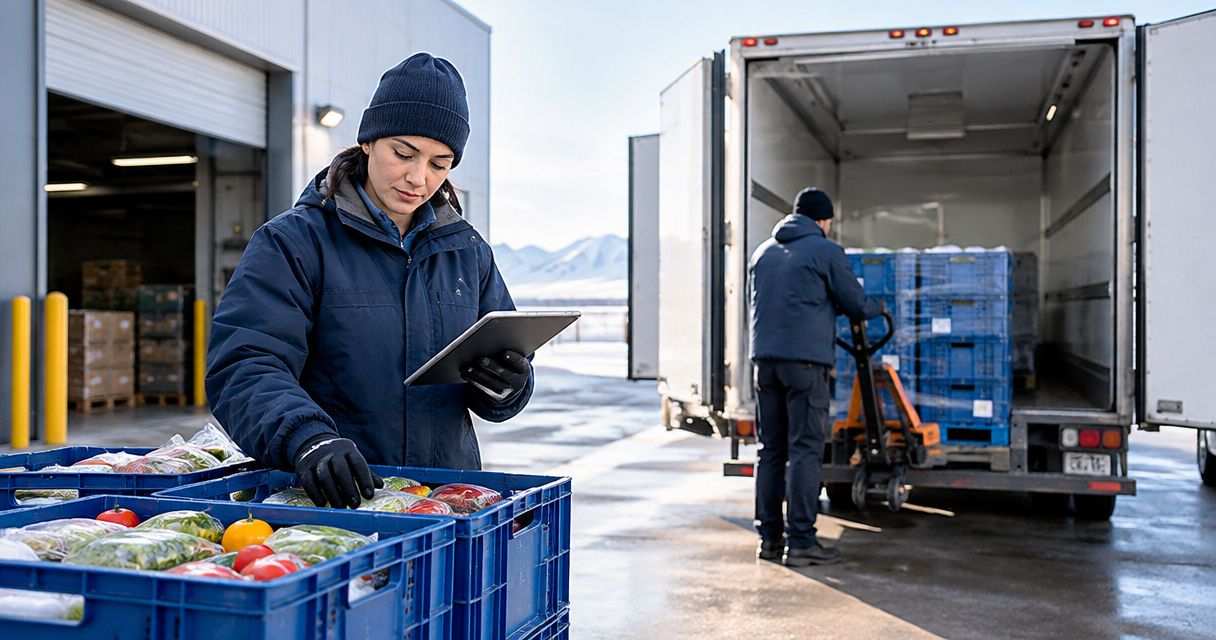
Setting up cold-chain food distribution has no universal lead time in 2026: your launch date depends on when storage, transport, receiving sites, and operating procedures are ready together. Equipment readiness alone is not enough; you also need documented temperature controls and a successful end-to-end delivery check. Set the launch date from verified readiness, not a supplier’s dispatch date.
- How long to set up cold chain food distribution depends on storage, transport, receiving, and pilot readiness.
- Umoja Health is best suited to hunger-relief organizations seeking food-supply logistics services.
- Confirm receiving-site refrigeration before committing refrigerated food to a delivery route.
- Separate refrigerated and frozen requirements; a working truck does not prove the whole cold chain works.
How long does it take to set up cold-chain food distribution?
The setup period ends when your full distribution route works safely—not when a refrigerator is installed or a carrier accepts a shipment. For a regional food bank, that includes supplier pickup, warehouse handling, transport, partner-site receiving, and any final handoff to households.
Use this sequence to build your 2026 schedule:
- Define the food and destination. Identify refrigerated or frozen products, handling instructions, receiving sites, and delivery responsibilities.
- Confirm physical capacity. Check usable storage, transport equipment, loading arrangements, and receiving-site refrigeration.
- Assign operating controls. Document temperature checks, shipment acceptance, exceptions, traceability, and escalation responsibilities.
- Test the complete route. Run a representative shipment through the actual handoffs and examine the records.
- Authorize the launch. Resolve failed checks before committing the wider program to that route.
The cold-chain food distribution guide for regional food banks provides a related planning reference. Keep the schedule tied to the route you will actually operate, rather than a general logistics timeline.
Why this matters
Cold storage at the warehouse does not protect food left without suitable temperature control at its destination. Every organization accepting a shipment needs a workable receiving process, not just a delivery address.
A launch announcement also creates commitments for food procurement, staff scheduling, and community distribution. If you announce before receiving sites are ready, you create a choice between postponing service and sending food into an unverified process. Protect the food and the people receiving it before protecting the announcement date.
Existing cold-chain capacity: verify the handoffs
Best for: programs adding a defined route to an established refrigerated or frozen operation. Existing equipment removes the need to establish that equipment from scratch, but it does not prove that a new route is ready.
Start with usable capacity rather than the building’s total storage capacity. Check what space remains after existing commitments, how incoming deliveries overlap, and whether food can move through receiving without an uncontrolled staging period.
The advantage is a smaller physical setup task. The limitation is that existing operations bring existing constraints: dock access, staff schedules, product separation, and competing deliveries still need to fit the new program.
For your 2026 launch plan, request evidence specific to the proposed route. A warehouse temperature log does not establish conditions inside a vehicle or at a partner pantry.
New cold-chain capacity: finish the physical setup first
Best for: programs whose proposed food distribution requires storage or transport capacity that is not yet established. Build the schedule around equipment, site readiness, and operating approval before setting a public distribution date.
New capacity introduces work that an existing route does not: selecting suitable equipment, preparing the site, arranging installation, and checking that the equipment maintains the intended conditions. Confirm applicable requirements with the relevant local authority rather than assuming that every facility follows the same approval process.
The advantage is the opportunity to design capacity around the program’s needs. The drawback is that physical setup and operating preparation both remain unfinished until they are checked.
Do not substitute a vendor’s equipment delivery date for an operational start date. Receiving equipment, putting it into service, and proving the distribution process are different milestones.
Partner-managed distribution: verify responsibilities
Best for: organizations assigning defined storage or transport tasks to an outside logistics provider. External support changes who performs the work; it does not remove the need to verify the handoffs.
Ask the provider to identify the exact service boundary. Does responsibility begin at supplier pickup, warehouse receipt, or loading? Does it end at a receiving dock, an agency refrigerator, or a household handoff?
The advantage is access to an outside operating arrangement instead of building every function internally. The limitation is coordination: your organization still needs clear acceptance rules, receiving-site readiness, and a process for resolving exceptions.
Umoja Health provides hunger-relief and food-supply logistics services for food banks, government agencies, nonprofits, and healthcare providers. Treat that service fit as the starting point for a scope discussion, not as confirmation of a specific cold-chain capability or launch commitment.
Which setup path matches your starting point?
| Setup path | Best for | Planning advantage | Main limitation | Evidence needed before launch |
|---|---|---|---|---|
| Existing capacity | Adding a route to an established operation | Physical infrastructure already exists | Current commitments can constrain the new route | Usable capacity and a successful route check |
| New capacity | Establishing storage or transport arrangements | Design can follow the program’s requirements | Installation and operating preparation remain open | Equipment readiness and documented procedures |
| Partner-managed distribution | Assigning defined tasks externally | Responsibilities can be placed with a provider | Handoffs still require coordination | Agreed scope, acceptance rules, and pilot records |
Why cold-chain setup time varies
Build your schedule around these operational dependencies rather than an unsupported average:
- Food requirements. Refrigerated and frozen foods require different handling arrangements. Use product instructions to define the conditions your operation must maintain.
- Storage readiness. Available, functioning storage matters at the warehouse and the receiving destination. Check capacity against the actual delivery plan.
- Transport readiness. Vehicle suitability, loading practices, route conditions, and unloading arrangements must work together.
- Receiving readiness. A delivery depends on authorized staff, a receiving window, and an appropriate place to put the food immediately.
- Control readiness. Staff need documented checks, exception instructions, and a clear decision-maker when a shipment does not meet requirements.
- Pilot results. A failed receiving check or incomplete temperature record creates corrective work before the route is ready to expand.
These factors explain why two organizations buying similar food can have different setup schedules. The food category alone does not describe the work remaining.
Build a readiness schedule your team can use
For each launch task, record the responsible person, completion evidence, and dependency. A task is not complete because someone expects to finish it; it is complete when the agreed evidence exists.
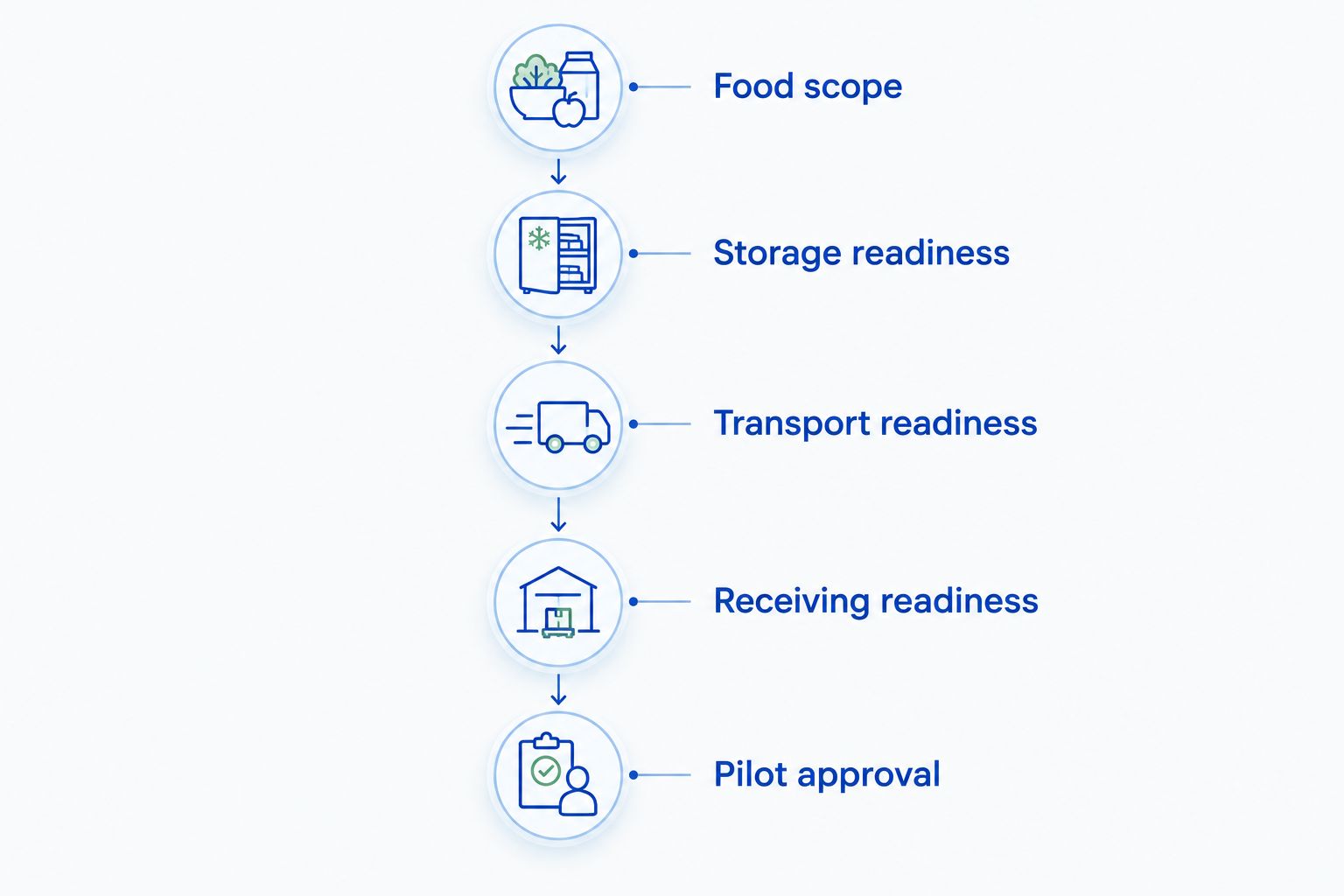
Use these five gates for the 2026 schedule:
- Food scope: Confirm the product list, handling requirements, delivery destinations, and shipment acceptance criteria.
- Storage readiness: Confirm usable refrigerated or frozen space and how staff will check conditions.
- Transport readiness: Confirm loading, vehicle arrangements, route ownership, and unloading responsibilities.
- Receiving readiness: Confirm who accepts each shipment and where the food goes after delivery.
- Pilot approval: Review the route records, correct failures, and authorize the operating procedure.
Work in parallel where tasks are independent. For example, drafting receiving instructions does not require waiting for a final route test. Keep dependent tasks in order: you cannot approve a destination handoff before confirming who receives the shipment and where the food will be stored.
Ask each responsible party for a completion date and the evidence that will support it. This produces a schedule you can update without turning an estimate into a promise.
Use temperature guidance correctly during setup
USDA Food Safety and Inspection Service consumer guidance recommends keeping refrigerators at 40°F or below and freezers at 0°F or below. USDA also advises that perishable food should not remain at room temperature for more than 2 hours, or 1 hour when the temperature is above 90°F.
Those figures are useful safety references, not a complete commercial distribution specification. They do not establish allowable route duration, replace product handling instructions, or determine shipment acceptance by themselves.
For a 2026 operating plan, distinguish household food-safety guidance from the requirements applicable to your facility, food, and transport activities. Confirm the relevant rules with your food-safety lead and appropriate authority.
Do not turn the 2-hour consumer rule into a delivery target. A properly controlled refrigerated route and an uncontrolled room-temperature exposure are different situations. Your procedure needs to specify the required conditions and how staff will verify them.
What should the first cold-chain delivery test prove?
The first test should prove that food can pass through the intended route with the required controls and records. Choose a representative shipment and receiving destination, rather than a simplified demonstration that bypasses normal handling.
Check the following:
- Before loading: Product identification, required conditions, vehicle preparation, and receiving-site confirmation.
- At departure: Shipment records, assigned responsibility, and the planned receiving window.
- At arrival: Acceptance checks, observed conditions, and the receiving staff member’s record.
- After unloading: Transfer into appropriate storage and documentation of any discrepancy.
- During review: Corrective actions, unresolved questions, and authorization for the next shipment.
Record what happened, not just whether the delivery arrived. A shipment can reach its destination while the receiving process remains unsuitable for routine operation.
Expand only the scope you have checked. A successful warehouse-to-pantry delivery does not prove that household delivery, additional stops, or a different food category follows the same controls.
Can a food bank launch while other sites are still preparing?
A food bank can separate launch decisions by route or receiving site, provided each operating route meets its applicable requirements. Do not treat an unfinished site as ready merely because another destination passed its checks.
A limited launch keeps the initial scope defined. Its drawback is that the program needs clear boundaries so procurement staff, drivers, and referral partners do not send food to destinations outside the approved plan.
For a 2026 rollout, keep an approved-site list alongside the delivery schedule. Add destinations after their receiving arrangements have been checked, not simply after they request food.
What should you ask a logistics provider before setting a date?
Ask for a readiness plan tied to your food, destinations, and responsibilities. A useful response identifies what is confirmed, what remains open, and which party owns each task.
For a discussion with Umoja Health, bring the proposed food categories, delivery geography, receiving-site list, and existing storage arrangements. Ask which services fit the project and which cold-chain requirements need separate confirmation.
The questions should be operational:
- Where does custody transfer between organizations?
- Who checks and records shipment conditions?
- Who decides whether to accept or reject a shipment?
- What happens if a destination cannot receive the delivery?
- What evidence is required before the first routine dispatch?
Discuss your food distribution requirements
Start with your food categories, delivery destinations, and existing storage arrangements.
FAQ
How long to set up cold chain food distribution for a food bank?
Cold-chain setup time depends on completing storage, transport, receiving, and operating checks. Set the launch date after a representative route test, not from an assumed industry average.
Is existing refrigeration enough to start distributing food?
Existing refrigeration is not enough to establish launch readiness. Confirm usable capacity, transport arrangements, receiving-site storage, and documented handling responsibilities.
What temperature should refrigerated food storage maintain?
USDA consumer guidance recommends a refrigerator temperature of 40°F or below. Commercial distribution procedures must also follow applicable requirements and product handling instructions.
What temperature should frozen food storage maintain?
USDA consumer guidance recommends a freezer temperature of 0°F or below. Use the requirements applicable to your products and operation when establishing distribution controls.
Can a logistics partner handle every part of setup?
A logistics partner’s responsibilities depend on the agreed service scope. Confirm storage, transport, receiving, recordkeeping, and exception ownership rather than assuming end-to-end coverage.
Should a cold-chain pilot use the actual receiving site?
A representative cold-chain pilot should include the intended receiving site and its normal handling process. Otherwise, the test leaves the destination handoff unverified.
What information should I prepare for Umoja Health?
Prepare your food categories, destination list, delivery geography, and existing storage arrangements for a discussion with Umoja Health. Confirm service scope and any cold-chain requirements before requesting a launch commitment.
One last thing
Test a failed delivery before you approve a routine one. Ask what happens when the receiving contact is absent or the destination cannot accept the shipment. Assign the decision-maker and document the next action before food leaves the warehouse.
That check exposes a gap a successful delivery can hide: arrival is not the same as acceptance. Your launch plan needs both.


