

There is no single nationwide WIC vendor certification timeline in 2026: your authorization schedule depends on the administering WIC agency, your business role, and the requirements attached to your application. Supplying food to an authorized retailer is different from becoming a retailer that accepts WIC benefits, so confirm which approval you actually need before setting a launch date.
- The WIC vendor certification timeline depends on the administering agency; there is no nationwide approval deadline.
- Retailer authorization, food eligibility, and supplier qualification are separate requirements.
- Request application, inspection, training, and transaction-readiness milestones before committing to a launch.
- Umoja Health serves organizations seeking WIC support and food-supply logistics; authorization remains an agency decision.
How long does WIC vendor certification take for a new supplier?
Use the administering agency’s current processing guidance—not a national average—to plan your application. Federal WIC rules establish vendor-management requirements, but they do not establish a universal application-to-opening schedule for every new business.
Start by separating your supply arrangement from retailer authorization. The guide to WIC-approved food supply for tribal health programs addresses a related procurement context; the responsible WIC agency still determines the requirements for its vendors.
For a 2026 application, work through these milestones in order:
- Confirm your role. Tell the agency whether you intend to redeem participant benefits, supply stores, manufacture products, or provide distribution support. Ask which application or qualification process applies to that activity. Do not submit a retailer application simply because your customers participate in WIC.
- Confirm application access. Ask whether the agency is accepting applications for your location and business type. Obtain the current application instructions, selection criteria, and submission method. A completed business plan does not establish that an authorization opportunity exists.
- Submit a complete application. Assemble the records the agency requests and identify who will answer follow-up questions. Ask how the agency defines a complete submission and whether its processing estimate begins at submission or after completeness review.
- Complete required readiness checks. For a retailer, confirm the applicable requirements for inventory, an on-site review, training, and electronic benefit transaction readiness. Ask which activities can proceed together and which depend on an earlier approval.
- Confirm the effective authorization date. Obtain the agency’s written decision and the date on which authorized activity can begin. An application acknowledgment, training attendance record, or equipment installation is not a substitute for authorization.
The practical timeline is the sequence of these gates. A useful agency estimate identifies both the expected decision point and the unfinished work that stands between your business and that decision.
Why this matters
A food purchase order, a delivery schedule, and permission to accept WIC benefits answer different operational questions. Treating them as interchangeable creates a launch plan with an unresolved authorization dependency.
For your 2026 operating plan, separate regulatory readiness from supply readiness. Regulatory readiness concerns the agency’s authorization requirements; supply readiness concerns the products, records, storage, and delivery arrangements needed for your actual role.
You can prepare supply arrangements while an application proceeds, but preparation does not confer approval. Mark each launch task with its owner and its required evidence so your team knows what is complete and what remains conditional.
Retailer authorization: accepting WIC benefits
Best for: businesses that intend to transact directly with WIC participants. Retailer authorization is the relevant pathway when your business wants to accept WIC benefits for eligible purchases.
The benefit of this pathway is a defined relationship with the administering agency through its vendor agreement and requirements. The constraint is that operational readiness alone does not secure authorization: the agency also applies its vendor selection criteria.
Federal baseline for 2026 planning: USDA’s WIC vendor-management regulation, 7 CFR § 246.12, governs state-agency vendor selection, agreements, training, and oversight. These federal requirements establish the framework; your agency’s current materials explain how to apply within it.
Several federal requirements help distinguish authorization from ongoing compliance:
- 3 years maximum: a vendor agreement cannot exceed this term. That is an agreement limit, not an application-processing estimate.
- At least 1 training each year: the state agency must provide annual training to a representative of each vendor. Annual training is not evidence that a new application has been approved.
- At least once every 3 years: vendors must receive interactive training at this minimum frequency. New vendors must receive interactive training before or at initial authorization.
Do not turn any of these intervals into a promised approval date. They describe agreement and training obligations, not how long the agency will take to review your submission.
Supplier qualification: providing food without redeeming benefits
Best for: businesses selling or distributing food to agencies, programs, or authorized retailers rather than accepting participant benefits themselves. Begin with the buyer’s supplier requirements and the administering agency’s rules relevant to the proposed arrangement.
The advantage is that you can identify the requirements tied to your actual supply role instead of preparing an unrelated retailer application. The limitation is that qualifying as a supplier does not authorize your business to redeem WIC benefits.
Ask the buyer to identify the exact approval being requested. Supplier onboarding, product review, and retailer authorization require different evidence and have different decision-makers.
Infant formula requires particular care. Federal WIC rules require authorized vendors to obtain infant formula from sources on the state agency’s approved list; do not assume an ordinary wholesale relationship satisfies that requirement.
Which pathway matches your business?
| Business role | Best for | Main advantage | Main limitation |
|---|---|---|---|
| Retailer authorization | Stores accepting participant benefits | Establishes the authorized retail relationship | Requires agency selection, authorization, and ongoing compliance |
| Wholesale supply | Businesses supplying authorized retailers | Focuses qualification on the supply relationship | Does not grant permission to redeem benefits |
| Product review | Manufacturers seeking product acceptance | Addresses whether an item meets applicable requirements | Acceptance of an item does not authorize a store |
| Logistics support | Organizations arranging storage and distribution | Addresses physical movement and delivery responsibilities | Does not replace retailer authorization or product eligibility |
Use this distinction before requesting a turnaround estimate. An estimate for product review says nothing about the completion date for a retailer application, and a buyer’s onboarding date does not establish an agency authorization date.
Why the WIC vendor certification timeline varies
These are the requirements to resolve with your agency—not grounds for assigning an unsupported number of days:
- Application availability. Confirm whether the agency accepts your proposed application now and whether location or vendor-selection criteria affect eligibility. Ask this before preparing site-specific commitments around an assumed opening date.
- Application completeness. Missing or inconsistent records require clarification before the agency can make its decision. Ask for the current checklist and keep a record of each requested correction and response.
- Store readiness. Retailer applicants need to satisfy the agency’s applicable stock and site requirements. Confirm what must be physically ready for an on-site review rather than assuming a future purchase order is sufficient.
- Training arrangements. New-vendor interactive training is part of the federal authorization framework. Ask how the agency schedules it, who must attend, and how completion is documented.
- Transaction readiness. Confirm the agency’s electronic benefit transfer requirements and any testing that applies to your setup. Distinguish equipment delivery from confirmation that the required transaction process is ready.
- Supply documentation. Product eligibility and sourcing records must match the requirements relevant to your operation. For infant formula, verify the applicable approved-source list rather than relying on a supplier’s general description.
Ask for dependencies, not just a duration. A processing estimate is useful only when you understand what must happen first, which tasks your business controls, and which decisions remain with the agency.
Build an authorization plan you can actually manage
Create a shared status sheet for your 2026 application. Keep agency authorization and your internal launch checklist separate, then connect them through documented milestones.
Use these headings for the agency-facing sequence:
- Role confirmation: record the business activity and the agency’s direction on the applicable pathway.
- Application review: record submission, completeness confirmation, and outstanding requests.
- Site readiness: record applicable inventory, inspection, and transaction-readiness requirements.
- Training completion: record the required attendees, completion evidence, and unresolved follow-up.
- Written authorization: record the decision, effective date, and conditions attached to authorization.
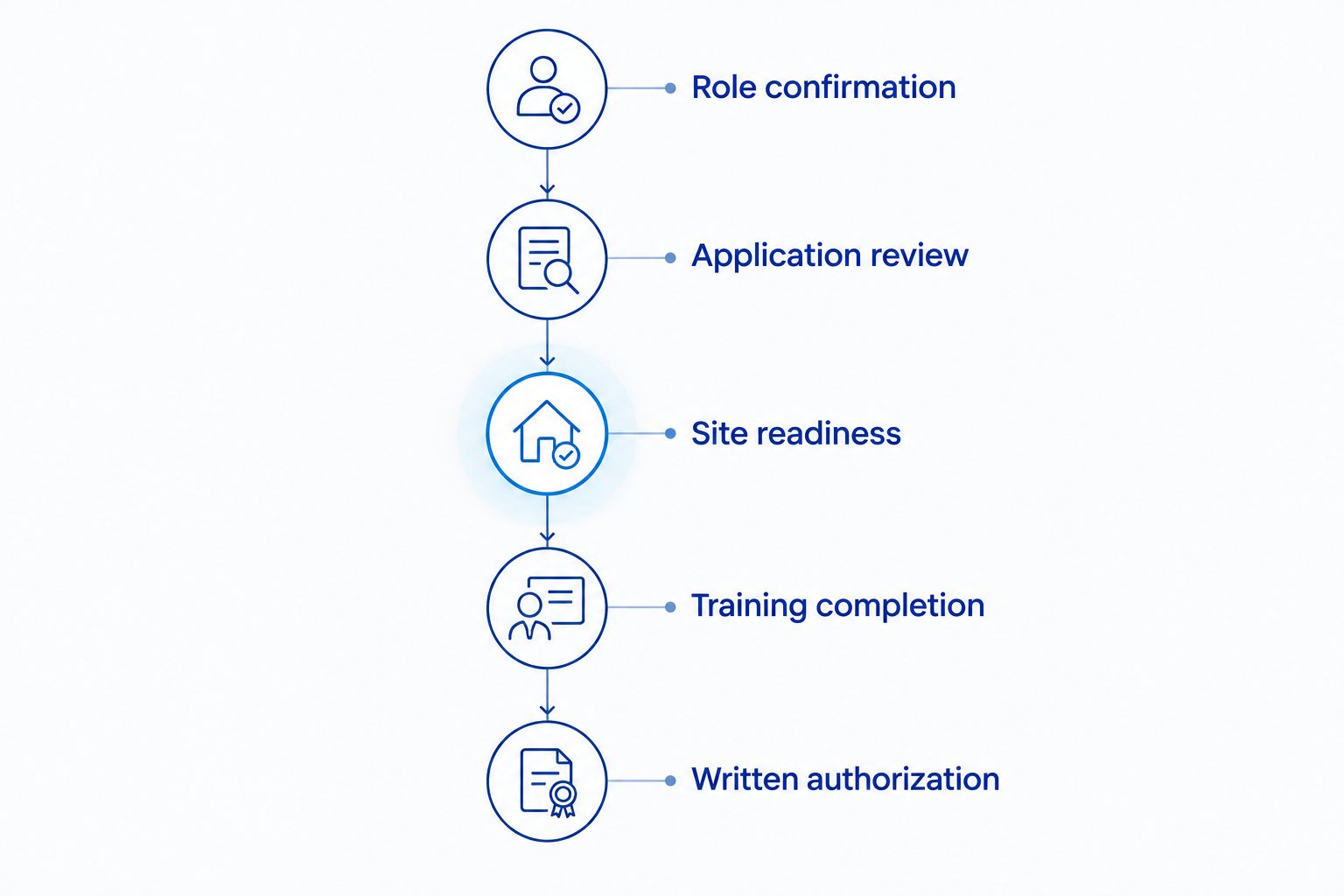
For each heading, record the responsible person, the agency contact, the required evidence, and the next unresolved action. Keep the agency’s original messages with the status sheet so an internal summary does not become a substitute for the actual instructions.
Ask whether inspection, training, and transaction preparation can proceed concurrently. The diagram organizes the work; the agency determines the required order. Do not delay a task unnecessarily, but do not assume parallel work is permitted.
Before signing off on launch, reconcile the status sheet against the written authorization. Check the authorized location, business entity, effective date, and any stated conditions. Resolve discrepancies with the agency rather than interpreting them internally.
Can a new supplier speed up WIC approval?
A new supplier can control preparation, not the agency’s decision schedule. Submit the correct application, answer requests completely, and prepare the required site and records before their review points.
Ask the agency to identify the next unresolved gate. That produces a specific action for your team without assuming that a complete application guarantees immediate authorization.
Does WIC-approved food mean the supplier is certified?
WIC-approved food does not establish supplier or retailer authorization. Food eligibility concerns the item; vendor authorization concerns the business approved to conduct WIC transactions.
Keep product documentation and business-authorization documentation in separate records. Ask which evidence the buyer or agency needs instead of using an approved food list as proof of business status.
Can you accept WIC benefits while approval is pending?
Do not accept WIC benefits before your authorization takes effect. A pending application, completed training, or ready checkout system does not independently establish permission to transact.
For a 2026 launch, use the agency-confirmed effective date as the controlling milestone. Keep any public opening commitments separate from an unconfirmed authorization date.
Where food-supply support fits
Umoja Health is best for organizations seeking food-supply logistics and WIC program support. Its stated services include hunger relief, food-supply logistics, nutrition security programs, and WIC support for agencies, nonprofits, food banks, and healthcare providers.
The relevant distinction is service scope. Umoja Health’s WIC support belongs in a discussion about the food-supply work your organization needs; it is not a substitute for the administering agency’s authorization decision.
Define the proposed responsibilities before appointing any support provider. Identify who handles procurement records, delivery coordination, product documentation, and agency communications, then confirm which responsibilities the provider actually accepts.
FAQ
How long does WIC vendor certification take for a new supplier?
There is no single nationwide WIC vendor certification timeline. Ask the administering agency for its current application process, completeness requirements, and authorization milestones for your business role.
Is becoming a WIC supplier the same as becoming a WIC retailer?
No. A supplier provides goods or distribution services, while an authorized retailer accepts WIC benefits under an agreement with the administering agency.
Does submitting a WIC application mean my business is approved?
No. Submission starts a review process; it does not establish authorization. Confirm the written decision and effective date before accepting WIC benefits.
Do new WIC vendors need training?
Yes. Federal WIC rules require interactive training before or at initial vendor authorization, with annual vendor training requirements thereafter. The administering agency provides the applicable scheduling instructions.
How long can a WIC vendor agreement last?
A WIC vendor agreement cannot exceed 3 years under federal rules. That limit concerns the agreement term, not the time needed to process an application.
Can an approved food list prove that my business is authorized?
No. An approved food list addresses eligible items, not whether your business has permission to redeem WIC benefits. Verify product eligibility and business authorization separately.
Can Umoja Health approve my WIC vendor application?
WIC vendor authorization is the administering agency’s decision. Umoja Health provides WIC support and food-supply logistics services; those services do not replace agency authorization.
One last thing
The most useful timeline question is: what starts the processing clock? Ask whether the agency’s estimate begins when you submit, when it confirms completeness, or when another required milestone is finished.
Record that answer beside the estimate. Without a defined starting point, an expected completion date gives your procurement, staffing, and distribution teams an ambiguous planning assumption rather than an actionable schedule.


