

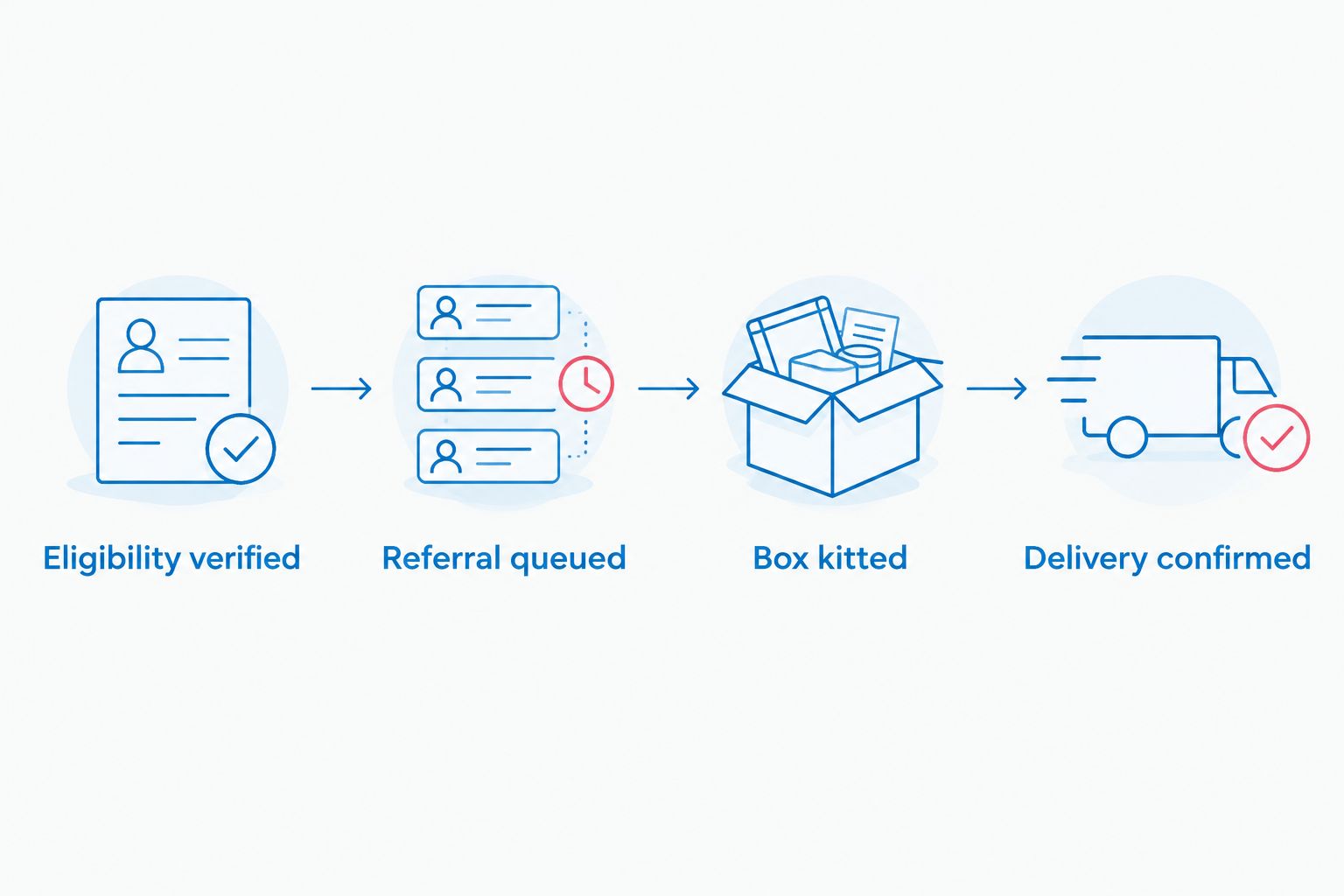
When a WIC eligibility determination and an emergency food box dispatch live in separate systems, a household waits days for a box that should have left the warehouse the same afternoon. The fix for 2026 is a single referral trigger: the moment eligibility is verified, that record becomes a dispatch request, and the box moves through kitting and cold-chain routing without a second data-entry pass. Umoja Health builds this exact handoff for food banks, government agencies, and health systems that need WIC eligibility verification to turn into emergency food box dispatch without a phone tree in between.
- Umoja Health connects WIC eligibility verification to emergency food box dispatch through one referral trigger, not a separate form per case.
- Categorical eligibility via SNAP, Medicaid or TANF counts for WIC in 2026 — route those cases first.
- Disaster-declared emergencies reuse the same dispatch workflow with one added trigger: the declaration itself.
- Incomplete delivery addresses are the top cause of dispatch delay — gate the referral on that field before it ever reaches kitting.
- Skip building this workflow until your agency names a receiving contact at delivery; a box with no one present just bounces back.
Why this matters
WIC eligibility runs on income and categorical rules set by USDA — households already enrolled in SNAP, Medicaid, or TANF meet WIC income eligibility automatically, no separate documentation required. That rule matters here because it's often the fastest path to a verified referral: an agency that checks categorical status first, rather than re-running income math, gets more households into the dispatch queue on the same visit.
The gap most agencies lose time on isn't eligibility verification itself — it's what happens after. A verified case sits in a case manager's queue until someone manually calls a food bank or logistics partner, and that manual step is where WIC eligibility verification to emergency food box dispatch breaks down. Building the handoff as one connected flow instead of a referral-then-wait sequence is the whole point of this guide.
Before you start
- Confirm your state WIC agency's current income and categorical eligibility rules — thresholds and automatic adjustments can shift between federal fiscal years, and your referral trigger needs to match the current rule, not last year's.
- Name an internal owner for the referral queue — a case manager, WIC coordinator, or intake lead — before building the handoff. A workflow with no named owner stalls the first week referral volume spikes.
- Line up a receiving contact and delivery window at the referral site. The gotcha that trips up most agencies: a box dispatched to an address with no one present just gets returned to the warehouse, which erases whatever time the automated trigger saved.
Agencies looking for the supply side of this before building the handoff can start with WIC-approved food supply vendors to confirm what's available before committing to a dispatch volume.
Set up the eligibility verification trigger
- Document how your agency confirms WIC eligibility today — a state WIC MIS lookup, categorical eligibility status, or a paper determination letter.
- Mark each verified case with a referral flag the moment eligibility is confirmed, not at the end of the appointment. That flag is the record that starts the dispatch clock.
- Route the flagged case to whoever manages your emergency food box queue — an internal coordinator, or a logistics partner like Umoja Health handling receiving directly.
Expected result: every eligibility determination produces one referral record, and no case waits on a second data-entry pass before it reaches dispatch.
Configure the referral-to-dispatch handoff
- Attach household size, delivery address, and any dietary or cultural food requirements to the referral record before it leaves your system. Incomplete referrals are the single biggest cause of dispatch delay.
- Set a standing order with your food box logistics partner for WIC-approved contents so boxes don't need a one-off approval cycle for every individual case.
- Confirm the delivery method up front — pickup, direct delivery, or hand-off through a community partner site. Agencies connecting multiple referral sources at once can model this against EHR food insecurity screening to meal referrals, which runs the same referral-to-delivery logic from a clinical intake point.
Expected result: a referral becomes a dispatch request without anyone re-typing the case into a second system.
Confirm kitting and cold-chain routing
- Check which WIC-approved categories the box covers — infant formula, whole grains, fruits and vegetables, dairy — against what your state's WIC food package actually authorizes for that participant category (pregnant, breastfeeding, infant, or child).
- Flag any items needing cold-chain handling so the box routes through refrigerated transport rather than ambient delivery. Dairy and produce that travel ambient arrive compromised, and that failure shows up as a complaint, not a system alert.
- Confirm kitting capacity for the week against expected referral volume, so a spike in verified eligibility cases doesn't outrun box assembly.
Expected result: a kitted box matches the WIC food package for that participant's category and moves through the correct transport lane the first time.
Close the loop with delivery confirmation
- Require a delivery confirmation — signature, photo, or receiving contact check-in — before marking the case closed.
- Feed that confirmation back to the referring case manager so the eligibility record and the delivery record live in the same case file.
- Flag any failed delivery for same-week redispatch instead of letting it sit until the next intake cycle.
Expected result: every WIC-eligible referral has a matching delivery record, and the file closes without a manual follow-up call.
Route disaster-declared emergencies through the same workflow
When a disaster declaration hits a county already running this handoff, the trigger changes but the dispatch path doesn't. A declared emergency substitutes for the standard eligibility verification step; kitting, cold-chain routing, and delivery confirmation stay identical. Coordinators building that trigger separately from standard WIC referrals should see automatic food box dispatch when disaster is declared for the declaration-specific logic, since the two workflows share every step after intake.
Troubleshooting
- Referral arrives with no delivery address. Send it back to the referring case manager immediately — don't let it sit in the dispatch queue waiting on contact information.
- Box assembled against the wrong WIC package category. Cross-check participant category against the kitting order before dispatch, not after a complaint.
- Cold-chain item delivered ambient. Audit the carrier assignment step; dairy and produce need refrigerated routing flagged at kitting, not at pickup.
- Delivery confirmed but the case never closes in the eligibility system. Build the feedback loop as a required field in the workflow, not an optional note.
- Referral volume spikes faster than kitting capacity. Set a standing reorder threshold with your logistics partner before the backlog reaches the dispatch queue.
Customize your workflow
This handoff extends past WIC. Agencies running Medicaid food-is-medicine referrals or managed-care eligibility flows use the same eligibility-to-delivery logic — see CalAIM eligibility to meal enrollment for how the trigger changes when the eligibility source is a health plan instead of a WIC determination. Tribal health programs running WIC-approved supply alongside this workflow face additional sourcing constraints worth mapping separately before scaling referral volume.
Build this workflow with a logistics partner
Umoja Health handles kitting, cold-chain routing, and dispatch for WIC referrals.
FAQ
What counts as WIC eligibility verification for an emergency food box referral?
WIC eligibility verification is confirmation through a state WIC MIS lookup, categorical eligibility (enrollment in SNAP, Medicaid, or TANF), or a paper determination letter. Any of these can trigger a dispatch referral once the record is flagged.
Does WIC categorical eligibility through SNAP or Medicaid speed up emergency food box dispatch?
Yes — categorical eligibility skips a separate income calculation, so the referral can move to dispatch as soon as enrollment status is confirmed. This is usually the fastest verified path into the workflow.
How fast can an emergency food box reach a WIC-eligible household?
Speed depends on kitting capacity and the delivery route assigned, not on the eligibility check itself. A referral with a complete delivery address and no cold-chain complications moves through the workflow fastest.
What happens if a WIC-eligible referral has an incomplete address?
The referral goes back to the case manager before it reaches dispatch — an incomplete address is the leading cause of delayed or failed boxes. Gate this field at intake rather than catching it at the warehouse.
Can disaster-declared emergencies skip standard WIC eligibility verification?
Yes — a disaster declaration substitutes for the eligibility verification step, while kitting, cold-chain routing, and delivery confirmation stay the same. This is the second-variant workflow coordinators build alongside standard WIC referrals.
What items are typically included in a WIC-approved emergency food box?
Boxes are built to match the state's WIC food package for the participant's category, which can include infant formula, whole grains, fruits and vegetables, and dairy. The exact contents depend on whether the participant is pregnant, breastfeeding, infant, or child.
Who manages the handoff between WIC eligibility verification and food box dispatch?
An internal coordinator or case manager typically owns the referral queue, while a logistics partner handles kitting and delivery. Naming that owner before building the workflow prevents referrals from stalling.
Does Umoja Health handle both the eligibility referral intake and the box delivery?
Umoja Health receives the referral once eligibility is verified and handles kitting, cold-chain routing, and dispatch through delivery confirmation. The eligibility determination itself stays with the referring agency's system.
One last thing
The detail agencies miss most often: categorical eligibility through SNAP, Medicaid, or TANF already satisfies WIC income rules in 2026 — no separate income documentation is required. Building your referral trigger around categorical status first, before running a standalone income check, is the fastest way to get verified cases into dispatch the same day.


