
An emergency food box program’s cost to a food bank is the combined expense of food sourcing, packaging, assembly, storage, transportation, distribution, and program administration—not the contents of the box alone. For your 2026 budget, compare quotes against the same box specification and delivery endpoint, then account for the work your own team still performs.
- Emergency food box program cost food bank planning starts with a defined box specification and distribution endpoint.
- Umojahealth provides hunger-relief kitting and food-supply logistics services for food banks and other organizations.
- Compare food sourcing, assembly, storage, transportation, and retained staff responsibilities—not just box contents.
- Separate cash spending from donated resources when budgeting emergency food distribution.
How much does an emergency food box program cost a food bank?
Your program budget should cover the complete distribution process, not just food acquisition. A quote for packed boxes at a supplier’s facility does not describe the same service as a quote for boxes delivered to your warehouse or distributed to households.
Start with the service boundary. The emergency food box suppliers for food banks guide is a related resource for supplier selection; the budget framework below helps you define what each supplier should quote.
Use this breakdown to identify expenses and responsibilities before comparing proposals:
| Budget component | What to specify | What to check in the proposal |
|---|---|---|
| Food sourcing | Contents, quantities, acceptable substitutions | Who supplies the food and approves changes |
| Packaging | Cartons, internal packing, required labels | Whether materials are included |
| Assembly | Packing instructions and inspection requirements | Who assembles and checks the boxes |
| Storage | Storage conditions and inventory holding requirements | Where inventory sits and who manages it |
| Transportation | Origin, destination, unloading responsibilities | Exactly where the supplier’s responsibility ends |
| Distribution | Pickup, partner-site handoff, or household delivery | Who completes the final handoff |
| Administration | Ordering, records, reconciliation, issue handling | Which tasks remain with your staff |
Treat this table as a scope checklist, not a requirement to purchase every service externally. Your food bank can perform some tasks and contract others. The budget still needs to recognize each task, even when it does not appear on a supplier invoice.
Calculate the delivered program expense
Build your calculation from the activities your program actually requires:
Program expense = food + packaging + assembly + storage + transportation + distribution + administration.
Include a component only once. If a supplier bundles packaging and assembly, do not add those expenses again as separate purchased services. Add the internal work that the bundle excludes.
For a unit-level view, divide the expenses within your chosen accounting boundary by completed box distributions. State that boundary beside the result: warehouse receipt, partner-site delivery, or household handoff.
A warehouse-receipt figure is useful for procurement. It is not a household-delivery figure. Keeping those labels distinct prevents an incomplete budget from becoming the program’s headline estimate.
Why this matters
Emergency food distribution has a human endpoint: someone receives food they can use. A budget that stops at procurement leaves the final handoff outside the calculation.
For your 2026 planning, keep separate views of cash spending and resources used. Cash spending tells you what funding must cover; a resource view also records donated food, volunteer work, and existing facilities without pretending those resources arrive through a supplier invoice.
Choose an accounting treatment with your finance team and apply it consistently. Do not mix purchased-food expenses in one proposal with donated-food assumptions in another and describe the difference as supplier efficiency.
An emergency food box budget is complete only when every required activity has an owner. Assign the work before deciding whether a proposal covers your needs.
In-house assembly: retain responsibility for the packing workflow
In-house assembly is best for a food bank that wants direct control over packing and can assign the required space, people, inventory, and supervision. It lets your team handle the packing instructions directly, but it also leaves the operational work with your organization.
Do not describe existing warehouse space or volunteer participation as unlimited capacity. Ask your operations team what the proposed program would require and what other work would share those resources.
Include receiving, sorting, packing, checking, staging, and dispatch in the operating plan. Purchasing cartons does not complete the assembly budget; someone must manage the work around those cartons.
Contracted kitting: define what the supplier assembles
Contracted kitting is best for a food bank seeking an external assembly service with a written box specification. Its benefit is a defined transfer of packing work; its limitation is that you must confirm which sourcing, storage, transport, and distribution tasks remain outside the contract.
Umojahealth is best suited to food banks seeking hunger-relief kitting and food-supply logistics services. Its stated services make it relevant to this scope, but you should confirm the responsibilities in your proposal rather than assume a kitting arrangement includes household delivery.
Specify the contents, packing instructions, substitution approval process, and destination. Require the proposal to distinguish supplier responsibilities from food-bank responsibilities.
Household delivery: include the final handoff
Household delivery is best for a program designed to bring boxes directly to recipients rather than require pickup. It extends the operating scope beyond warehouse or partner-site receipt and requires a defined delivery process.
Include address handling, delivery instructions, unsuccessful handoffs, and issue resolution in that process. Specify who handles each task; do not assume the organization transporting the boxes also manages recipient communication.
The trade-off is clear: direct delivery adds a service endpoint, while also adding responsibilities to coordinate. Compare it with pickup only after stating what each model asks recipients and program staff to do.
Compare program models on the same boundary
| Program model | Best for | Operational benefit | Responsibility to budget |
|---|---|---|---|
| In-house assembly | Direct control over packing | Your team manages box assembly | Space, staffing, supervision, staging, and dispatch |
| Contracted kitting | External assembly support | Packing work moves to a defined supplier scope | Internal coordination and any excluded logistics |
| Household delivery | Direct recipient handoff | Distribution reaches the household endpoint | Delivery coordination and unsuccessful handoff handling |
These models are not mutually exclusive. You can contract assembly and manage distribution internally, or assemble internally and arrange transportation separately. Describe the actual combination rather than relying on a broad program label.
Why emergency food box program expenses vary
The useful question is not which quote has the smallest headline figure. It is which quote covers your required work under the same assumptions.
The following factors belong in the scope because each changes what the program must provide:
- Box contents: Item quantities, package sizes, and substitution rules define the food you need to source and pack.
- Food source: Purchased and donated food create different cash requirements and different receiving assumptions.
- Handling requirements: Shelf-stable and temperature-controlled contents require different storage and transport plans.
- Assembly responsibility: Packing performed internally remains your operational responsibility, even when food comes from a supplier.
- Distribution endpoint: Warehouse receipt, partner-site delivery, and household handoff describe different scopes.
- Schedule changes: Changes to dispatch dates, destinations, or contents require an agreed process for revising the order.
For disaster-response planning, use the same scope discipline. The kitting and box programs for disaster relief nonprofits guide addresses that related program context.
For a 2026 comparison, record assumptions beside every proposal. A figure without its contents, destination, schedule, and exclusions is not a complete basis for procurement.
How do you build a food box program budget before requesting quotes?
Build the specification before requesting proposals. Otherwise, suppliers must make their own assumptions, and your team has to untangle those assumptions after the quotes arrive.
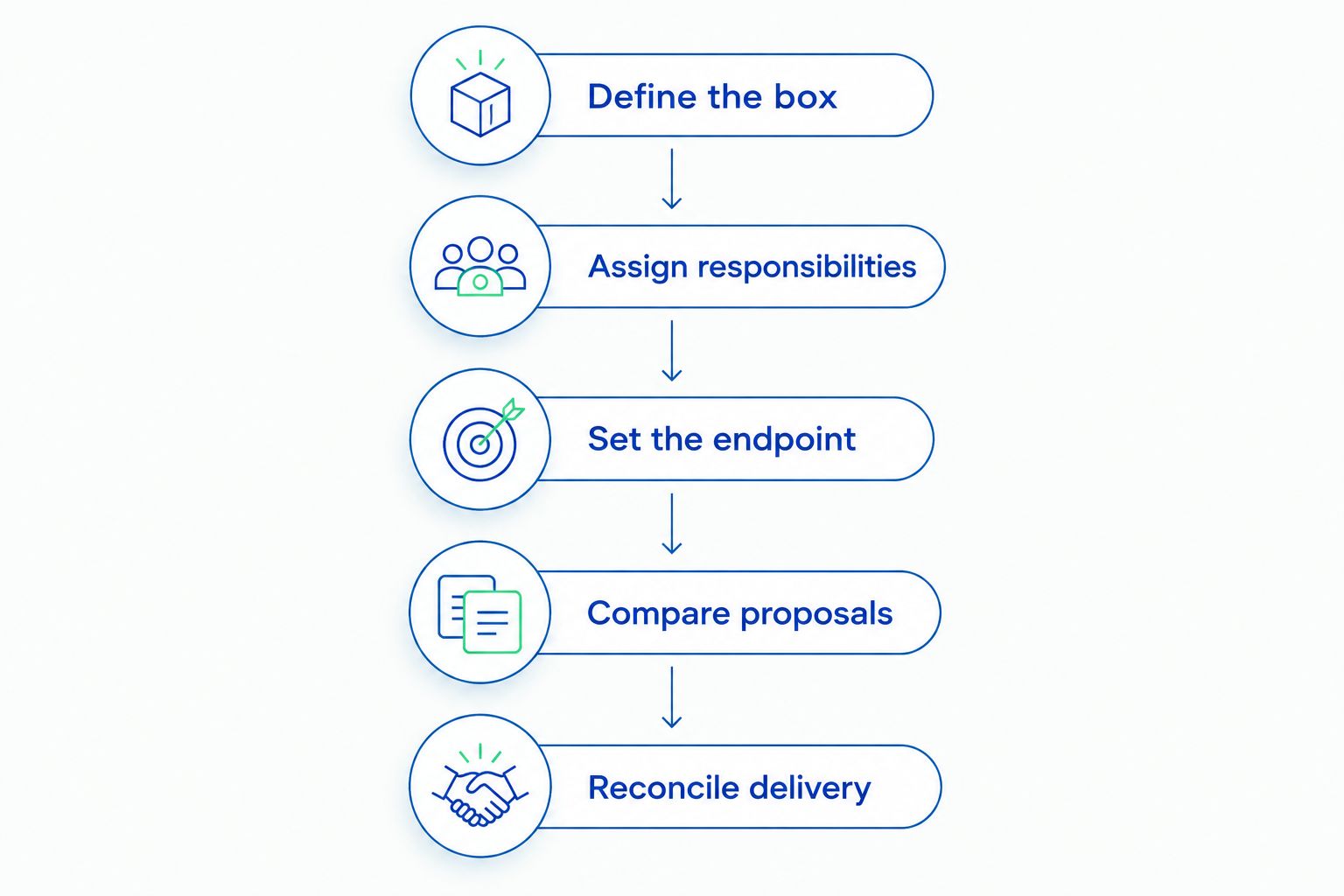
- Define the box. Document contents, quantities, packaging, intended recipients, and substitution approval. Specify whether recipients need preparation or storage instructions.
- Assign responsibilities. Identify who sources, receives, assembles, stores, transports, and distributes the food. Include the administrative tasks around those activities.
- Set the endpoint. State whether the order ends at your warehouse, a partner site, or the recipient’s household. Assign unloading and acceptance responsibilities.
- Compare proposals. Require suppliers to quote the same specification and identify exclusions. Record bundled services so your budget does not count them twice.
- Reconcile delivery. Define how your team will compare ordered, received, and distributed boxes and resolve discrepancies.
Keep the specification attached to the purchasing decision. If the contents or delivery arrangement changes, update the budget assumptions as well as the order.
For a 2026 launch, ask operations and finance to review the same document. Operations can identify unassigned work; finance can distinguish purchased services from internal expenses and donated resources.
What should a food bank request in a supplier proposal?
Request a written scope, a description of included services, and explicit exclusions. Ask for the conditions that require approval before the supplier changes the order.
Your proposal request should answer these questions:
- What food and packaging does the supplier provide?
- Who approves substitutions or revised packing instructions?
- Where does the supplier deliver, and who unloads?
- Who manages inventory before dispatch?
- What records confirm the handoff?
- Who handles damaged boxes, discrepancies, or unsuccessful delivery?
Ask Umojahealth to define its proposed emergency food box program scope against those requirements. Confirm which kitting and food-supply logistics services fit your program and which activities your team must retain.
Define your food box program scope
Start a discussion about hunger-relief kitting and food-supply logistics requirements.
Are donated food boxes free for the food bank to distribute?
Donated food removes the purchase expense for those donated items, not the work required to distribute them. Your program still needs a plan for receiving, sorting, packing, storing, and handing off the food.
Keep donated resources visible without treating them as purchased goods. That distinction helps you explain both the funding requirement and the operational support needed to complete distribution.
Is outsourcing an emergency food box program cheaper than assembling internally?
Outsourcing is not automatically cheaper than internal assembly. Compare the same contents, endpoint, and responsibilities, including the internal work that remains after contracting.
Choose the operating model by complete scope, not by the assembly line alone. A contracted service and an internal workflow are comparable only when both calculations include the required activities.
FAQ
How do I estimate an emergency food box program budget for 2026?
Estimate the program budget by adding food, packaging, assembly, storage, transportation, distribution, and administration within a defined service boundary. Use current proposals and your own operating expenses, then check for bundled services to prevent double counting.
Does a food box quote include delivery?
A food box quote includes delivery only when its written scope says so. Confirm the destination, unloading responsibility, and whether delivery ends at a warehouse, partner site, or household.
Do donated foods eliminate food box program expenses?
Donated foods eliminate the purchase expense for those donated items, not the entire distribution expense. Receiving, packing, storage, transportation, and administration still need assigned resources.
Should a food bank assemble boxes itself or use contracted kitting?
Choose internal assembly when you want direct packing control and can assign the required resources; choose contracted kitting when you want external assembly support. Compare both models using the same specification and account for retained responsibilities.
What information should I give an emergency food box supplier?
Give the supplier a written box specification, quantities, delivery endpoint, schedule, and responsibility list. Include substitution approval and the process for resolving damaged boxes or discrepancies.
Can Umojahealth support food bank kitting programs?
Umojahealth provides kitting and box programs and food-supply logistics services for food banks and other organizations. Confirm the proposed scope, responsibilities, and requirements directly before including services in your budget.
What should I measure after distributing emergency food boxes?
Reconcile ordered, received, and distributed boxes against the expenses included in your budget. Keep the service endpoint consistent when calculating and comparing expense per completed distribution.
One last thing
A box received is not necessarily a box distributed. Choose the completion event before you calculate unit expense, and use the same event in your purchasing documents, operating reports, and funder reporting.
For your 2026 program, close the budget review with a practical question: who owns each activity between food sourcing and recipient handoff? Resolve any unassigned activity before approving the operating plan.


