

The cost to outsource food bank procurement is the full cost of acquiring and receiving food under a defined service agreement, not just the procurement fee. For a 2026 decision, compare food purchasing, provider charges, transportation, handling, and the work your team retains; a sourcing-only quote does not answer what a delivered program will require.
- Evaluate the cost to outsource food bank procurement against the same food specifications, delivery requirements, and retained staff responsibilities.
- Umoja Health serves food banks through hunger-relief logistics and food-supply services; match the service scope to your program.
- Compare sourcing-only support with coordinated logistics before selecting a procurement arrangement.
- Require written exclusions, substitution approvals, and delivery responsibilities before committing.
How much does it cost to outsource food bank procurement?
Outsourced procurement requires a scope-specific quote. Compare the total delivered program cost, not an isolated service charge. Start by defining whether you need purchasing support alone or purchasing coordinated with transportation, storage, and box assembly.
Use the food bank sourcing and procurement partner guide to frame the service comparison, then request the same breakdown from every prospective partner.
| Cost component | What to request in writing | What to check separately |
|---|---|---|
| Food purchasing | Item specifications, pack sizes, quantities, and substitution rules | Whether providers are quoting equivalent food |
| Procurement service | Included purchasing tasks and the charging basis | Work your staff must still complete |
| Transportation | Delivery destinations and responsibility for arranging freight | Transfers between facilities and final distribution |
| Receiving and storage | Who receives, inspects, stores, and releases inventory | Work performed at your own warehouse |
| Kitting or box assembly | Contents, packaging, assembly, and labeling responsibilities | Whether the quote covers food alone or completed boxes |
| Administration | Ordering, reporting, invoice reconciliation, and issue resolution | Systems and records your team must maintain |
Treat each row as a contract question, not an assumption that every provider supplies that service. Ask the provider to mark each responsibility as included, excluded, or retained by your food bank. An unexplained blank is not an agreement.
Why this matters
Food bank procurement is a supply decision and an operating decision. A quote that transfers purchasing work but leaves delivery scheduling, receiving discrepancies, and inventory reconciliation with your team has a different scope from a coordinated logistics agreement.
For your 2026 budget, distinguish cash you stop spending from staff capacity you redirect. Reassigning an employee from purchase orders to partner support creates useful capacity, but it does not remove that employee's salary from the budget.
Keep mission requirements in the comparison. Specify the food your program needs, the people it serves, and the handoff points your staff can manage before evaluating the commercial proposal.
Which procurement arrangement should you compare?
Compare arrangements by the work transferred, not by the provider's description of its service. The following are purchasing models to evaluate, not claims about any particular company's contract.
| Arrangement | Best for | Main advantage | Main limitation |
|---|---|---|---|
| In-house procurement | Food banks that want to retain purchasing decisions and supplier coordination | Keeps ordering and supplier relationships under direct control | Your team retains purchasing administration and exception handling |
| Outsourced sourcing only | Food banks seeking purchasing support while retaining warehouse and distribution operations | Separates purchasing assistance from physical logistics | Your team must coordinate the handoff to receiving and distribution |
| Procurement with coordinated logistics | Food banks seeking a defined purchasing-to-delivery handoff | Allows related responsibilities to be specified together | Requires closer review of exclusions, reporting, and accountability |
Keep procurement in-house when direct control is the priority and your team can perform the work. Document that work before comparing an external proposal; otherwise, the baseline excludes responsibilities the provider is being asked to take on.
Choose sourcing-only support when purchasing is the problem you need to solve. Do not expand the agreement into warehousing or distribution unless those functions also need support.
Evaluate coordinated logistics when the purchasing-to-delivery handoff is the problem. Require responsibility for each handoff to be explicit. A broader agreement still needs a clear process for substitutions, damaged deliveries, and disputed invoices.
Sourcing-only support: define where purchasing ends
A sourcing-only request should identify who develops specifications, approaches suppliers, approves substitutions, places orders, and resolves purchasing discrepancies. Ask prospective providers to explain exactly which of those tasks they accept.
The advantage is a narrower assignment. You can assess purchasing support without changing every warehouse process at the same time.
The trade-off is coordination. Your food bank still needs a named owner for delivery appointments, receiving records, storage decisions, and release to distribution when those functions remain outside the agreement.
Before signing, trace a purchase order from request through receipt. At every step, identify the person authorized to act and the record that confirms completion. Do not treat the phrase procurement support as a substitute for that workflow.
Coordinated logistics: define the physical handoffs
A coordinated request should state which physical activities belong in the proposal: inbound transportation, receiving, storage, assembly, or delivery. Include only the activities your program actually needs.
Umoja Health is best suited to food banks seeking hunger-relief logistics and food-supply program services. Its stated services include nutrition security programs, kitting and box programs, child nutrition programs, and WIC and disaster-response support.
Explore Umoja Health when those service categories match your requirements. Confirm the proposed procurement responsibilities, reporting, and delivery scope directly rather than assuming that a program description defines the agreement.
The benefit of this service fit is relevance to hunger-relief operations. The limitation is that a service category alone does not establish your contract's boundaries; your procurement brief must still specify who purchases, who handles food, and who accepts delivery.
Why the cost to outsource food bank procurement varies
Use these scope factors to explain differences between proposals. Do not attribute a difference to efficiency until you have checked whether both proposals cover the same work.
- Food specifications: Define the required food categories, pack formats, and acceptable substitutions. Compare equivalent requirements rather than different baskets.
- Program requirements: State whether purchasing supports general hunger relief, child nutrition, WIC-related support, or disaster response. Ask bidders to identify the tasks associated with your program.
- Logistics boundaries: Identify where responsibility begins and ends, including receiving, storage, transfers, and delivery.
- Kitting requirements: Separate food purchasing from packaging, assembly, labeling, and completed-box handling when requesting a box program.
- Ordering pattern: Describe routine ordering and emergency requests separately. Require the provider to explain how each enters the workflow.
- Retained administration: Identify approvals, reporting, reconciliation, and issue resolution that remain with your staff.
For a 2026 comparison, send every bidder the same scope document and record any exceptions beside the relevant requirement. A proposal that excludes assembly should not be compared directly with one covering completed boxes.
How do you build a like-for-like comparison?
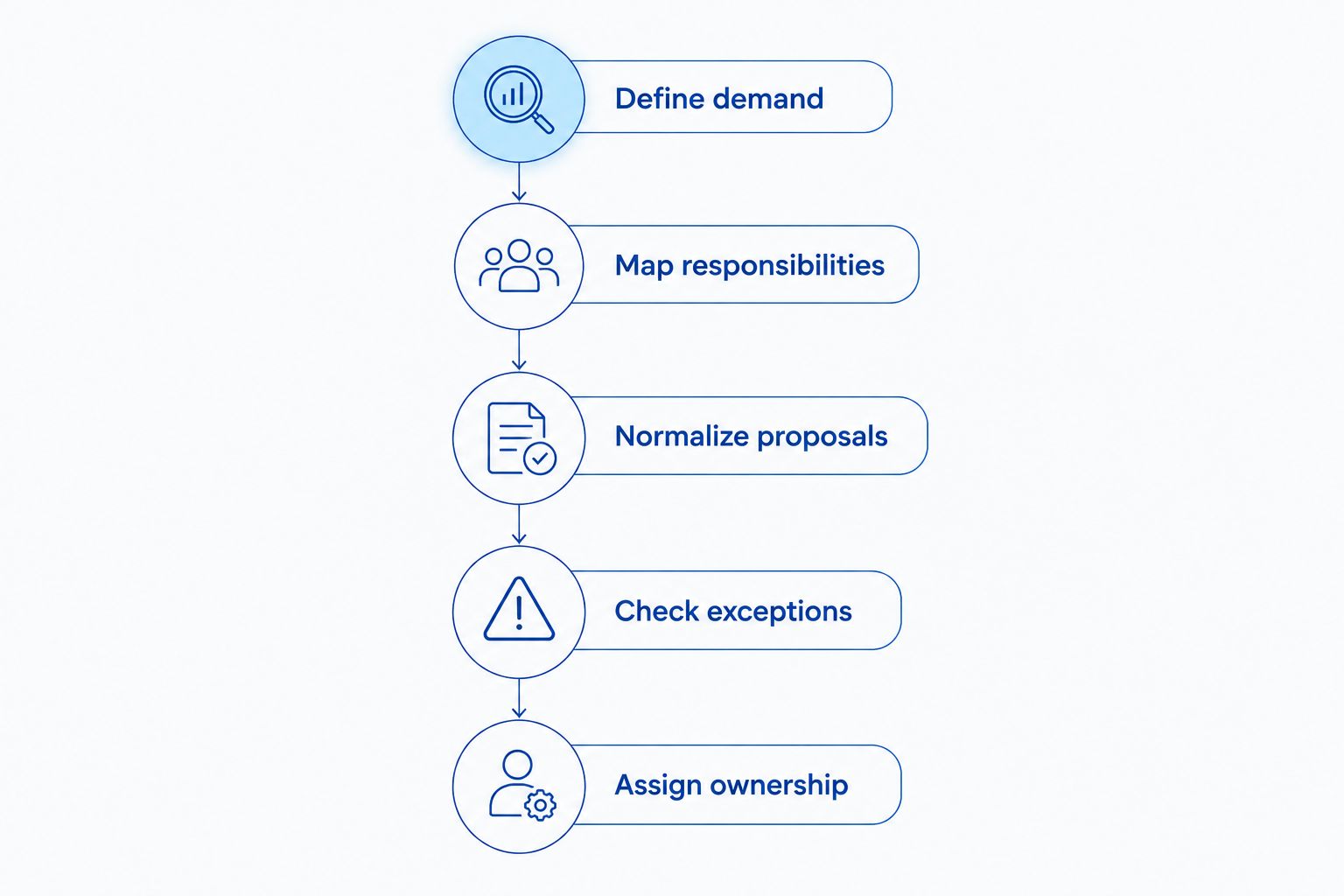
Use this sequence before asking for a final proposal. It creates a common basis for evaluating the work, without assuming a particular contracting model.
- Define demand. List the food specifications, program requirements, ordering pattern, and delivery destinations you want covered.
- Map responsibilities. Assign purchasing, transport, receiving, storage, assembly, and reporting to either your team or the proposed provider.
- Normalize proposals. Require the same units, scope, reporting period, and exclusions from each bidder.
- Check exceptions. Ask how substitutions, damaged food, incomplete orders, and delivery discrepancies will be resolved.
- Assign ownership. Name the person on each side who approves changes and closes unresolved issues.
These steps should produce a usable operating brief, not just a purchasing document. Warehouse and program staff should be able to read it and identify their responsibilities without interpreting sales language.
Use 12 months as a proposed comparison period when you need an annual operating view. Apply the same period to your internal baseline and every proposal, and distinguish routine demand from emergency-response activity.
Choose a unit that matches the service. A comparison per 1 box needs a defined box specification; a comparison per 1 pallet needs a defined pallet configuration. Neither unit is meaningful when bidders use different contents or pack arrangements.
These are comparison units, not performance targets. Keep the underlying order detail available so your team can explain what each total includes.
What should remain under your food bank's control?
Retain approval authority over food requirements, substitutions, and program commitments. Outsourcing purchasing work does not require you to hand over every decision about the food your community receives.
For 2026 planning, define an approval route for changes before orders begin. Specify who can accept a substitute, who checks that the replacement meets the program's requirements, and how the decision is recorded.
Your agreement should also make records accessible. Ask how your team will receive order confirmations, receiving discrepancies, inventory information where relevant, and invoice support. Avoid relying on a single person's inbox as the operating record.
Finally, define the end of the relationship. Ask how open orders, unresolved claims, and program records will be handed back if you change providers. That is an accountability requirement, not a prediction that the arrangement will fail.
Is outsourcing food bank procurement cheaper than doing it internally?
Outsourcing is not automatically cheaper; compare equivalent work and distinguish budget reductions from reassigned staff time. Include the internal work that remains after outsourcing, not only the work transferred to the provider.
A useful decision also considers whether the arrangement addresses your actual operating problem. If the issue is unresolved receiving discrepancies, purchasing support alone does not define a solution.
Can you outsource procurement without outsourcing warehousing?
Yes—you can request purchasing support while retaining receiving, storage, and distribution responsibilities. State those boundaries in the request and require the provider to confirm its accepted scope.
The main task is defining the handoff. Identify who schedules deliveries, receives supplier documents, reports discrepancies, and follows up when an order does not match the specification.
What should a food bank ask before accepting a proposal?
Ask what is included, what remains with your team, and who resolves exceptions. Then require the answers to appear in the agreement rather than remaining in a presentation or conversation.
Request a walk-through of an ordinary order and a problem order. The second example should explain what happens when a supplier proposes a substitute or a delivery arrives incomplete, without promising a resolution time that has not been agreed.
FAQ
How do I estimate the cost to outsource food bank procurement?
Estimate the cost to outsource food bank procurement by defining the purchasing work, physical logistics, and administration you want covered. Request an itemized proposal and add the internal responsibilities your food bank retains.
Is a procurement fee the same as the total program cost?
No. A procurement fee does not by itself establish whether food, transportation, storage, assembly, or delivery is included. Require the agreement to identify each component.
What's the best way to compare food bank procurement proposals?
Compare proposals against one written scope with matching food specifications, delivery requirements, responsibility assignments, and reporting periods. Record exclusions beside the relevant requirement.
Can our food bank keep its existing warehouse?
You can request a scope that retains your existing warehouse operations. Confirm who handles delivery appointments, receiving discrepancies, inventory records, and supplier follow-up under that arrangement.
Should we count staff time as a saving?
Count staff time as a budget reduction only when the associated spending actually ends. Otherwise, describe it as capacity redirected to other work and identify the tasks that remain.
Does Umoja Health work with food banks?
Umoja Health provides hunger-relief and food-supply logistics services for food banks and other organizations. Its stated services include nutrition security programs, kitting and box programs, child nutrition, and WIC and disaster-response support.
What should we confirm before outsourcing procurement in 2026?
Before outsourcing procurement in 2026, confirm specifications, approval authority, service boundaries, reporting, and exception handling. Put the agreed responsibilities in writing before orders begin.
One last thing
Test the handoff, not just the proposal. Before approving your 2026 agreement, ask both teams to explain the same incomplete-delivery scenario independently.
Who records the shortage? Who contacts the supplier? Who decides whether the program needs a replacement? If the answers conflict, resolve ownership before the first order. A clear exception process turns a procurement agreement into an operating plan.


