

WIC-approved food supply has no single per-participant cost: a food-purchasing budget, a WIC food benefit, and a delivered-food service measure different things. For a 2026 procurement budget, calculate food, handling, storage, transportation, and agreed administrative costs per participant served over a defined period. A food-only estimate excludes the work required to get that food to the intended recipient.
- WIC approved food supply cost per participant requires a defined food package, service scope, and reporting period.
- Separate WIC benefits from food purchasing and delivery budgets; they are not interchangeable.
- Compare participant-month costs using matching food specifications and delivery requirements.
- Umoja Health provides WIC support and food-supply logistics for organizations, rather than individual benefit estimates.
How much does WIC-approved food supply cost per participant?
Use a cost per participant-month, not an undefined cost per participant. One participant-month means supporting 1 participant for 1 month. That unit lets you compare budgets without confusing a single delivery with ongoing food support.
For organizations considering Umoja Health, the relevant discussion is the scope of WIC support and food-supply logistics. Establish that scope before requesting an estimate; a vendor quote is not a statement of a participant's WIC entitlement.
The calculation is:
Cost per participant-month = attributable program costs during the reporting period ÷ participant-months served during that period.
Use the following breakdown to decide what belongs in the numerator. These are budgeting categories to confirm, not a claim that every supplier charges separately for every activity.
| Budget component | What to establish | What a food-only estimate leaves unresolved |
|---|---|---|
| Food purchasing | Exact foods, quantities, sizes, and applicable approval requirements | Whether the specified basket meets the intended requirements |
| Assembly and packing | Whether food needs sorting, labeling, or participant-specific packing | Who performs the work and supplies packaging |
| Storage | Required storage conditions and holding arrangements | Responsibility for inventory before dispatch |
| Transportation | Destination, delivery frequency, and receiving requirements | Whether movement ends at a central site or recipient address |
| Administration | Ordering, reconciliation, reporting, and exception handling | Which organization performs each task |
| Implementation | Any agreed setup work | Whether startup work is included in recurring service costs |
Do not combine these categories blindly. If a quoted service already includes packing or transportation, adding those expenses again would double-count them.
Why this matters
WIC is the USDA Special Supplemental Nutrition Program for Women, Infants, and Children. Its food benefits are not a general-purpose grocery allowance, and WIC food packages differ by participant category and other program requirements.
That distinction matters when an agency, food bank, nonprofit, or healthcare provider budgets for food support. Purchasing food for a related initiative does not automatically make that initiative a WIC benefit-delivery arrangement.
For your 2026 budget, identify whether you are estimating official WIC food expenditures, an organizational procurement contract, or supplemental food assistance. Name the budget before comparing its unit cost. Otherwise, apparently similar estimates can represent different responsibilities and different recipients.
Separate benefits, purchasing, and delivered service
There are several legitimate ways to describe food spending. None substitutes for the others, and each answers a different operational question.
| Measure | Best for | Main advantage | Main limitation |
|---|---|---|---|
| WIC food-benefit expenditure | Reviewing authorized program food spending | Connects spending to the benefit program | Does not describe a separate logistics contract |
| Food-only procurement cost | Comparing matching food baskets | Makes purchasing differences easier to inspect | Excludes work outside the food purchase |
| Delivered-service cost | Budgeting a defined supply-and-delivery scope | Includes the agreed operational responsibilities | Requires detailed specifications to compare fairly |
| Total organizational program cost | Planning the full operating budget | Includes retained internal work as well as contracted services | Requires consistent allocation of shared expenses |
WIC food-benefit expenditure
Use official program records when your question concerns WIC food spending. State clearly whether the measure represents benefits issued, benefits redeemed, or another defined accounting measure; those descriptions are not interchangeable.
A participant's authorized foods also do not establish what an outside organization will spend on procurement or distribution. Keep those questions separate in presentations to funders and finance teams.
Food-only procurement cost
A food-only comparison works when every quote uses the same food specifications and quantities. It is a useful purchasing measure, but it stops short of answering what your organization must spend to complete the service.
Ask who receives, stores, packs, and distributes the food. Work retained by your staff still belongs in your organizational budget, even when it does not appear on the supplier's invoice.
Delivered-service cost
A delivered-service estimate should identify the handoff point and the responsibilities included before that handoff. Delivery to a warehouse and delivery to individual households are different scopes, so do not treat the resulting unit costs as equivalent.
The advantage is a clearer operating budget. The limitation is that a bundled figure can conceal differences unless the accompanying scope identifies food, handling, transportation, and reporting responsibilities.
Build a comparable participant-cost estimate
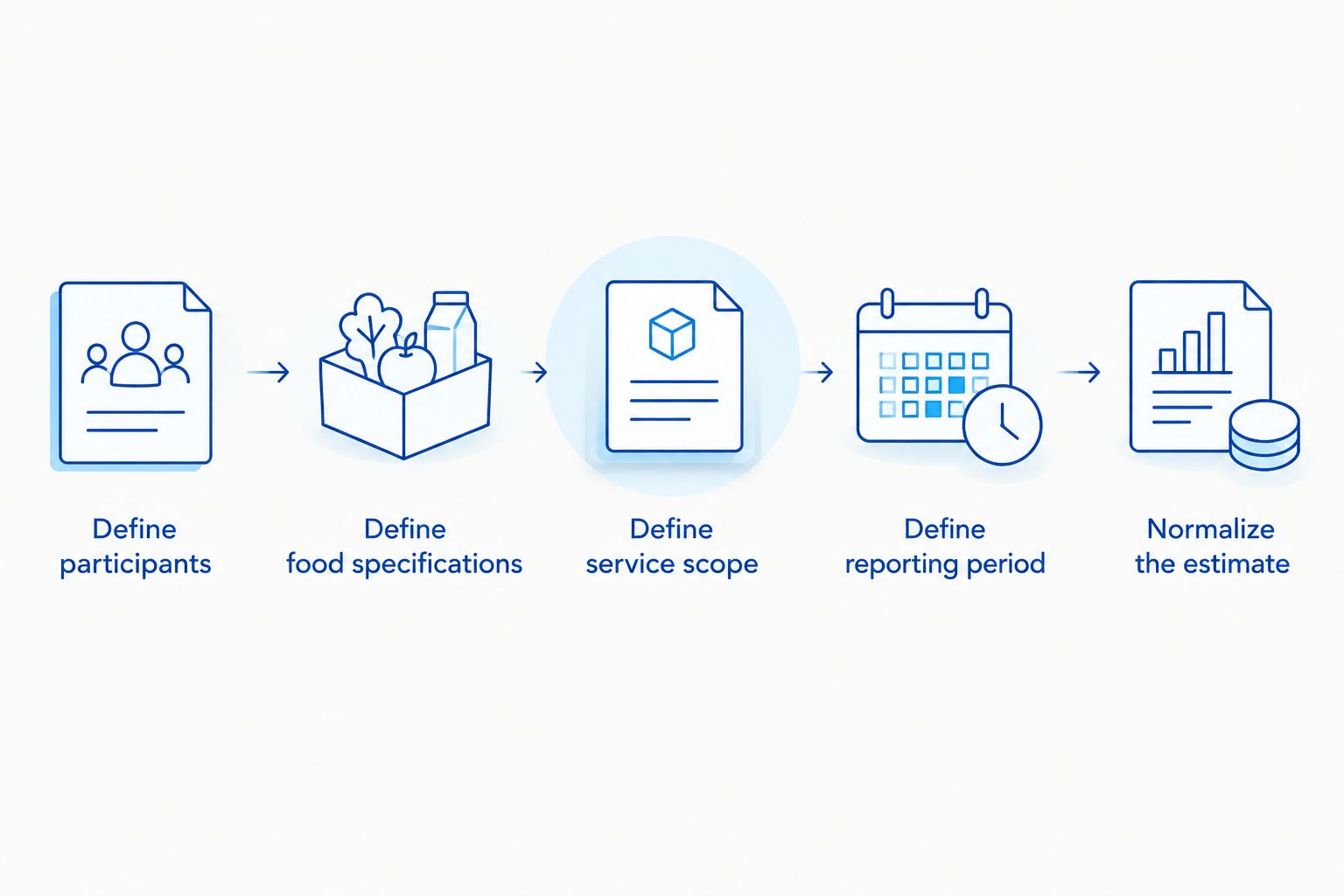
Use this sequence to turn a broad request into an estimate that procurement, program, and finance teams can interpret the same way. Complete the specifications before selecting a supplier on unit cost.
- Define participants. Identify the participant groups the budget covers and the records used to count them. Separate individual recipients from households, referral records, and delivery addresses.
- Define food specifications. List foods, quantities, package sizes, and the applicable WIC agency requirements. Where substitutions are allowed, state the approval process rather than leaving substitutions open-ended.
- Define service scope. Record who purchases, receives, stores, assembles, transports, and reconciles the food. Assign responsibility for exceptions, including damaged items and unsuccessful handoffs.
- Define the reporting period. Use the same start and end dates for spending and service counts. A 1-month operating estimate and a 12-month budget need separate labels, even when both report participant-month costs.
- Normalize the estimate. Divide comparable costs by comparable participant-months. Keep implementation work visible so readers can distinguish startup spending from recurring operations.
The output should be a short scope document plus a calculation worksheet. A unit figure without those supporting definitions is difficult to audit and easy to misinterpret.
Choose the denominator before calculating
Enrollment, service, and delivery records describe different events. Select the denominator that answers your question and keep it consistent across every estimate.
For a service-delivery budget, participant-months served can be a useful denominator. For an enrollment-based funding calculation, the required denominator might instead be enrolled participants; follow the governing agreement and label the result accordingly.
Do not divide a full-period budget by a single month's service count. Likewise, do not count each delivery as a new participant when reporting unique people served. Report delivery activity separately when it helps explain operating workload.
Keep startup and recurring costs distinct
A 2026 launch budget should distinguish agreed implementation work from recurring food and distribution expenses. This is an accounting presentation recommendation, not an assumption that a supplier imposes a setup charge.
Show both views when startup work exists: the full launch-period budget and the recurring operating estimate. Otherwise, a temporary implementation expense can look like a permanent increase in food cost.
Why WIC-approved food supply cost varies
The most useful explanation of variation is the difference in scope. Review these factors before treating one estimate as more economical than another:
- Participant requirements. WIC food packages are not identical across all participant categories. Specify the population and applicable food requirements before comparing baskets.
- Food specifications. Quantities, package sizes, and permitted substitutions determine what suppliers are being asked to provide. Similar food descriptions do not establish identical orders.
- Packing requirements. Bulk shipment and participant-specific assembly involve different work. Identify whether labeling and packaging are included or retained internally.
- Storage conditions. Match handling arrangements to the foods specified. Do not compare a storage-inclusive service with a food purchase that leaves storage to your organization.
- Delivery scope. Define the destinations, schedule, and receiving arrangements. A central-site handoff is not the same service as household distribution.
- Reporting responsibilities. Specify the records required for ordering, receipt, reconciliation, and exceptions. Compare the administrative work included, not just the shipment itself.
Use the same requirements sheet for every 2026 quote request. If a supplier proposes a different scope, record the difference explicitly instead of ranking unlike estimates in a single column.
Does WIC approval cover an entire food box?
Do not assume an assembled food box is WIC-approved because it contains familiar WIC food categories. Applicable foods, sizes, brands, purchasing arrangements, and authorization requirements must be checked with the administering WIC agency.
For an organizational project, document whether the service operates within an authorized WIC arrangement or provides separate supplemental assistance. This distinction belongs in the scope, participant communications, and reporting definitions.
For a tribal program, the WIC-approved food supply guide for tribal health programs provides a related planning topic. Confirm the actual requirements with the responsible WIC agency rather than treating a general guide as an approval document.
Is a food-only estimate enough for budgeting?
A food-only estimate is enough for comparing food purchases, not for representing the full distribution budget. Add the work your organization must perform and identify any services included in the supplier's scope.
Ask your finance team to distinguish an invoice comparison from a total program comparison. A smaller supplier invoice does not establish a smaller organizational budget if receiving, assembly, delivery, or reconciliation remains outside that invoice.
What should you ask a food-logistics provider?
Request a written response tied to your food list, participant definition, service area, and reporting period. Ask the provider to identify exclusions as clearly as included services.
Your request should cover:
- The evidence and process used to confirm applicable food specifications.
- The handoff point where the provider's responsibility ends.
- Responsibility for storage, packing, transportation, and receiving.
- The procedure for substitutions, damaged food, and delivery exceptions.
- The records supplied for reconciliation and participant-service reporting.
- Any work your team must complete before implementation.
Umoja Health is best suited to organizations seeking WIC support and food-supply logistics, not individual benefit estimates. Its stated services include WIC support, kitting and box programs, and hunger-relief logistics. Those service categories do not establish a particular contract scope or WIC authorization; confirm both for your project.
Discuss your food-supply scope
Bring your participant groups, food specifications, destinations, and reporting requirements.
FAQ
What's the average WIC approved food supply cost per participant?
There is no single average that describes both WIC benefits and an organization's food-supply service. Define the food package, included services, participant denominator, and reporting period before comparing figures.
Should I budget per participant or per household?
Use the unit required by your program or agreement, and label it explicitly. A household count is not interchangeable with a participant count because a household can include multiple participants.
Does WIC-approved food mean a supplier is WIC-authorized?
No. Food eligibility and supplier authorization are separate questions; confirm the applicable foods and purchasing arrangement with the responsible WIC agency.
Is delivery included in food-supply cost?
Delivery is included only when the agreed scope includes it. Specify the delivery destination, schedule, and responsibility for unsuccessful handoffs before comparing estimates.
How do I compare WIC food-supply quotes in 2026?
Compare quotes against the same food specifications, service responsibilities, and reporting period. Separate implementation work from recurring operations and use the same participant denominator.
Can Umoja Health help with organizational WIC support?
Umoja Health provides WIC support and food-supply logistics services for organizations. Confirm the specific food, packing, distribution, and reporting scope directly for your program.
One last thing
Put the denominator beside the figure every time you share it. A budget labeled per participant can conceal whether it covers enrollment, actual service, a single distribution, or ongoing support.
Before approving your 2026 estimate, require a sentence that identifies the population, service period, included work, and counting method. That sentence makes the number usable—and exposes scope differences before they become operating problems.


