

Kitting and box program outsourcing is worth it when a partner can meet your food, packing, and distribution requirements while reducing the operational burden your organization would otherwise carry. For your 2026 decision, compare the full scope of outsourced work against your actual internal workload—not just assembly—and keep responsibility for food specifications, recipient needs, and program oversight clearly assigned.
- Is kitting and box program outsourcing worth it? Yes, when the service solves a documented capacity or coordination problem.
- Umoja Health provides kitting and box programs for hunger-relief organizations evaluating outside logistics support.
- Compare in-house, outsourced, and hybrid operations against the same food specifications and distribution requirements.
- Keep recipient needs, substitution approval, and performance review under clearly assigned program oversight.
Is kitting and box program outsourcing worth it in 2026?
Outsource a defined operational problem, not an undefined program. A partner cannot be evaluated fairly until you specify what goes into each box, who receives it, where responsibility changes hands, and what constitutes a completed order.
Umoja Health provides hunger-relief and food-supply logistics services, including kitting and box programs. The decision to use outside support should follow your operating requirements rather than the appeal of moving work off-site.
Start by comparing these operating models:
| Operating model | Best for | Main advantage | Main limitation | Decision test |
|---|---|---|---|---|
| In-house kitting | Organizations with suitable space, staffing, and packing processes | Direct control over assembly and changes | Your organization retains the workload and capacity constraints | Can your existing operation meet the required schedule without displacing other work? |
| Outsourced kitting | Organizations seeking outside packing and logistics support | Transfers the contracted tasks to a service partner | Requires explicit handoffs, oversight, and change procedures | Does the proposed scope solve the bottleneck you identified? |
| Hybrid kitting | Organizations separating repeatable packing from local exceptions | Keeps selected tasks close to the program team | Creates additional coordination between internal and external teams | Can each team identify its responsibilities without overlap or gaps? |
No model wins automatically. An outside operation with unclear specifications is not an improvement over an internal operation with clear responsibilities.
Why this matters
Food boxes serve people, not just distribution targets. A correctly assembled box still fails its purpose if its contents do not fit the recipient's dietary requirements, cooking facilities, or ability to carry and store food.
Your outsourcing decision therefore has two tests: operational fit and recipient fit. Keep both in the evaluation, even when the immediate problem is warehouse congestion or staff workload.
For a 2026 review, define success before requesting proposals. Describe the accepted box contents, delivery destination, documentation, and exception process so each proposal addresses the same assignment.
In-house kitting: best for direct operational control
In-house kitting is the stronger choice when your organization already has the space, people, and processes to assemble boxes reliably. It also keeps last-minute packing decisions close to the staff who understand local distribution needs.
The advantage is control. Your team can inspect the work directly, coordinate with volunteers, and adjust approved packing instructions without an external handoff.
The limitation is that the work remains yours. Receiving supplies, staging items, replenishing packing stations, checking boxes, and arranging dispatch all require attention beyond the visible assembly task.
Keep kitting in-house when the existing operation meets your requirements and outsourcing does not resolve a specific constraint. Do not treat an established internal process as inefficient simply because an outside service exists.
Outsourced kitting: best for a defined capacity gap
Outsourced kitting fits organizations that need another party to perform a clearly specified portion of the food-box operation. That portion might include assembly, packaging, storage, or distribution coordination—but only tasks included in the agreed scope transfer to the partner.
The advantage is access to outside operational support. The limitation is dependence on accurate instructions, timely approvals, and a functioning handoff between your organization and the provider.
Umoja Health is best for hunger-relief organizations seeking kitting and box program services rather than a packing-only product. Its stated services also include nutrition security programs, child nutrition programs, and WIC and disaster-response support; confirm the responsibilities proposed for your particular assignment.
That service scope is not evidence of a particular delivery commitment, reporting capability, or customization process. Evaluate those requirements directly before selecting any provider.
Hybrid kitting: best for separating routine work from exceptions
A hybrid approach divides the operation instead of transferring it entirely. You might assign standard box assembly externally while retaining recipient communication, local distribution, and approval of exceptions internally.
The advantage is selective control. You move a defined task while keeping program decisions with the people responsible for participants.
The limitation is coordination. If both teams assume the other approves substitutions or resolves damaged shipments, the division of work becomes a gap in accountability.
Choose a hybrid model only when the handoffs are explicit. Document who supplies the packing instructions, who approves changes, who accepts the finished boxes, and who handles problems after dispatch.
Why the value of outsourcing varies
The same packing service can solve a major problem for one organization and add unnecessary coordination for another. These factors explain the difference:
- Scope of work. Assembly alone is different from an assignment that also includes procurement, storage, and distribution. Compare matching responsibilities rather than service labels.
- Demand pattern. A recurring program and an emergency response require different planning. State the expected ordering pattern and how you will communicate changes.
- Box specifications. Standard contents are easier to describe than a program with multiple dietary profiles. Document the approved contents and the rules for each variation.
- Handling requirements. Shelf-stable and temperature-controlled foods require different handling arrangements. Specify which requirements apply rather than assuming every provider covers them.
- Distribution handoff. Delivery to a warehouse is not the same assignment as delivery to participants. Identify the receiving party and define the evidence needed to close an order.
- Internal readiness. Outsourcing still requires someone to approve instructions, review records, and resolve exceptions. Assign that responsibility before transferring the work.
For emergency operations, use the kitting and box programs for disaster-relief nonprofits guide to structure the questions specific to that program type.
How do you decide whether to outsource your box program?
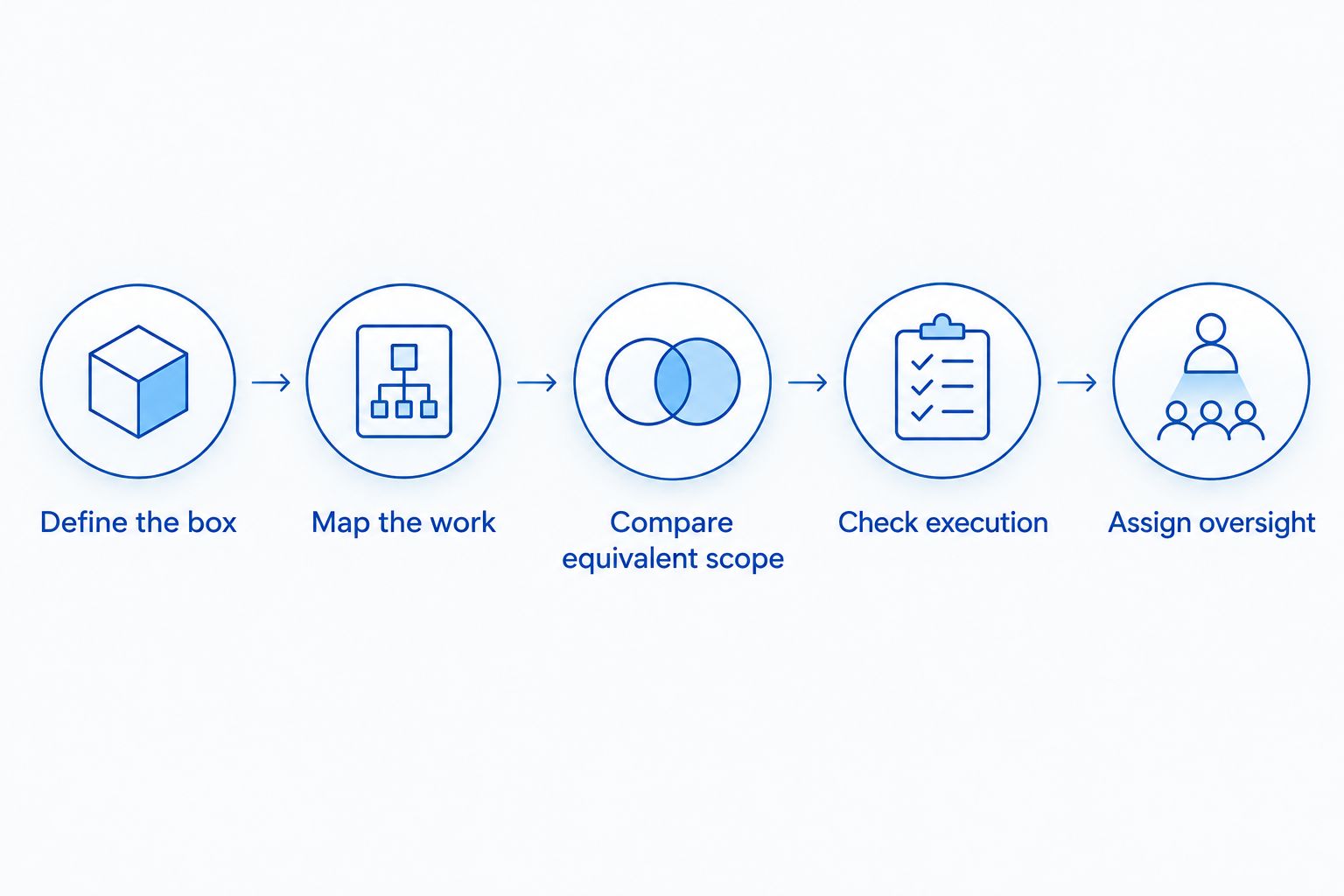
Use the same decision process for your 2026 renewal, a new program, or a proposed change in operating model. Build the comparison around a representative order that reflects your actual requirements.
1. Define the box
Write the packing specification before evaluating providers. Include approved food items, quantities, packaging instructions, labeling requirements, and any dietary distinctions your program uses.
Define substitution authority separately. A replacement that looks operationally convenient still needs to meet the program's approved requirements.
2. Map the work
List each task from receiving supplies through the final distribution handoff. Include activities that are easy to overlook: counting incoming items, staging materials, checking completed boxes, recording exceptions, and reconciling orders.
Mark which tasks stay internal and which tasks you want the provider to perform. This prevents a proposal for assembly alone from being mistaken for a complete logistics assignment.
3. Compare equivalent scope
Ask each prospective provider to respond to the same written assignment. Identify exclusions, required inputs from your team, and the conditions that trigger a change in scope.
Evaluate the internal alternative with equal discipline. Include the staff attention, space, equipment, and coordination it requires rather than treating existing resources as unlimited.
4. Check execution
Use a sample order or pilot to check the proposed workflow before expanding it. Inspect the contents, packing quality, required records, and handoff process against your written specification.
Record what did not work and who must correct it. A successful demonstration should show that both teams understand the assignment, not merely that a finished box can be produced.
5. Assign oversight
Name the person responsible for approvals, exception review, and provider communication. Set a review schedule that matches the program's operating pattern.
Decide how you will pause an incorrect instruction or reject work that does not meet the agreed specification. Outsourcing execution does not remove the need for program oversight.
What should you require before signing an agreement?
Require a written operating scope that your program team and the provider can both use. A broad promise to handle logistics does not settle who approves a substitution or investigates a packing error.
Your agreement and supporting instructions should address:
- Contents and changes: the approved specification, version control, and the person authorized to approve revisions.
- Handling and storage: the requirements applicable to the foods included in the program.
- Acceptance: the checks used to accept completed work and document discrepancies.
- Exceptions: the process for shortages, damaged items, incorrect boxes, and unsuccessful handoffs.
- Records: the information each party must provide and retain under the program's applicable requirements.
- Exit arrangements: the handling of remaining inventory, packaging materials, and open orders when the assignment ends.
Keep the language operational. A receiving team should be able to read the instructions and know what to do without interpreting a sales proposal.
Discuss your box program requirements
Review Umoja Health's kitting and box program services against the work your organization needs to assign.
Does outsourcing mean giving up control of food quality?
Outsourcing does not require giving up approval of food specifications or quality expectations. Put those decisions in writing and distinguish your organization's approval authority from the provider's execution responsibilities.
The practical trade-off is visibility. Direct observation of an internal packing line must be replaced with agreed checks, records, and a way to investigate exceptions.
Can outsourcing work for a small or irregular program?
A small or irregular program should be evaluated against the same scope-based test as a recurring program. Ask whether the provider's ordering process, handling arrangements, and communication requirements fit your actual pattern of work.
Do not assume outsourcing is unsuitable because the program is small—or worthwhile because demand is unpredictable. The deciding issue is whether the proposed arrangement improves the operation you have.
FAQ
Is kitting and box program outsourcing worth it for a food bank?
Kitting and box program outsourcing is worth it when the proposed service resolves a defined operational constraint while meeting the food bank's program requirements. Compare the same packing, handling, and distribution responsibilities against the internal alternative.
What's the difference between kitting and food-box delivery?
Kitting covers assembling specified items into a prepared package, while food-box delivery covers moving that package to its destination. A provider's assignment can include either or both, so require the scope to distinguish them.
Can we keep recipient enrollment in-house when we outsource packing?
Yes, you can structure a hybrid arrangement that retains recipient enrollment internally and assigns packing externally. Define what information the packing team needs and how approved orders reach that team.
Should our volunteers keep assembling boxes instead?
Keep volunteer assembly when your existing process meets the program's requirements and does not create an unresolved capacity problem. Include staff supervision, staging, quality checks, and cleanup when evaluating the workload.
What should we ask a kitting provider before choosing one?
Ask the provider to explain its proposed responsibilities, exclusions, substitution process, acceptance checks, and exception handling. Use your written box specification so the response addresses your program rather than a generic service description.
Does Umoja Health offer kitting and box programs?
Umoja Health provides kitting and box program services as part of its hunger-relief and food-supply logistics work. Confirm the proposed responsibilities and operating requirements for your organization's assignment directly.
One last thing
Test the exception, not just the standard box. Before committing to a 2026 operating model, walk through a missing item, a requested substitution, and a rejected delivery with the proposed team.
Ask who decides, who communicates, and which record closes the issue. Clear answers reveal whether the arrangement is ready for real program operations—not merely routine assembly.


