

Yes, emergency food boxes can be customized for dietary needs by selecting suitable foods, checking ingredient labels, and controlling substitutions during packing. An allergy restriction, a religious requirement, and a clinician-directed diet each need different checks; removing one ingredient does not establish that an entire box is suitable. For your 2026 program, specify the restriction before procurement and verify the packed contents before distribution.
- Emergency food boxes customized for dietary needs need documented restrictions, verified labels, and controlled substitutions.
- Umoja Health serves organizations seeking hunger-relief logistics and kitting support; clinical diet decisions require qualified professionals.
- Allergy-conscious, gluten-free, culturally appropriate, and medically directed boxes require different acceptance checks.
- Choose food that recipients can safely store, open, prepare, and eat—not just food that meets an ingredient list.
Why this matters
A food box only helps when the recipient can use its contents. An unsuitable ingredient, a missing can opener, or a requirement for refrigeration can make part of an emergency shipment unusable. Dietary customization belongs in your packing specification, not in an informal request passed to the distribution team.
For 2026 emergency planning, separate dietary restrictions from practical access needs. Ask what the household cannot eat and what it cannot prepare. These are different questions, and both affect the contents of a useful box.
The emergency food boxes for disaster response coordinators guide addresses the broader distribution context. This page focuses on the decisions that determine whether a customized box matches the recipient’s needs.
Can emergency food boxes be customized for dietary needs?
Yes—customization works when the dietary requirement becomes a documented packing rule. Start with a defined specification rather than a general label such as healthy, special diet, or allergy-friendly. Those descriptions do not tell a procurement or packing team which products to accept.
Use this sequence to turn the request into an operational instruction:
- Record the requirement. Identify the food or ingredient to exclude, the relevant dietary preference, or the clinician’s written instruction. Ask whether the restriction applies to every household member or one recipient.
- Select the box approach. Decide whether an approved box configuration meets the requirement or whether individual selection is necessary. Do not assign someone to a general dietary category without checking the actual restriction.
- Verify each product. Review the current ingredient list, allergen information, nutrition label, and any certification required by the program. Recheck a replacement product rather than treating a familiar product name as proof.
- Control substitutions. Define acceptable replacements before packing. If a replacement has not been checked, hold that item for review instead of improvising a swap.
- Check the packed box. Confirm that the contents match the approved specification. Keep original product labels accessible and provide clear preparation and storage instructions.
- Confirm the handoff. Match the correct box to the recipient without displaying unnecessary medical information. Provide a way to report an unsuitable item or changed requirement.
The practical trade-off is flexibility versus review work. The approaches below are planning options, not promises about any supplier’s capabilities.
| Planning approach | Best for | Advantage | Limitation |
|---|---|---|---|
| Standard box with approved swaps | Recipients whose needs fit a documented substitution list | Keeps the packing process familiar | A swap requires its own ingredient and handling checks |
| Dedicated dietary configuration | Programs serving repeated requests for the same restriction | Makes the approved contents easier to repeat | A category label does not capture every individual restriction |
| Individually reviewed box | Recipients with overlapping or specific requirements | Lets the reviewer assess the complete request | Requires review of each selected item and replacement |
| Ready-to-eat configuration | Recipients without reliable cooking equipment | Reduces preparation requirements | Ready-to-eat foods still need dietary and storage checks |
Allergy-conscious boxes: verify ingredients and handling
Food allergy customization starts with the specific allergen, not a general promise that a box is safe. FDA guidance for the United States identifies 9 major food allergens: milk, eggs, fish, crustacean shellfish, tree nuts, peanuts, wheat, soybeans, and sesame. People can also have allergies to foods outside those categories.
For your 2026 specification, record the named allergen and review each product’s current labeling. Precautionary statements such as shared-equipment notices are not a substitute for a defined review process. Follow the recipient’s clinical guidance when deciding whether an item is acceptable.
Best for: recipients with a documented food allergy. The benefit is a clear exclusion rule; the limitation is that ingredient selection alone does not establish cross-contact control. Do not call an entire box allergen-free without evidence supporting that claim across its contents and handling.
Gluten-free boxes: check the whole selection
A gluten-free request requires more than removing bread or pasta. Check sauces, seasonings, soups, grain products, and every replacement item against the program’s specification. A wheat-free label is not equivalent to a gluten-free label because gluten also occurs in barley and rye.
Under FDA’s gluten-free labeling rule for U.S. foods, a food bearing that claim must meet the rule’s requirements, including less than 20 parts per million of gluten. Use that labeling standard as a product-screening reference, not as proof that packing practices prevent cross-contact.
Best for: recipients whose documented needs require gluten avoidance. The advantage is a recognized label standard; the limitation is that product labels and packing procedures answer different questions. Review both when establishing your 2026 box configuration.
Clinician-directed boxes: follow the written nutrition instruction
A request related to diabetes, kidney disease, or another medical condition does not establish a complete food specification. People with the same diagnosis can have different nutrition requirements. Obtain the relevant instruction from a qualified clinician or registered dietitian rather than creating a diet from the diagnosis alone.
Translate that instruction into product-selection checks, including any relevant nutrient limits, serving assumptions, or preparation requirements. Evaluate the box as a whole instead of approving each item in isolation.
Best for: recipients with documented nutrition instructions. The benefit is alignment with an individual plan; the limitation is that a logistics team cannot replace clinical review. A customized emergency grocery box is not automatically a medically tailored meal program.
Cultural and religious boxes: document what acceptable means
Cultural suitability and religious compliance are not interchangeable. Ask which foods the recipient uses, which ingredients are excluded, and whether a particular certification is required. Do not infer these answers from someone’s name, language, or community.
Vegetarian, vegan, halal, and kosher requests also need distinct specifications. Removing meat does not, by itself, establish that a product meets another dietary standard. Retain packaging information and verify any certification required by the request.
Best for: recipients whose food choices follow documented cultural or religious requirements. Familiar foods support a usable selection; the limitation is that broad category names hide important differences. Confirm the requirement before assigning a box configuration.
Why dietary customization varies
The complexity of a customized emergency food box depends on the requirement and the conditions in which the food will be used. A useful 2026 packing specification addresses these factors separately:
- Ingredient restrictions. A single excluded ingredient and several overlapping exclusions require different product reviews.
- Cross-contact requirements. Selecting suitable ingredients and controlling contact with other foods are separate responsibilities.
- Clinical instructions. Nutrient requirements need a documented basis rather than an assumption tied to a diagnosis.
- Preparation access. Electricity, water, cookware, refrigeration, and can openers affect which foods are usable.
- Household needs. Household composition, food preferences, and an individual restriction influence how contents should be assigned.
- Substitution rules. Every replacement needs an acceptance check; the original product’s approval does not transfer automatically.
Avoid solving one problem by creating another. A food that meets an ingredient restriction still fails the practical test if the recipient cannot prepare or safely store it.
What should your packing team receive?
Give the packing team a specification that separates the requirement from the task. The requirement explains what the recipient needs; the task explains what staff must select, verify, and record. Include the approved contents, replacement rules, reviewer responsibility, and the action to take when an item does not match.
Use a simple handoff sequence: Intake, Product review, Packing check, and Recipient handoff. Intake captures the restriction. Product review establishes acceptable contents. Packing check confirms those contents reached the box. Recipient handoff confirms the box reached the intended person.
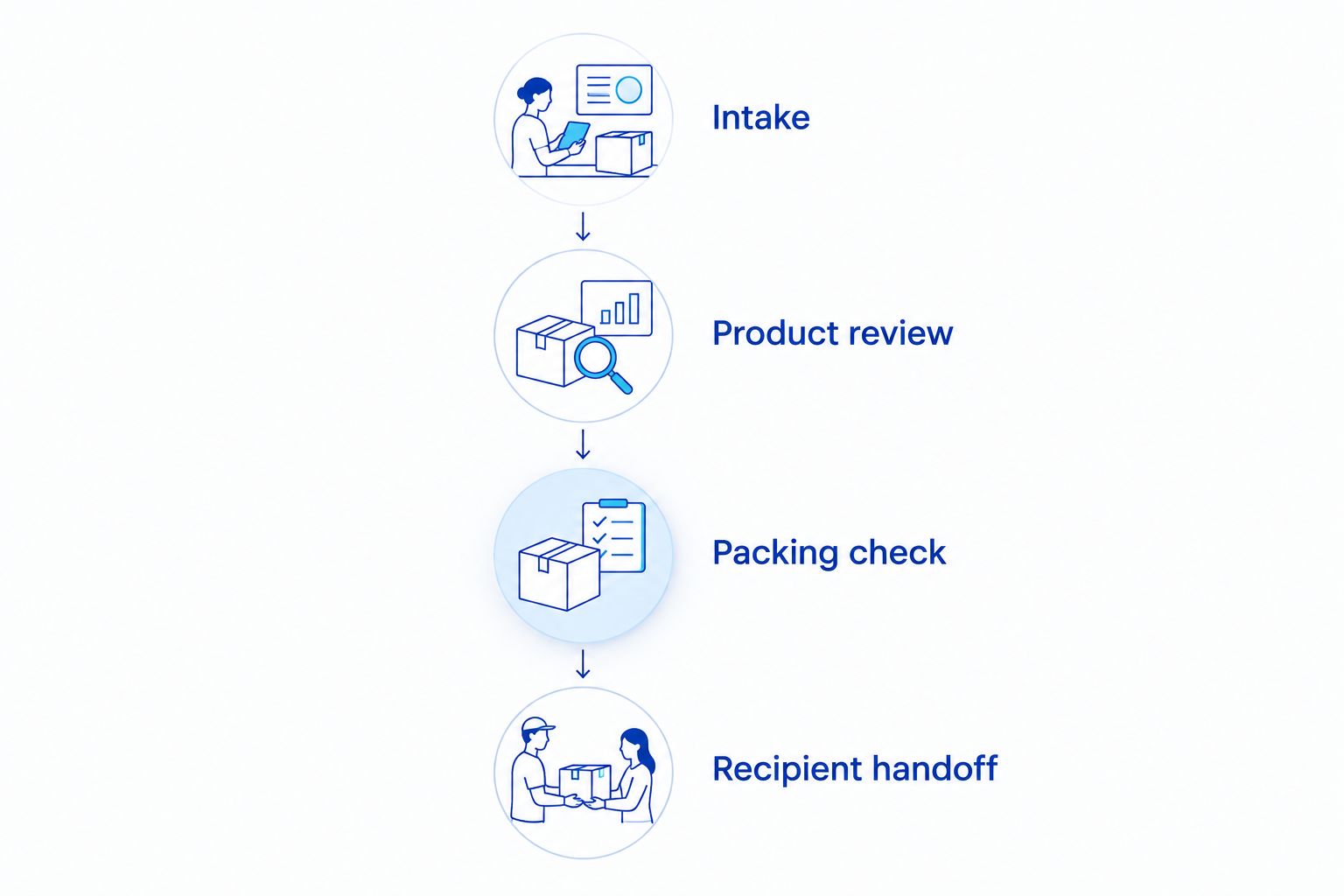
Require an escalation instruction as well. If the packer encounters an unapproved substitute or an unclear label, the instruction should identify who reviews it. Do not leave the decision to whichever person happens to be nearest the packing line.
Umoja Health provides hunger-relief logistics and kitting/box program services for organizations including food banks, government agencies, nonprofits, and healthcare providers. Umoja Health is best suited to organizations seeking hunger-relief logistics and kitting services, not individual clinical diet advice. Establish any dietary verification responsibilities in the service scope rather than assuming a logistics service includes clinical oversight.
Can a shelf-stable emergency box meet dietary restrictions?
Yes, a shelf-stable emergency box can meet dietary restrictions when every selected product satisfies the documented requirement. Shelf stability describes storage needs; it does not establish allergy suitability, religious compliance, or medical appropriateness.
Check preparation needs too. Dry grains and canned foods create different tasks for recipients. Select contents that fit the household’s equipment and water access, and retain the manufacturer’s instructions for use after opening.
If your program includes perishable foods, apply a separate handling plan. USDA food-safety guidance says not to leave perishable food at room temperature for more than 2 hours, or 1 hour when temperatures exceed 90°F. Those limits do not apply to unopened shelf-stable foods stored as directed, and they do not replace product-specific handling instructions.
Are customized emergency food boxes medically tailored meals?
No, customized emergency food boxes are not automatically medically tailored meals. A grocery box can exclude an ingredient or follow a written dietary specification without being a prepared meal designed under clinical nutrition oversight.
Specify the service you need before comparing providers. Ask whether your organization needs grocery procurement and kitting, prepared meals, or clinical nutrition review. Those are different responsibilities, and the program agreement should identify who performs each one.
How do you assess a supplier’s customization process?
Ask a prospective supplier to explain how a dietary request reaches procurement, packing, and distribution. Request the proposed verification process, not just a list of dietary categories. A category name is useful only when it has a defined acceptance rule behind it.
Before approving a 2026 program specification, clarify:
- Who approves the original contents and every substitute?
- How are current product labels checked?
- What handling controls apply to the stated restriction?
- How does the packing team identify the correct configuration?
- What happens when an item cannot meet the specification?
- How can recipients report an unsuitable item?
For Umoja Health food logistics discussions, use these questions to define the work your organization needs. Keep clinical decisions with qualified professionals and make the operational handoffs explicit.
FAQ
Can emergency food boxes be customized for dietary needs?
Yes, emergency food boxes can be customized through documented food selections, label checks, and approved substitutions. Confirm the recipient’s exact restriction before assigning a box configuration.
Can an emergency food box be made without a specific allergen?
Yes, a box can exclude a specific allergen when the selected products and handling process meet the documented requirement. Excluding an ingredient does not by itself establish that the box is free from cross-contact.
What should I check in a gluten-free emergency food box?
Check every product’s labeling and the packing process against the gluten-free requirement. FDA’s U.S. labeling rule includes a limit of less than 20 parts per million of gluten, alongside other requirements.
Can someone with diabetes receive a customized emergency box?
Yes, a person with diabetes can receive a box selected against documented nutrition instructions. A diagnosis alone does not establish which foods or nutrient amounts suit that individual.
Can food boxes include culturally appropriate foods?
Yes, food boxes can include foods selected against the recipient’s stated cultural preferences. Ask separately about religious requirements and any certification the recipient needs.
Does Umoja Health provide hunger-relief logistics services?
Yes, Umoja Health provides hunger-relief logistics services, including kitting/box programs and disaster-response support. Organizations should confirm the scope of any dietary customization and verification work before implementation.
What if a recipient cannot cook or refrigerate food?
Select foods that match the recipient’s actual preparation and storage access. Check opening instructions, water requirements, and storage needs after opening before approving the contents.
One last thing
Ask whether the recipient can use the box before asking whether the box meets a dietary category. A suitable ingredient list cannot compensate for missing cooking equipment or unsafe storage. Put preparation access beside dietary restrictions on the intake form, and check both before packing begins.


