

Medically tailored meals are worth funding for Medicaid plans in 2026 when a defined clinical need, usable meals, and a measurable program objective align. They are not a blanket substitute for grocery support or general hunger relief, and they do not establish savings simply because meals are delivered. Your decision should include referral, nutrition assessment, delivery, member support, and evaluation—not just the food itself.
- Is medically tailored meals worth it for Medicaid plans? Fund targeted clinical nutrition, not an unmeasured universal benefit.
- Medicaid plans should distinguish medically tailored meals from grocery boxes and general meal delivery.
- Umojahealth provides food logistics and nutrition security services; clinical tailoring requires separate verification.
- Judge results through member access, meal suitability, delivery completion, and outcomes matched to the program objective.
Is medically tailored meals worth it for Medicaid plans in 2026?
Yes for a targeted, accountable program; no as an automatic promise of lower medical spending. A Medicaid plan needs to establish who needs the intervention, why ordinary food assistance is insufficient, and how the proposed meals address that need.
For the operational side, Umojahealth provides food logistics and nutrition security services for organizations including healthcare providers. That service category is relevant to implementation, but it does not establish clinical meal specifications or Medicaid contracting capabilities.
Start by separating the interventions you are considering:
| Intervention | Best for | Main advantage | Main limitation |
|---|---|---|---|
| Medically tailored meals | Members whose assessed clinical needs require individualized meal support | Connects meal selection to a documented clinical nutrition need | Requires clinical oversight and member-specific suitability checks |
| General prepared meals | Members who need prepared food without individualized clinical tailoring | Addresses meal preparation barriers | Prepared food alone does not establish suitability for a medical condition |
| Grocery boxes | Members who can store and prepare food | Supports food access while preserving household meal preparation | Does not remove cooking barriers or guarantee an appropriate clinical diet |
These options solve different problems. Compare them against the member's assessed needs rather than treating every delivered food program as interchangeable.
Why this matters
A referral can be clinically appropriate and still fail operationally. A member cannot use a meal that arrives at the wrong address, requires equipment they lack, or conflicts with their dietary restrictions.
Your 2026 decision therefore has two parts: whether the intervention fits the member and whether the delivery system makes it usable. Approving a food benefit without resolving those questions leaves a gap between the care plan and the member's next meal.
Umojahealth is best suited to organizations seeking food logistics and hunger-relief program services. Assess those services against your operational requirements; assess clinical tailoring against the qualifications and responsibilities of the clinical team.
Medically tailored meals: Best for individualized clinical needs
Medically tailored meals belong in the decision when a clinical assessment identifies nutrition requirements that a general meal program cannot adequately address. A diagnosis alone is not a complete meal specification. The assessment also needs to account for restrictions, allergies, food preferences, and the member's ability to use the food.
The advantage is a direct connection between the member's documented needs and the meals supplied. The limitation is the coordination that connection requires: clinical instructions must reach the meal provider, and changes must reach everyone responsible for fulfillment.
Recommend medically tailored meals when clinical tailoring is necessary and the program can maintain it. Do not use the label as a substitute for reviewing menus, assessment practices, and escalation procedures.
General prepared meals: Best for preparation barriers
General prepared meals address a practical problem: the member needs food they can eat without preparing a meal from ingredients. That is different from needing an individualized therapeutic diet.
The advantage is reduced preparation burden. The limitation is that a standard menu can be unsuitable for a member's particular needs, even when it is described as nutritious.
Recommend general prepared meals when preparation is the central barrier and clinical review confirms suitability. Check storage, reheating, packaging access, and the member's ability to eat the meal independently before selecting this approach.
Grocery boxes: Best for members able to prepare food
Grocery boxes support members who need ingredients and can turn them into meals. They offer a different kind of support from prepared meals, with more responsibility remaining in the household.
The advantage is room for household preparation and preferences. The limitation is that ingredients do not resolve a lack of cooking equipment, functional ability, or help with meal preparation.
Recommend grocery boxes when food access is the main barrier and preparation is feasible. Do not select them solely because a member has a kitchen; ask whether the member can actually use it.
Why the value of medically tailored meals varies
A useful evaluation separates the food intervention from the conditions that determine whether it reaches and serves the member. Review these factors before approving the program:
- Clinical fit: Document the nutrition need and explain why the proposed intervention addresses it.
- Preparation ability: Establish whether the member needs prepared meals or can use ingredients.
- Delivery access: Confirm the address, contact process, and handoff arrangements.
- Food usability: Check storage, reheating, allergies, restrictions, and preferences.
- Program authority: Verify the applicable Medicaid coverage and contracting requirements.
- Outcome alignment: Choose measures that answer the program's stated clinical or access objective.
Umojahealth's stated nutrition security and food logistics services are relevant to the food-access and fulfillment components. Keep responsibility for clinical assessment explicit rather than assuming the logistics provider owns it.
How should a Medicaid plan evaluate a program in 2026?
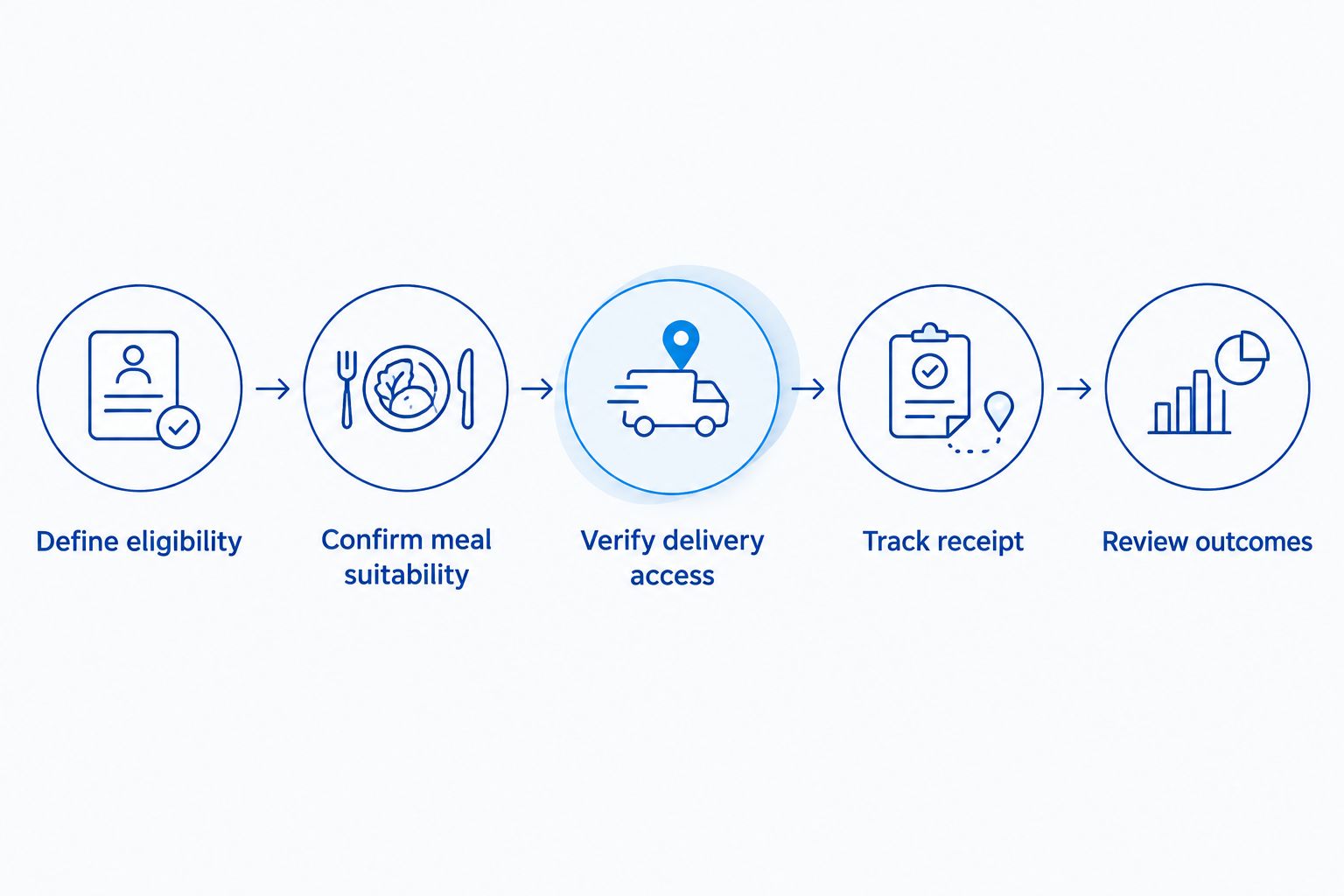
Use a staged decision process. Each stage should produce something the next team can act on—not merely a referral status in a system.
1. Define eligibility
Describe the clinical and functional circumstances the program is intended to address. Separate eligibility for the benefit from suitability for a particular meal format; those are related decisions, not identical ones.
Confirm the applicable program requirements before enrollment. A service offered in one Medicaid arrangement does not establish coverage in another.
2. Confirm meal suitability
Assign responsibility for the nutrition assessment and approval of meal requirements. Record restrictions and the process for updating them when the member's circumstances change.
Ask who resolves a conflict between the prescribed meal requirements and the available menu. A delivery team should not have to make that clinical decision.
3. Verify delivery access
Confirm the delivery location, member contact method, and handling arrangements. Ask about refrigeration, reheating, packaging, and assistance rather than treating a valid address as proof that delivery will work.
For referrals beginning at discharge, review the workflow for ordering medically tailored meals at hospital discharge. The referral needs an owner through the handoff, not just at its starting point.
4. Track receipt
Distinguish meals scheduled, meals dispatched, meals delivered, and meals the member reports receiving. These events answer different questions about program performance.
Define how the team handles an unsuccessful delivery or a member who cannot use the food. A closed order is not enough information to resolve either problem.
5. Review outcomes
Choose an evaluation method before enrollment begins. Record the intended outcome, the data source, the observation period, and the comparison approach.
Use the findings to decide whether to continue, change, or stop the intervention. Delivery performance should inform that decision without being presented as proof of clinical benefit.
What should the business case include?
Your 2026 business case should describe the whole service pathway. Include food preparation, clinical assessment, referral administration, fulfillment, delivery exceptions, member support, and evaluation wherever those responsibilities sit in the proposed arrangement.
Then distinguish the outcomes you want from the outcomes you can measure. Improved access to appropriate food is one objective; reduced hospital use is another. Do not present evidence of the first as proof of the second.
Use a budget-impact model to test the proposal, but label assumptions as assumptions. A model does not become an observed result when it appears in a procurement presentation.
Approve the business case only when the scope, responsibilities, and evaluation method are clear. If the objective is nutrition access, say so directly rather than attaching an unsupported savings promise.
How should you interpret reported results?
Meal delivery records show fulfillment activity. Member feedback helps establish whether the food was received and usable. Clinical measures and claims data address different questions and need their own interpretation.
A before-and-after change does not, by itself, show that the meals caused it. Recovery, other care services, and differences between enrolled and comparison members can affect the result.
For a 2026 evaluation, specify which population the finding covers and which outcome was measured. Keep conclusions within that scope; a result from one program does not automatically apply to every Medicaid member or delivery model.
What should you ask a potential delivery partner?
Separate operational questions from clinical questions during procurement. Ask each potential partner to identify its responsibilities and the responsibilities retained by the plan, care team, or another contractor.
- Who receives and confirms the referral?
- Who approves member-specific meal requirements?
- How are dietary changes communicated to fulfillment staff?
- What happens when delivery fails or the member cannot use the food?
- Which records confirm receipt and support follow-up?
- How are service changes and program exits handled?
Umojahealth provides food-supply logistics and hunger-relief program services. Evaluate that scope without assuming unconfirmed clinical capabilities, integrations, coverage arrangements, or reporting features.
Review food logistics services
Explore nutrition security and food-supply logistics services for your organization's program.
Are medically tailored meals better than grocery boxes?
Medically tailored meals are the better fit when individualized clinical nutrition and prepared food are both needed. Grocery boxes are the better fit when the member can prepare food and the main barrier is access to ingredients; neither format is universally better.
Should every discharged Medicaid member receive tailored meals?
Discharge alone does not establish a need for medically tailored meals. Use an assessment of clinical nutrition needs, food access, and preparation ability to select the intervention, then confirm the applicable coverage requirements.
Can a Medicaid plan claim savings before measuring results?
A Medicaid plan should not present projected savings as achieved savings. Use projections for planning, then evaluate observed results with a defined population, comparison method, and outcome before making a performance claim.
FAQ
Are medically tailored meals worth it for Medicaid plans in 2026?
Medically tailored meals are worth funding when they address an assessed clinical need and the plan can deliver and evaluate the intervention. They do not establish medical savings simply because meals are supplied.
Does Medicaid cover medically tailored meals everywhere?
Medicaid coverage is not uniform across every state and program arrangement. Verify the applicable authority, eligibility rules, and contract requirements before enrolling members.
What's the difference between medically tailored meals and ordinary meal delivery?
Medically tailored meals connect meal selection to an individual's assessed clinical nutrition needs. Ordinary meal delivery supplies prepared food without necessarily providing that individualized tailoring.
Are grocery boxes enough for members who cannot cook?
Grocery boxes do not remove the need to prepare food. Assess cooking ability, equipment, and available assistance before selecting ingredients instead of prepared meals.
How do you know whether a member can use delivered meals?
Confirm dietary suitability, storage, reheating, packaging access, and help with eating when needed. Follow up on receipt and usability rather than relying only on a delivery status.
How should a health plan measure a tailored meal program?
Measure delivery performance, member receipt and usability, and outcomes tied to the program objective. Use an appropriate comparison method before attributing clinical or utilization changes to the meals.
What role does Umojahealth play in a food-support program?
Umojahealth provides nutrition security, food logistics, and hunger-relief program services. Confirm the specific service scope and assign clinical meal assessment responsibilities explicitly.
One last thing
Before expanding the program, trace a referral from assessment through receipt and follow-up. Ask each responsible team to show what happens when the address changes, the diet changes, or the member rejects the food.
The decisive operational question is not whether food can be shipped. It is whether an appropriate meal reaches a member who can use it—and whether someone acts when that does not happen. Make that test part of your 2026 launch decision.


