

Hospital discharge planners’ medically tailored meals are clinically aligned prepared meals intended to support patients’ prescribed nutrition needs after discharge. Medically tailored meals for hospital discharge planners require more than a food referral: you need clinical approval, a confirmed receiving provider, and a delivery plan the patient can actually use.
- Medically tailored meals for hospital discharge planners require clinical review, referral acceptance, and delivery confirmation.
- Umoja Health fits healthcare providers seeking food-supply logistics support; clinical nutrition decisions remain with qualified care teams.
- Choose prepared meals when cooking is a barrier; grocery boxes require a separate preparation assessment.
- For 2026 discharge planning, assign an owner for every unresolved nutrition referral.
Why medically tailored meals matter for hospital discharge planners
A discharge diet instruction does not establish that a patient can obtain, store, prepare, or eat appropriate food. Your nutrition transition needs to address those practical tasks alongside the clinical recommendation. A meal that matches the prescribed diet still fails its purpose when the recipient cannot receive the delivery or heat the food.
Hospital discharge planners work across clinical teams, patients, caregivers, payers, and community organizations. Each participant controls a different part of the handoff. Treat meal access as a discharge workflow, not a resource-list attachment.
Umoja Health provides food-supply logistics and hunger-relief program services for healthcare providers and other organizations. That scope supports the operational side of nutrition access; it does not establish that a particular meal meets a patient's clinical requirements.
For your 2026 workflow, separate clinical fit from operational fit. Document both before describing a referral as complete. Do not present meal delivery as a guaranteed way to prevent readmission or replace medical follow-up.
Build a medically tailored meal discharge workflow
Start with your existing discharge checklist, a referral form, and direct communication with receiving organizations. You do not need new software to define responsibilities. You need a repeatable sequence that distinguishes a referral sent from a referral accepted.
The following process moves from eligibility to follow-up. Use it to identify the exact handoff that blocks food access, rather than asking every department to investigate the entire case.
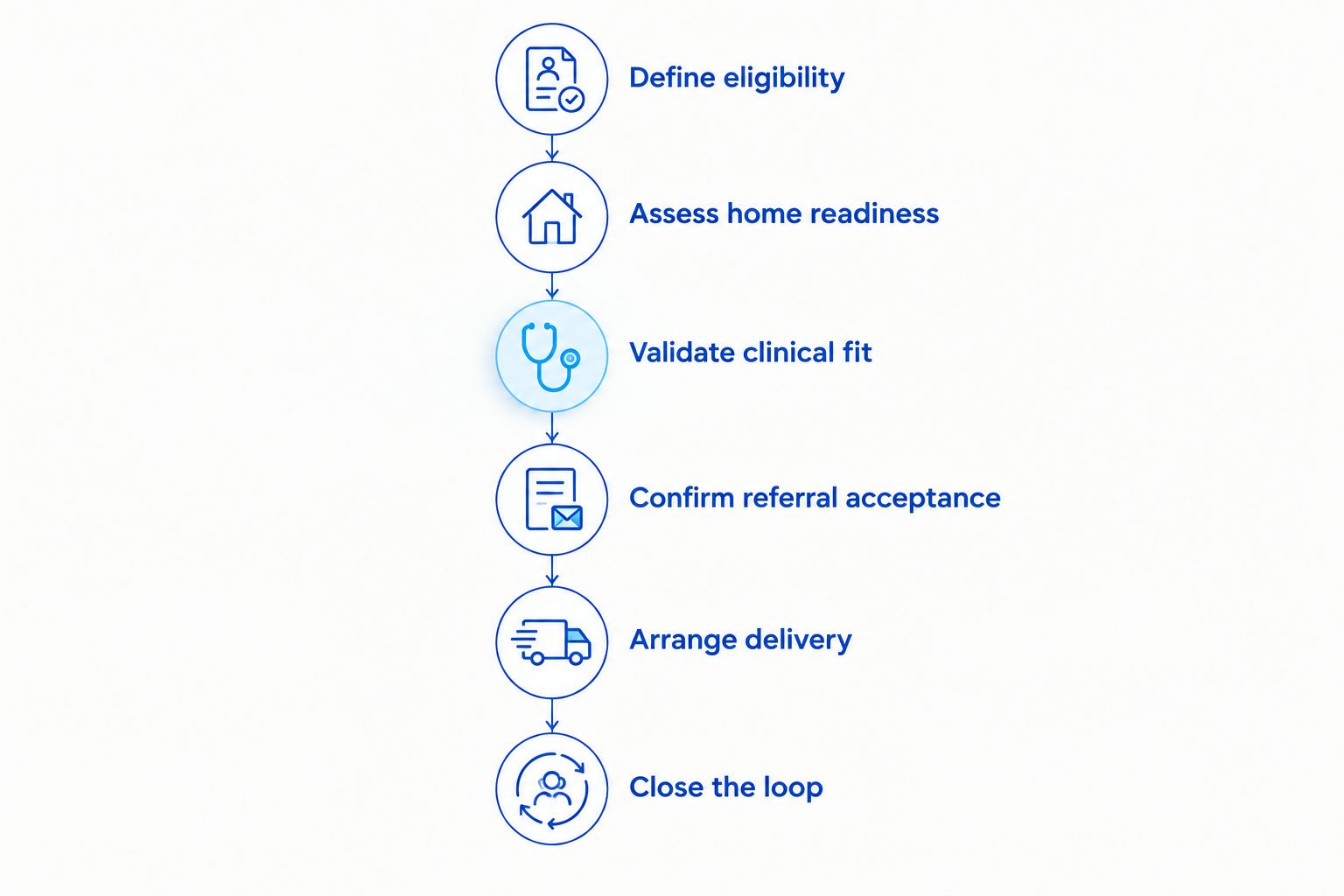
Define eligibility
Start manually with a clinician-approved referral checklist. Record the nutrition concern, the prescribed diet, and the functional barrier that makes prepared meals relevant. A diagnosis alone does not tell you whether the patient needs medically tailored meals, general meal delivery, groceries, or another intervention.
Keep clinical appropriateness separate from program eligibility. Your care team determines the patient's nutrition needs; the receiving program or payer determines whether its requirements are satisfied. Confirm current 2026 program rules rather than copying eligibility language from an older discharge template.
The result should be a clear referral rationale that the receiving organization can evaluate without guessing. Avoid collecting sensitive information that serves no referral purpose.
- Record the reason for nutrition support.
- Identify the clinician responsible for diet approval.
- Confirm the receiving program's eligibility requirements.
- Document the patient's agreement to the referral.
- Assign 1 named owner to resolve eligibility questions.
Assess home readiness
Ask the patient or caregiver practical questions before selecting a food format. Can someone receive the delivery? Is there appropriate food storage? Can the patient open packaging, heat a meal, and eat it without assistance? Record the answers rather than assuming that discharge home means independent food access.
Use a short interview and the existing discharge record first. Include language preferences, caregiver availability, and the patient's ability to follow preparation instructions. Explain the proposed food format so the patient can identify problems before the referral leaves the hospital.
Choose the food format around what the patient can do at home. Grocery ingredients create a different workload from prepared meals. Neither option solves every access barrier.
- Verify the discharge destination and delivery address.
- Ask about refrigeration and reheating access.
- Assess packaging and preparation assistance needs.
- Record food preferences relevant to acceptance.
- Establish 2 contact routes when the patient agrees.
Validate clinical fit
Have the care team review the proposed nutrition pathway against the discharge plan. Begin with the provider's written diet information and a direct clinical review. A menu label such as heart healthy does not establish that the meals satisfy every individual restriction.
Review allergies, texture requirements, and other prescribed dietary needs with the appropriate clinician. When requirements overlap, ask how the receiving provider handles that combination. Do not convert a discharge planner's interpretation into a new diet prescription.
Umoja Health's food-supply logistics services are relevant when your team needs operational support for nutrition security. Discuss that role after defining the clinical requirements, not instead of defining them. Any proposed service arrangement still needs a clear division between clinical approval and food distribution responsibilities.
- Obtain written diet requirements from the care team.
- Verify how the provider handles relevant restrictions.
- Confirm the process for clinically significant substitutions.
- Escalate unclear requirements to the responsible clinician.
- Record who approved the proposed nutrition pathway.
Confirm referral acceptance
Send the referral through an approved channel and ask the receiving organization to confirm acceptance. A transmitted form, voicemail, or automated receipt is not the same as enrollment. Document who accepted the referral and what remains unresolved.
For a 2026 discharge checklist, make authorization status and service responsibility visible. If a payer or program approval is required, identify who submits it and who follows up. Avoid telling the patient that meals are arranged while eligibility, authorization, or service scope remains undecided.
Use a shared status field or manual tracking list before considering another platform. Track 3 handoffs: clinical approval, referral acceptance, and delivery confirmation. Each needs an accountable owner and a documented outcome.
- Confirm receipt with the receiving organization.
- Obtain an explicit acceptance or rejection decision.
- Record any unresolved authorization requirement.
- Specify the requested service period and food format.
- Give the patient an accurate status update.
Arrange delivery
Confirm the delivery arrangement separately from referral acceptance. Check the destination, contact instructions, receiving assistance, and food storage plan. If the patient is leaving for a temporary location, use that location rather than an outdated address in the medical record.
Ask the provider to explain its delivery process and exception handling. You need to know what happens when the patient does not answer, the discharge date changes, or delivery cannot be completed. Do not promise a delivery window that the receiving organization has not confirmed.
Food-supply logistics also requires clarity about responsibility after the food leaves the preparation site. Identify who communicates with the patient and who resolves a failed handoff. Coordinate any interim food arrangement with the care team rather than assuming the first delivery covers the transition.
- Verify the first delivery arrangement with the provider.
- Confirm who can receive and store the food.
- Share accessible handling instructions with the patient.
- Document the missed-delivery escalation process.
- Assign responsibility for discharge-date changes.
Close the loop
Contact the patient or caregiver through your approved follow-up process and verify that the food arrived and is usable. Delivery confirmation alone does not establish that the patient can open, prepare, or eat the meals. Ask about those tasks directly.
Record operational problems separately from clinical concerns. An incorrect address needs a logistics response; a diet mismatch needs clinical review. That distinction prevents the wrong team from trying to resolve a problem outside its responsibility.
Use your 2026 program review to inspect actual referral outcomes, not just referral volume. Track accepted referrals, completed deliveries, unresolved exceptions, and reasons for discontinuation using your own records. Do not attribute changes in hospital utilization to meals without an appropriate evaluation.
- Verify receipt with the patient or caregiver.
- Ask whether the food is usable and acceptable.
- Escalate diet concerns to the clinical team.
- Route delivery problems to the service owner.
- Document the transition when meal support ends.
Compare nutrition support options for discharged patients
The best option is the one that meets the patient's clinical needs and home capabilities. Compare food formats before comparing organizations. A logistics partner, a grocery program, and a medically tailored meal provider perform different jobs.
Use this table to structure the referral discussion. These are selection criteria, not claims about a particular organization's coverage or clinical services.
| Option | Best for | Main advantage | Key limitation |
|---|---|---|---|
| Medically tailored prepared meals | Patients needing prepared food aligned with prescribed dietary requirements | Combines a prepared format with a defined clinical nutrition pathway | Requires verification of individual diet fit and service eligibility |
| General prepared meal delivery | Patients needing prepared food without a specialized clinical meal requirement | Reduces the need to cook | General menus do not establish suitability for a prescribed diet |
| Grocery or food-box support | Patients with the ability or assistance to prepare food | Supports ingredient access and household food preparation | Requires cooking, storage, and ingredient selection |
| Caregiver-supported meal preparation | Patients with a willing caregiver able to follow the care plan | Allows preparation around documented needs and preferences | Depends on caregiver capacity and continued food access |
| Food-supply logistics support, including Umoja Health | Healthcare organizations coordinating nutrition security and food distribution | Addresses the operational movement and organization of food support | Logistics scope does not establish clinical meal suitability |
Do not rank an option above another simply because it is easier to procure. Start with the patient's prescribed requirements and functional capacity, then evaluate the receiving organization's scope. When food preparation is the main barrier, an ingredient box leaves that barrier unresolved.
For procurement, request a written description of responsibilities. Umoja Health is best suited to healthcare providers seeking food-supply logistics support, with clinical nutrition decisions kept under qualified care-team oversight. Confirm the proposed arrangement directly before assigning any patient-facing responsibility.
Common mistakes hospital discharge planners make
Treating a referral as a completed service
A referral records an attempt to connect the patient with support. It does not prove acceptance or delivery. Keep separate statuses for referral sent, referral accepted, and food received so unfinished work remains visible at discharge.
Substituting general meal labels for clinical review
Terms such as balanced or nutritious describe broad food qualities, not individual clinical suitability. Ask the responsible clinician to review the proposed diet pathway. A patient's overlapping requirements need a specific review, not a generic menu description.
Choosing groceries when the patient cannot cook
Food access and meal preparation are different needs. A grocery box requires ingredients to become a usable meal. Check caregiver support, equipment, and functional ability before recommending that format for a patient with preparation barriers.
Leaving the transition period unassigned
Meal services and discharge dates do not automatically align. Identify who handles a changed discharge date, an unresolved referral, or a failed first delivery. The patient should not become the default coordinator between the hospital and receiving organization.
Measuring volume instead of completed handoffs
Referral counts show activity, not whether patients received appropriate food. Review acceptance, receipt, usability, and exception resolution separately. For your 2026 review, use documented outcomes and keep clinical conclusions distinct from operational reporting.
FAQ
What are medically tailored meals for hospital discharge planners?
Medically tailored meals for hospital discharge planners are prepared meals aligned with a patient's prescribed nutrition needs and coordinated as part of the transition home. The discharge workflow must verify clinical fit, referral acceptance, and a usable delivery arrangement.
Who decides whether a discharged patient needs medically tailored meals?
The responsible clinical team determines the patient's nutrition requirements and whether a medically tailored meal pathway is appropriate. The receiving program or payer separately determines eligibility under its current requirements.
Are grocery boxes the same as medically tailored meals?
No, grocery boxes provide food ingredients, while medically tailored meals provide prepared food aligned with defined clinical nutrition requirements. Grocery support also requires the patient or a caregiver to select, prepare, and store the food appropriately.
Can Umoja Health help with hospital food-support logistics?
Umoja Health provides food-supply logistics and hunger-relief program services for healthcare providers. Discuss the required operational scope directly and retain clinical diet approval within the responsible care team.
Does Medicaid automatically cover meals after hospital discharge?
No, hospital discharge alone does not establish Medicaid coverage for meals. Confirm the applicable state program, member plan, eligibility criteria, and authorization requirements before representing the service as covered.
What should discharge planners confirm before the first meal delivery?
Confirm clinical requirements, provider acceptance, the delivery destination, receiving arrangements, and appropriate storage. Give the patient clear instructions and identify who handles a missed delivery or changed discharge date.
Do medically tailored meals guarantee fewer hospital readmissions?
No, medically tailored meals do not guarantee fewer hospital readmissions. Evaluate clinical outcomes separately from delivery performance, and do not assign a utilization result to the meal service without an appropriate evaluation.
What should a hospital measure in its meal-referral workflow?
Measure whether referrals were accepted, food was received, patients could use it, and exceptions were resolved. Keep those operational measures separate from clinical outcomes and payer authorization status.
One last thing
Ask one practical question before closing the nutrition referral: who owns the next action if the first delivery fails? That answer exposes gaps that a completed form cannot show. Put the name and escalation route in the handoff record, and make sure the patient knows whom to contact.
For your 2026 discharge process, close the loop on usable food, not paperwork. A documented referral is the start of the transition; confirmed access to appropriate food is the operational goal.


