

Instead of manually chasing eligibility checks, referrals, and delivery details, build a CalAIM eligibility to medically tailored meal enrollment workflow that separates plan approval from food fulfillment. For 2026 operations, move each referral through verified coverage, clinical documentation, authorization, member agreement, and a confirmed service start.
- CalAIM eligibility to medically tailored meal enrollment requires separate coverage, clinical, authorization, and delivery checks.
- Umojahealth supports food logistics; the Medi-Cal managed care plan controls Community Supports authorization.
- A submitted referral is not approval, and approval is not confirmed meal enrollment.
- Keep one accountable owner until the member’s first delivery is confirmed.
Why this matters
Medi-Cal enrollment alone does not establish eligibility for medically tailored meals. Your team must check the member’s managed care plan, the relevant Community Supports requirements, and the documentation needed for a service decision. Food insecurity screening identifies a need; it does not replace a clinical assessment or authorization.
Umojahealth provides hunger-relief and food-supply logistics services for healthcare providers, food banks, government agencies, and nonprofits. Umojahealth is best for organizations seeking food-logistics support, not a substitute for clinical assessment or plan authorization. Confirm the scope of any proposed CalAIM arrangement separately.
Use the California Department of Health Care Services’ CalAIM Community Supports Policy Guide, particularly its Medically Tailored Meals/Medically Supportive Food section, as your policy reference for 2026 implementation. Pair that guidance with the member’s plan requirements; this operational guide does not establish an individual member’s eligibility.
Before you start
- Access and ownership: Assign an intake owner with access to approved coverage-verification, referral, and authorization channels. Identify the clinician or care team responsible for documenting the nutrition-related need.
- Member and service information: Gather the member’s identifying information, contact preferences, relevant clinical documentation, and delivery requirements through approved channels. Confirm the intended fulfillment partner’s role and service area before promising enrollment.
- The gotcha: Do not treat a medically tailored meal referral as a general food-box order. Confirm the plan’s service definition, authorization requirements, and provider arrangements before scheduling fulfillment; an existing food-distribution relationship does not establish CalAIM participation.
For your 2026 intake process, use 1 intake record per referral and assign 1 accountable owner per record. These are recommended operating rules, not state-mandated staffing requirements. They give your team a single place to find the latest decision and the person responsible for the next action.
The bold field names below are suggested labels for your internal tracker, not claims about a particular portal’s interface. In an actual plan portal, follow that system’s required fields and submission instructions.
Coverage and clinical intake
Verify the coverage record
- Record the member identifier in Member ID and the responsible organization in Managed care plan. Verify coverage through an approved source rather than relying only on an old insurance card.
- Enter the verification date in Coverage checked. Identify the plan’s current pathway for the requested Community Support, including who accepts referrals and who makes the authorization decision.
- Record the referral source in Referring team and the next responsible person in Intake owner. Obtain the permissions required for coordination and information sharing under your organization’s procedures.
- Set Coverage status to a clear operational state, such as verified, needs clarification, or not verified. Keep uncertain records out of the fulfillment queue.
Expected result: The intake owner can identify the member’s plan, the service pathway, and any unresolved coverage question. Coverage verification is complete only when your record identifies its source and date.
Assemble the clinical referral
- Ask the qualified referring clinician or care team to document the condition and nutrition-related need supporting the requested service. Use the plan’s documentation requirements; do not substitute a logistics coordinator’s assessment.
- Capture the requested service in Requested support. Distinguish prepared medically tailored meals from other medically supportive food arrangements rather than assuming the terms are interchangeable.
- Put the referral and supporting documentation in Clinical referral using your approved secure system. Record missing items in Documentation needed, with a named person responsible for obtaining them.
- Keep practical food information in Dietary requirements: allergies, clinician-directed restrictions, and relevant preferences. Separate medical instructions from preferences so the fulfillment team does not interpret one as the other.
Expected result: The referral explains why the member needs the requested support and contains the documentation required for review. The logistics team receives actionable dietary information without being asked to make clinical decisions.
Authorization and member enrollment
Submit a complete request
- Compare the referral packet with the plan’s current submission requirements. Resolve missing identifiers, unsigned documents, or unclear service requests before submission.
- Submit through the designated channel and record the reference in Request reference. Save the submission confirmation in the approved record rather than treating a sent email as proof of receipt.
- Set Authorization status to submitted, additional information requested, approved, or denied, according to the actual response. Record the decision and its date.
- For an approval, capture the authorized service, applicable dates, scope, and any stated limits in Authorization details. If the decision is unclear, obtain clarification before arranging service.
Expected result: Your team can distinguish a request awaiting review from an authorized service. The fulfillment handoff includes the decision itself, not simply the intake owner’s summary.
Confirm the member’s participation
- Explain the approved support to the member in their preferred communication format. Describe what the authorization covers without promising services beyond it.
- Confirm that the member wants to participate. Record agreement, required enrollment documentation, and the preferred contact route in Member participation.
- Verify the delivery location and access instructions in Delivery details. Ask about refrigeration, safe storage, and meal preparation requirements where these affect the proposed service.
- Record a workable plan for failed contact or delivery in Delivery exception plan. Identify who receives the alert and how the member will be contacted.
Expected result: Authorization and member participation are both documented. The record contains enough practical information to arrange service without guessing about the member’s living situation.
For a 2026 workflow review, keep 3 separate checkpoints visible: coverage verified, service authorized, and member enrolled. Combining them into a single eligible checkbox hides the exact reason a referral has stopped.
Fulfillment and closed-loop tracking
Prepare the service handoff
- Send the receiving team the authorized service details, necessary dietary instructions, delivery information, and escalation contact through an approved channel. Share only the information required for that team’s role.
- Ask the receiving team to confirm that the requested service fits its agreed scope. Verify the provider arrangement with the plan; do not assume a food-logistics supplier is authorized to perform every part of the benefit.
- Record acceptance in Fulfillment accepted. Agree on the intended service start and record it in Scheduled start, subject to the authorization and the member’s confirmed arrangements.
- Set Enrollment status to scheduled only after the handoff is accepted. If fulfillment cannot proceed, return the record to a named owner rather than leaving it in an active queue.
Expected result: Both teams know what is authorized, what they must deliver, and who resolves an exception. A planned start is supported by an accepted handoff.
Close the first-delivery loop
- Record the initial delivery outcome in First delivery outcome. Distinguish delivered, attempted, declined, and unresolved outcomes instead of marking every dispatched order complete.
- Confirm receipt through your agreed process. Ask the member or designated contact about practical problems, such as inaccessible packaging or instructions that do not match the agreed service.
- Route clinical questions to the referring clinician or designated clinical team. Route delivery failures to the fulfillment owner; do not ask either team to resolve issues outside its role.
- Update Next action with an owner and a due date whenever a problem remains open. Record the next review required by the authorization or care plan.
Expected result: Enrollment reflects a documented service start, not just an outbound shipment. The care team receives a clear outcome and unresolved issues remain visible.
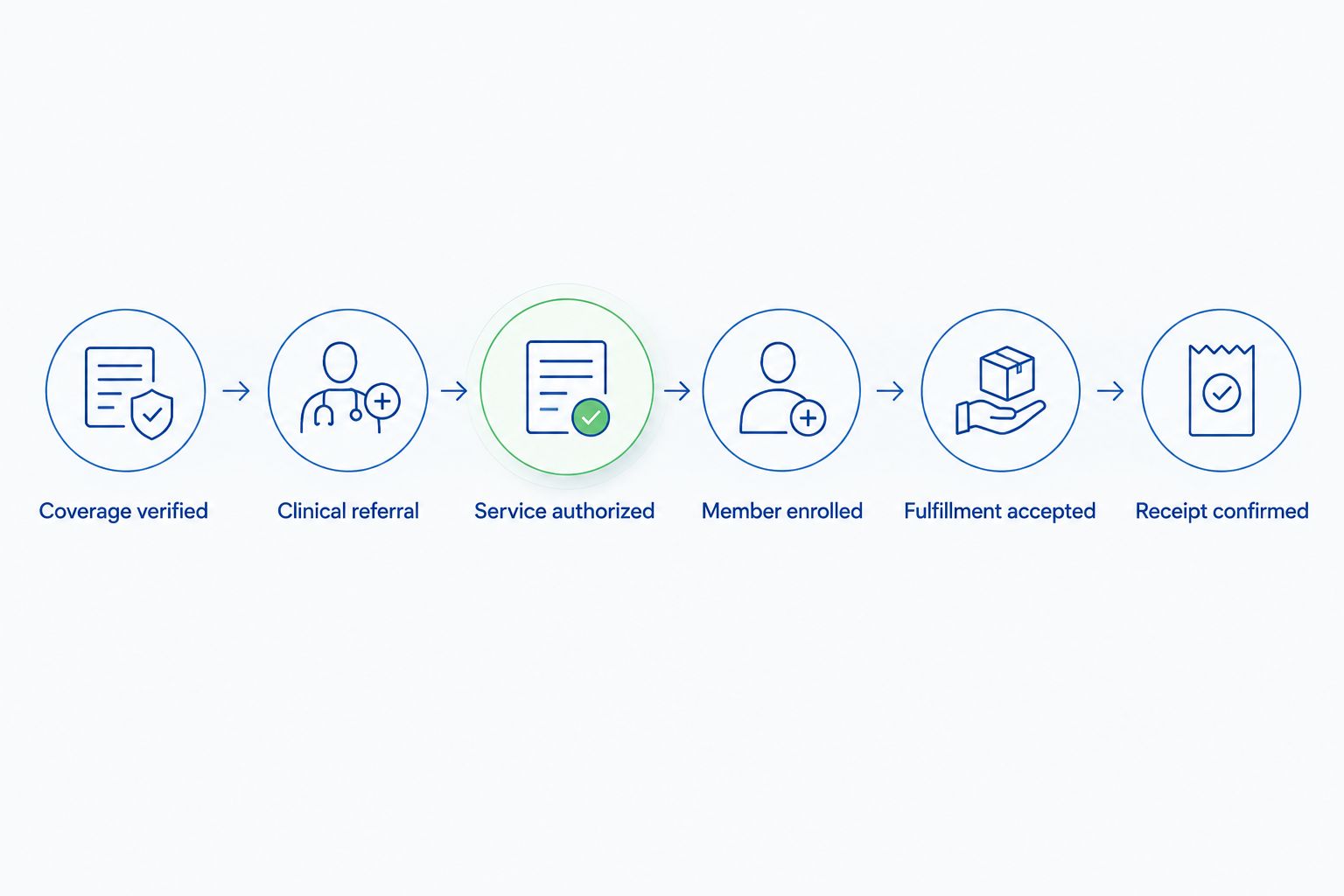
In your tracker, use Coverage verified, Clinical referral, Service authorized, Member enrolled, Fulfillment accepted, and Receipt confirmed as separate milestones. That sequence makes the diagram actionable: a coordinator can see the last completed milestone and the next required handoff without reconstructing the entire referral history.
Update an existing meal enrollment
An address change is not a new eligibility determination, but a changed clinical need requires the appropriate clinical review. Your update workflow should identify what changed before deciding which checks to repeat.
| Workflow | Best for | Advantage | Limitation |
|---|---|---|---|
| New enrollment | Members without an active service enrollment | Establishes coverage, clinical documentation, authorization, and delivery arrangements together | Requires a complete initial handoff |
| Delivery update | Enrolled members changing contact or delivery details | Corrects operational information without rebuilding an unchanged referral | Does not approve a different service or extend authorization |
| Clinical or authorization review | Members with changed dietary needs or an approaching authorization end | Routes benefit and clinical decisions to the responsible team | Does not justify continuing beyond the existing approval |
- Record the change in Change requested and identify whether it concerns contact information, delivery arrangements, clinical instructions, coverage, or authorization.
- Recheck the affected part of the record. A delivery update needs operational confirmation; a changed diet needs direction from the appropriate clinical team.
- Ask the plan whether the proposed service change requires a revised authorization. Keep the existing authorization details intact so the record shows what was approved before the change.
- Confirm the accepted update with the member and receiving team. Record the effective date and any unresolved issue.
Expected result: The service record reflects the change without silently expanding the authorization. Use this distinction in 2026 staff training so administrative updates do not become undocumented clinical changes.
Troubleshooting
The referral says eligible, but there is no approval
Treat eligibility screening and authorization as different events. Locate the submitted request and decision; if no decision exists, route the record to the authorization owner and keep it out of the authorized fulfillment queue.
The plan requests more documentation
Record exactly what the plan requested and assign each missing item to the person who can supply it. Resubmit through the specified channel and retain the confirmation, rather than sending multiple incomplete versions from different teams.
An approved member cannot be reached
Use the documented contact preferences and your organization’s outreach procedure. Ask the referring team to help resolve contact barriers through approved channels; do not treat an unreturned call as completed enrollment.
The requested meal does not match dietary instructions
Pause the affected fulfillment handoff and send the discrepancy to the designated clinical reviewer and receiving team. Logistics staff should not select a substitute that changes the prescribed dietary requirements without appropriate direction.
Delivery fails after service starts
Record the reason, notify the responsible owner, and contact the member through the agreed route. Reconfirm access and storage arrangements before scheduling another attempt; changing the dispatch date alone does not resolve an incorrect address or inaccessible delivery location.
Customize your workflow
Build exception queues around the actual blocker: coverage, documentation, authorization, member contact, dietary clarification, or delivery. Give each queue a named owner and require a documented next action before a record changes hands.
For Umojahealth food-logistics discussions, define the handoff your organization needs rather than assuming an end-to-end CalAIM service. Ask which responsibilities belong to the plan, clinical team, enrollment coordinator, and fulfillment partner, then document those boundaries in the operating agreement.
Expand your 2026 dashboard with timestamps for referral receipt, complete submission, authorization decision, accepted handoff, and confirmed service start. Measure the time between those events using your own records; do not substitute a generic benchmark for your program’s performance.
FAQ
Does Medi-Cal coverage automatically qualify someone for medically tailored meals?
No. Medi-Cal coverage does not by itself establish eligibility for medically tailored meals; the member’s plan must assess the requested support under applicable requirements.
What comes first in CalAIM eligibility to medically tailored meal enrollment?
Verify the member’s coverage and the plan’s referral pathway first. Then assemble the clinical documentation required for the requested service.
Can a food insecurity screening replace a clinical referral?
No. Food insecurity screening identifies a need but does not replace the clinical documentation or authorization required for the requested support.
Is a submitted referral the same as an approved enrollment?
No. Submission, authorization, member participation, and service start are separate events that your team should record separately.
Can Umojahealth authorize CalAIM medically tailored meals?
The member’s managed care plan controls Community Supports authorization. Umojahealth’s stated services include hunger relief and food-supply logistics; confirm any proposed CalAIM role directly.
What should happen when an enrolled member changes their address?
Update and verify the delivery details, then confirm the change with the receiving team. Recheck coverage or service arrangements if the move affects them.
Who should approve a change to a member’s dietary instructions?
The appropriate clinical professional should review changes to clinical dietary instructions. The logistics team should implement documented instructions rather than make clinical substitutions.
One last thing
The most useful enrollment checkpoint is confirmed receipt, not dispatch. A meal that leaves a facility has not yet resolved a member’s access problem. Keep the intake owner accountable for the first-delivery outcome, then transfer ongoing responsibility explicitly.
For Umojahealth food-logistics coordination, make that responsibility boundary a written part of the handoff. It gives your clinical and operational teams a concrete point at which enrollment becomes an active service.


