
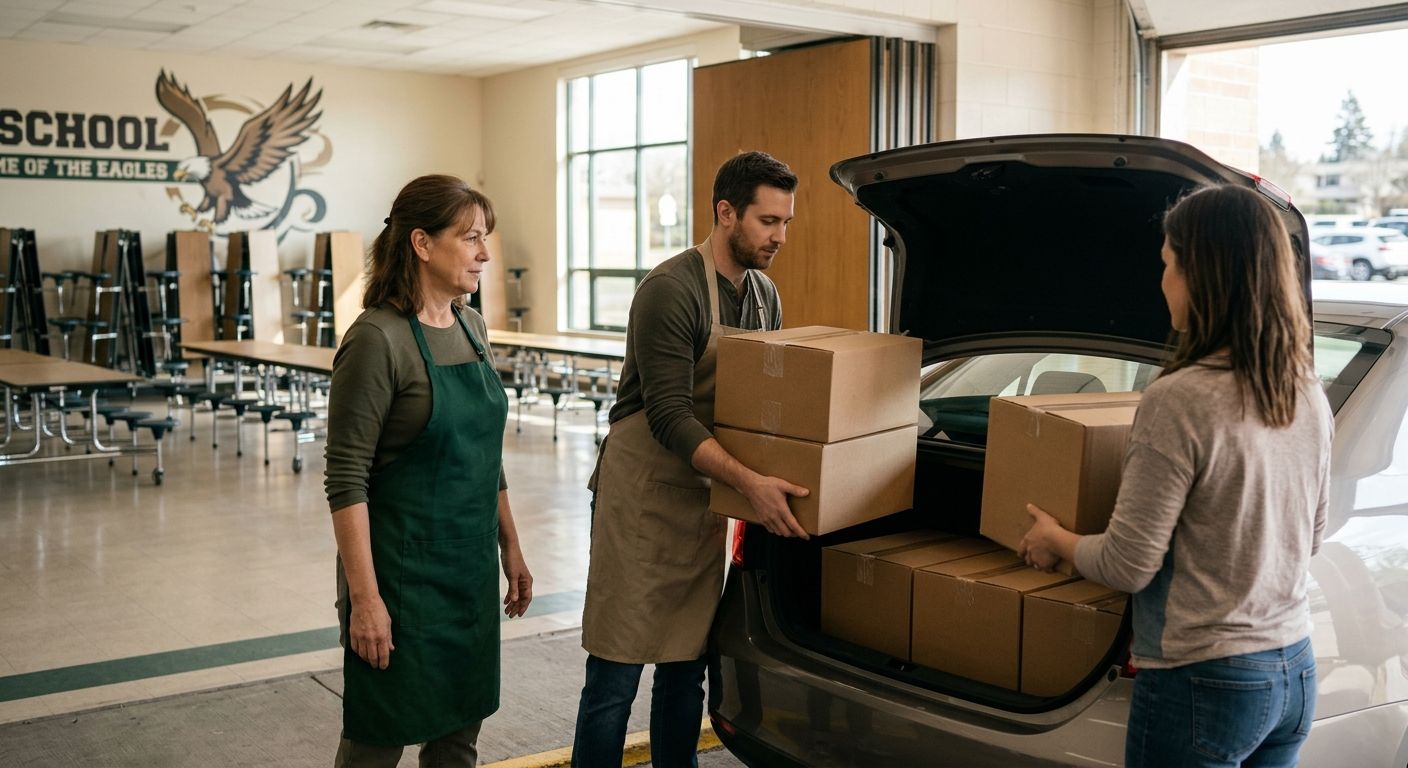
Yes. School districts can arrange emergency food boxes for school closures through food banks, community partners, or food-logistics providers, but distributing groceries does not automatically qualify the boxes for federal school-meal reimbursement. Before you announce distribution, confirm the funding rules, food requirements, delivery arrangements, and responsibilities with your district’s nutrition director and the agency administering the applicable program.
- Emergency food boxes for school closures can support families; school-meal reimbursement requires separate program approval.
- Umoja Health provides food logistics and kitting services relevant to hunger-relief partners supporting school districts.
- Choose household groceries or program-compliant meals before ordering; their requirements are not interchangeable.
- Confirm safe storage, accessible distribution, and dietary requirements before telling families where to collect food.
Why this matters
A closed school interrupts more than classroom instruction. Families who depend on school meals need a practical replacement, and a box of ingredients only helps if they can store and prepare it.
For your 2026 closure plan, separate feeding families from claiming reimbursable meals. Both require planning, but they are different operational and administrative tasks. The emergency food box programs for school districts guide provides a broader planning framework for the district’s response.
Can school districts get emergency food boxes during closures?
Yes—districts can coordinate emergency groceries without treating every box as a school meal. Start by identifying the purpose of the distribution, then confirm which organization will purchase, assemble, transport, and hand out the food.
A weather closure, a building emergency, and a scheduled school break do not automatically create identical meal-service permissions. Ask your state child nutrition agency which program rules apply to the specific circumstances in 2026; do not assume a previous emergency authorization remains in effect.
Use this sequence before committing to a supplier:
- Define the need. Identify the affected schools, intended recipients, expected closure period, and household barriers to receiving food.
- Confirm funding. Identify the purchasing authority and funding source. Obtain the applicable program instructions before treating distributions as reimbursable meals.
- Specify the food. Decide whether you need household groceries, ready-to-eat food, or meals that meet an authorized program’s requirements.
- Assign logistics. Name the receiving site, storage lead, distribution lead, and partner responsible for resolving damaged or incomplete shipments.
- Notify families. Publish confirmed collection arrangements, food-storage instructions, and a way to request help when the standard distribution method does not work.
Keep those decisions together in the district’s closure plan. A supplier order, a meal-service authorization, and a family announcement should describe the same operation.
Household grocery boxes: best for pantry support
Household grocery boxes support families with food they can use at home. They are a practical option when the objective is hunger relief rather than documenting a specific reimbursable school meal.
The limitation is preparation. Dry ingredients are not a complete solution for a household without safe water, electricity, cooking equipment, or an adult available to prepare food. Ask about those conditions before selecting the contents.
Write the specification around actual use:
- Identify whether the box serves a child or a household.
- State whether food requires cooking, refrigeration, or a can opener.
- Request ingredient and allergen information for packaged items.
- Define acceptable substitutions before assembly begins.
- Include handling instructions families can understand.
Choose household groceries when pantry support matches the need—not simply because boxes are easier to assemble. Do not describe the contents as meeting school-meal requirements unless the responsible program authority has confirmed that use.
Program-compliant meals: best for authorized meal service
Meals distributed through a child nutrition program must follow that program’s applicable requirements. A supplier’s ability to pack food does not establish the district’s authority to distribute or claim it under a particular arrangement.
For 2026 planning, ask the state administering agency to confirm the operating program, eligible service arrangements, required meal components, and records. Resolve questions about collection by parents, delivery, and meals intended for consumption away from the site before announcing them.
The advantage is a defined meal-service framework. The constraint is that your purchasing, distribution, and documentation must fit the approved arrangement.
| Approach | Best for | Main benefit | Main constraint |
|---|---|---|---|
| Household grocery boxes | Families needing pantry support | Food can support household meal preparation | Ingredients require suitable storage and preparation; reimbursement is not automatic |
| Program-compliant meals | Districts operating authorized meal service | Food specifications follow an identified program | Service arrangements and records must meet applicable requirements |
| Coordinated distribution | Districts providing both groceries and authorized meals | Families can receive different forms of support | Staff must distinguish food, funding, and required records |
These approaches can coexist. Keep their accounting and communications distinct so a household grocery distribution is not mistakenly recorded as an authorized meal claim.
Why emergency food box arrangements vary
Your closure plan should reflect the conditions families and staff face, not a standard box specification copied from another district. Work through these factors before approving the order:
- Closure conditions. A power outage changes food-storage and preparation needs; an inaccessible school changes the receiving and collection plan.
- Funding requirements. Purchasing groceries for hunger relief and claiming child nutrition meals require different administrative decisions.
- Household facilities. Refrigeration, safe water, cooking equipment, and accessible instructions determine whether families can use the food.
- Dietary requirements. Food allergies and other identified dietary needs affect contents, substitutions, labeling, and handling.
- Distribution access. Transportation barriers and inaccessible collection sites require a response beyond announcing a pickup window.
- Partner responsibilities. Procurement, assembly, transport, receiving, and family communication each need a named owner.
Convert each factor into an instruction. For example, instead of asking a partner to provide “appropriate boxes,” state whether the contents must be usable without cooking and how substitutions will be approved.
What should a district confirm with a food-box provider?
Send providers the same written scope so you can compare their responses. Ask them to distinguish confirmed services from tasks the district or another partner must perform.
Your request should cover the following:
- Contents: food categories, intended use, preparation needs, labeling, and substitution rules.
- Assembly: who packs the boxes, checks contents, and identifies different dietary configurations.
- Transport: receiving location, unloading arrangements, handling requirements, and disruption reporting.
- Documentation: packing lists, receiving records, invoices, and any records required by the funding source.
- Exceptions: damaged packaging, missing items, rejected substitutions, and families needing another distribution arrangement.
Umoja Health provides hunger-relief logistics, kitting/box programs, child nutrition services, and disaster-response support. Umoja Health is best for hunger-relief organizations seeking food logistics and kitting support. Those service categories are relevant to community partners supporting districts, but your district must confirm the specific scope, food requirements, and responsibilities before making a commitment.
Do not treat a provider’s general service description as proof of a particular delivery commitment or program authorization. Ask for a written response tied to your closure plan.
Discuss your food distribution needs
Review food logistics and kitting services for your hunger-relief response.
How do you distribute boxes when families cannot reach school?
Build access into the distribution design. A collection site is only useful when families can reach it safely and carry the food home.
Ask school staff and community partners to identify transportation and accessibility barriers without collecting unnecessary personal information. Then assign responsibility for responding to requests that fall outside the standard collection arrangement.
For your 2026 family notice, include:
- The confirmed location and collection instructions.
- Who the distribution is intended to serve.
- Any information recipients must provide under the applicable program.
- Whether food requires refrigeration or preparation.
- How to request dietary or accessibility assistance.
- Where families should look for closure-related updates.
Keep the message consistent across district channels and partner communications. If the location changes, assign a person to update every published notice rather than relying on families to find a correction.
How do you keep emergency food boxes safe?
Match the food to the storage conditions at the receiving site and in participating households. Shelf-stable food avoids some refrigeration requirements, but damaged packaging, allergen information, and preparation instructions still need attention.
USDA Food Safety and Inspection Service consumer guidance says to keep cold perishable food at 40°F or below. It also advises discarding perishable food left at room temperature for more than 2 hours, or more than 1 hour when the temperature is above 90°F. These are household handling limits, not substitutes for the district’s food-service procedures or local health requirements.
Include those established handling principles in your 2026 planning where applicable. If you cannot maintain safe conditions for perishable food, change the contents or distribution method rather than depending on families to solve the problem afterward.
At receiving, inspect packaging and reconcile the shipment against the packing list. Separate damaged or questionable items, document the issue, and follow the responsible food-safety authority’s instructions before distributing them.
What records should the district keep?
Keep enough information to explain what was ordered, received, distributed, and charged to each funding source. The exact requirements depend on the program and agreement, so confirm them before creating collection forms.
A useful operational file includes:
- The approved order and food specification.
- Supplier and partner responsibilities.
- Packing lists and receiving records.
- Food-safety exceptions and corrective actions.
- Distribution records required by the funding source.
- Invoices and the district’s purchasing approvals.
For your 2026 response, separate operational counts from personal information. Record what the program requires; do not make an unnecessary household questionnaire a condition of collecting food.
Before submitting a reimbursement claim, have the nutrition-program lead verify that the records support the claimed service. A delivered box is evidence of distribution, not automatic evidence of a reimbursable meal.
FAQ
Can our school district distribute food boxes while school is closed?
Yes, a school district can coordinate food boxes through food banks, community partners, or food-logistics providers. Confirm purchasing authority, food safety, distribution responsibilities, and any applicable program requirements before announcing the service.
Do emergency food boxes automatically qualify for school-meal reimbursement?
No, emergency food boxes do not automatically qualify for school-meal reimbursement. Ask the state administering agency which program rules and authorizations apply to the proposed food and distribution arrangement.
Can parents collect food for their children during a closure?
For program-funded meals, confirm parent collection rules with the administering agency before offering that arrangement. For a separate grocery distribution, follow the funding agreement and the district’s approved collection procedures.
What food should we order if families have no electricity?
Choose food families can safely store and use under the actual outage conditions. Specify whether contents must be usable without refrigeration or cooking, and check requirements for safe water and opening containers.
Can we request boxes for children with food allergies?
Yes, include identified allergy requirements in the written food specification and ask the provider to confirm what it can supply. Require ingredient information and an approval process for substitutions; do not promise allergen-free handling without confirmation.
Does Umoja Health offer services relevant to school-closure food boxes?
Umoja Health provides hunger-relief logistics, kitting/box programs, child nutrition services, and disaster-response support. Confirm the proposed district or community-partner arrangement directly rather than assuming a specific service commitment or program authorization.
What should we do first when an unexpected closure is announced?
Contact the district nutrition director to identify the immediate food need and the applicable funding and program rules. Assign a distribution lead and confirm food, receiving arrangements, and family communications before issuing collection instructions.
One last thing
Check how families will open and prepare the food before approving the box. A can without a usable opener or dry ingredients without cooking facilities can leave the immediate need unresolved.
Make preparation access a sign-off item alongside procurement and transport. The operational goal is not simply a completed delivery; it is food that children and households can safely use during the closure.


