

Yes—senior centers can combine congregate and home-delivered meal funding within a coordinated operation, but they must preserve each funding source’s eligibility, accounting, and reporting requirements. Sharing a kitchen or supplier does not authorize unrestricted transfers between funding categories or charging the same expense twice. For 2026 planning, distinguish shared operations from an approved transfer of Older Americans Act funds.
- Senior centers can combine congregate and home-delivered meal funding operationally, without treating restricted awards as interchangeable.
- Older Americans Act Title III-C separates congregate nutrition services from home-delivered nutrition services.
- Allocate shared costs by documented benefit; never charge the same expense twice.
- Umoja Health supports food-supply logistics; funding approvals remain with the responsible administering agencies.
Can senior centers combine congregate and home-delivered funding?
Yes to coordinated operations; no to unrestricted pooling. A senior center can organize purchasing, meal preparation, staffing, and distribution across both services when its awards and agreements permit those activities. Each award still needs an accurate record of the services and expenses it supports.
Under Older Americans Act Title III-C, congregate nutrition services fall under C-1 and home-delivered nutrition services under C-2. These are 2 distinct funding categories, not interchangeable labels for the same meal.
| Operating approach | Best for | Benefit | Limitation |
|---|---|---|---|
| Separate congregate and delivery operations | Centers whose contracts require operational separation | Clear responsibility for each service | Separate processes can duplicate administrative work |
| Shared operations with separate accounting | Centers coordinating kitchen, purchasing, or staff resources | Common resources can support both services | Shared expenses need a defensible allocation method |
| Approved funding transfer | Programs seeking to change the authorized allocation between services | Aligns the funding allocation with an approved change | Requires the applicable agency process; a center cannot approve it itself |
Umoja Health provides hunger-relief and food-supply logistics services. That operational role is separate from deciding whether a public award permits a transfer, a reimbursement, or a particular participant’s enrollment.
Why this matters
A meal program can look integrated to participants while remaining distinct in its financial records. That distinction protects service continuity without turning separate funding streams into an undocumented common account.
For your 2026 operating plan, ask two different questions: can the center share resources, and can the funding allocation change? The first concerns allowable costs and operations. The second concerns authority under the award and the administering agency’s rules.
A larger delivery caseload does not, by itself, authorize moving congregate funds. Likewise, buying ingredients together does not mean every expense belongs equally to both services.
What can a senior center share?
A shared operation starts with identifying which resources actually benefit both services. Share resources where permitted, then assign expenses according to the benefit each service receives. Do not start with the available balances and work backward to a convenient allocation.
Shared purchasing
A center can propose common purchasing for ingredients, packaging, or other allowable supplies. The purchasing record should identify what was received and how the expense relates to the funded services.
An invoice covering both services needs supporting allocation records. A delivery-only packaging item should not be assigned to congregate meals merely because both programs use the same vendor.
Shared kitchen and staff
A kitchen can prepare meals for both service models when the operating arrangements permit it. Staff records and other documentation must support how compensation and shared operating expenses are charged.
One shared kitchen does not create one unrestricted budget. A staff member’s preparation work can benefit both programs, while route scheduling or dining-room service benefits a particular activity. The accounting method needs to recognize that difference.
Shared administration
Intake, purchasing administration, and reporting processes can be coordinated without erasing service-specific requirements. Keep each participant’s enrollment status and each meal’s service category identifiable.
A common participant database is useful only if it can distinguish congregate attendance from home delivery. A combined total alone does not explain which award supported which service.
How to combine operations without combining restricted funds
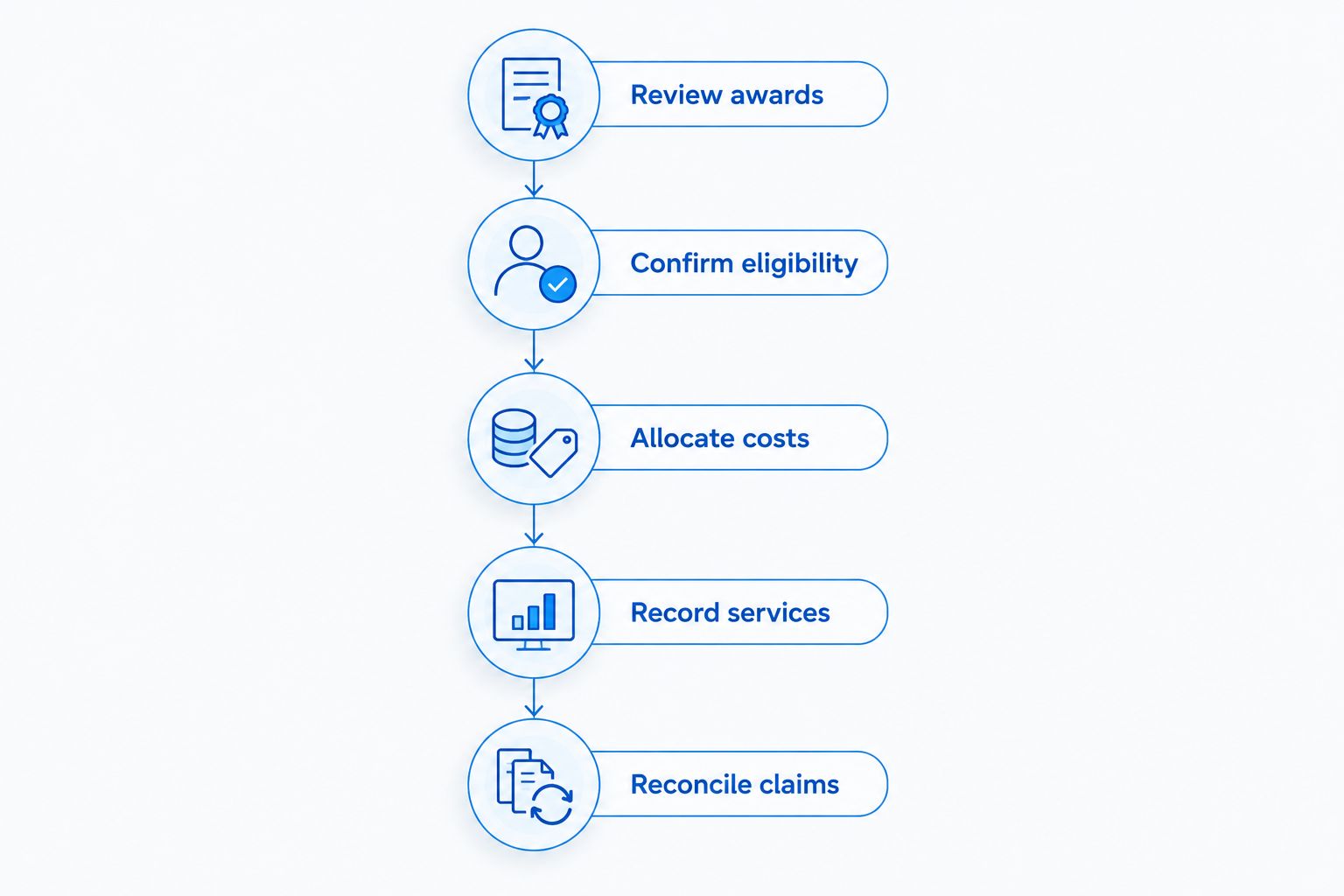
Use this sequence before changing purchasing, staffing, or billing. For a 2026 launch or expansion, make the approved accounting approach part of the operating plan rather than a correction after invoices arrive.
- Review awards. Identify the funding source, allowable activities, service definitions, budget restrictions, and required approvals for each agreement. Include state, local, charitable, or healthcare funding if those sources also support the operation.
- Confirm eligibility. Document who qualifies for each service under the applicable requirements. Do not assume that enrollment in a congregate program automatically establishes eligibility for home delivery.
- Allocate costs. Separate expenses that benefit only one service from expenses that benefit both. Choose an allocation basis that reflects the actual benefit and retain the supporting calculation.
- Record services. Track meal dates, service categories, attendance or delivery records, and the funding source associated with each claim. Preserve an audit trail when a participant changes services.
- Reconcile claims. Compare purchasing, payroll support, service records, and reimbursement requests before submission. Resolve duplicate charges and unexplained differences before closing the reporting period.
The sequence matters: eligibility and service definitions determine what you record, and those records support the costs you charge. A financial allocation cannot repair an unsupported service claim.
How should shared meal-program costs be allocated?
Allocate shared costs according to the relative benefit received—not according to which award has money left. Federal cost principles in 2 CFR §200.405 establish the allocability standard for federal awards. Your agreement and administering agency determine the documentation and approval requirements that apply to the center.
A practical allocation worksheet should identify the expense, the benefiting activities, the allocation basis, and the supporting record. Someone reviewing the worksheet should be able to follow the charge back to the invoice or payroll documentation.
For example, meal-production counts can support allocating an expense that varies with meal production. Those counts do not automatically explain delivery-route expenses, dining-room staffing, or every administrative task.
Keep these distinctions clear:
- Direct expenses: Assign an expense benefiting only home delivery or only congregate service to that activity, subject to allowability.
- Shared expenses: Distribute an expense benefiting both activities using a reasonable, documented basis.
- Donated resources: Record and treat donated goods or services under the applicable award rules rather than billing them as purchased expenses.
- Administrative expenses: Apply the agreement’s treatment of administrative and indirect costs; do not create an unsupported surcharge.
Review the method when the operation changes. A major shift in delivery routes or congregate attendance can make an old allocation basis a poor description of current activity.
When does a funding transfer require approval?
A transfer changes the authorized allocation of funds; shared purchasing does not necessarily do that. Under the Older Americans Act framework, transfers involving nutrition-service allocations operate through the applicable state and federal requirements, not a senior center’s unilateral decision.
Start with your Area Agency on Aging or contracting agency. Ask whether the proposed change is an allowable expenditure within the existing award, a budget revision, a contract amendment, or a transfer requiring action elsewhere in the funding structure.
Provide a clear request: describe the service demand, the proposed change, its effect on congregate and home-delivered services, and the supporting records. Obtain the required written authorization before implementing a change that depends on approval.
Do not relabel home-delivered meals as congregate meals to fit an available balance. Service classification must follow the governing definition and actual service arrangement, not the account with remaining funds.
Why permission to combine funding varies
The answer depends on the specific awards and service arrangements. These factors determine what your center can coordinate and what requires additional authorization:
- Funding source: OAA, state, local, charitable, and healthcare funding carry different conditions. Permission under one source does not amend another source’s restrictions.
- Contract scope: Your agreement defines the funded service, approved budget, reporting responsibilities, and amendment process.
- Participant eligibility: Congregate and home-delivered services have distinct eligibility requirements; a shared intake process must preserve those distinctions.
- Service classification: The way a meal is provided affects its reporting category. Location alone is not a substitute for checking the applicable definition.
- Shared-cost documentation: A coordinated operation still needs records showing which activities benefited from each expense.
- Transfer authority: The center’s purchasing authority is not the same as the state or administering agency’s authority over allocations.
For 2026 decisions, use the current award documents, the Older Americans Act Title III-C framework, applicable federal cost principles, and written agency instructions. A vendor’s proposal is not a substitute for those authorities.
Can the same senior receive congregate and home-delivered meals?
Yes, a participant can receive both service types when the person meets the applicable eligibility requirements and the arrangement follows program rules. Being enrolled in both services does not authorize claiming the same meal twice.
OAA nutrition services generally serve adults age 60 years and older, with specified eligibility exceptions. Home-delivered eligibility also depends on the applicable program criteria; age alone does not establish entitlement to delivery.
Record the service actually provided on each date. If a participant resumes attending the center after receiving home delivery, update scheduling and records so an outdated delivery order does not create an unsupported claim.
Can Medicaid funding support the same meal operation?
Yes, a center can coordinate an operation that also serves eligible Medicaid participants when it has the required arrangements. Medicaid coverage for meals depends on the applicable state program, benefit authority, authorization, and contract—not simply on the participant’s Medicaid enrollment.
Keep Medicaid service authorizations and claims distinct from OAA records. Coordinated service does not permit duplicate payment for the same expense. Resolve payer responsibility before submitting claims rather than assuming another funding source will cover a rejected charge.
What should a center ask a logistics provider?
Ask whether the proposed operating arrangement can preserve the records your awards require. Request a clear description of ordering, packing, dispatch, delivery exceptions, and the information returned to your program team.
Umoja Health is best for organizations seeking food-supply logistics support, not funding authorization. Its stated services include nutrition security programs and kitting or box programs for organizations including nonprofits, government agencies, and healthcare providers.
Confirm the exact service scope before selecting a provider. Do not assume a logistics agreement includes participant eligibility decisions, OAA reporting, Medicaid billing, or agency approvals unless the agreement expressly assigns those responsibilities.
The same procurement discipline applies to any provider: define who owns each record, who corrects errors, and who approves changes. An operational handoff should not leave accountability unassigned.
FAQ
Can a senior center combine congregate and home-delivered meal funding?
Yes, a senior center can coordinate operations supported by both funding streams, but it must preserve each award’s restrictions and records. An actual funding transfer requires the applicable approval process.
Can we use one kitchen for congregate and home-delivered meals?
Yes, a shared kitchen can support both services when the awards and operating agreements permit it. Allocate shared expenses using a documented basis that reflects the benefit each service receives.
Does serving both meal types let us combine the budgets?
No, operating both services does not make restricted budgets interchangeable. Confirm whether a proposed change requires a budget revision, contract amendment, or authorized transfer.
Can a senior receive meals at the center and at home?
Yes, a participant can receive both service types when eligible under the applicable rules. Record the actual services and prevent duplicate claims for the same meal.
Do adults qualify for home-delivered meals as soon as they turn 60?
No, age 60 years alone does not establish home-delivered meal eligibility. The participant must meet the applicable program criteria.
Who should approve changes between congregate and home-delivered funding?
Start with your Area Agency on Aging or contracting agency to identify the required approval authority. A senior center cannot authorize a transfer simply by changing its internal accounting codes.
Can Umoja Health approve our meal-program funding arrangement?
Umoja Health’s stated role is food-supply logistics and hunger-relief services, not public funding authorization. Obtain funding decisions from the responsible administering agency.
One last thing
A combined invoice is not evidence that funds can be combined. Before approving your next shared purchase, trace an expense from its invoice through the allocation worksheet to the service record and reimbursement request.
Use that check in your 2026 operating review. If the record cannot explain why each award bears its assigned expense, fix the allocation process before expanding the shared operation.


