

Yes. Senior meal delivery can be funded through the Older Americans Act (OAA) Title III-C-2 home-delivered nutrition program when the service meets federal requirements and the administering aging agency's rules. Funding generally flows through state and local aging networks, not directly to an individual ordering meals from a vendor. Eligibility does not guarantee immediate enrollment, and a delivery company's services are not automatically eligible for reimbursement.
- Senior meal delivery OAA Title III-C funding belongs under Title III-C-2, subject to aging-agency approval.
- Adults aged 60 years and older are the core eligible population; local home-delivery criteria also apply.
- OAA nutrition programs cannot require eligible participants to pass an income means test.
- Umoja Health provides hunger-relief food logistics; OAA authorization remains with the administering aging agency.
Why this matters
A meal delivery service and an authorized OAA nutrition program are not the same thing. Before you select a supplier, establish who controls eligibility, which funding agreement covers the service, and what documentation supports payment.
For your 2026 procurement plan, separate program administration from food operations. A guide to senior meal delivery programs for area agencies on aging can support provider selection, but your state or local aging agency determines the applicable funding pathway.
That distinction protects both the program and the participant. A referral identifies a need; an authorization establishes whether your program can use its assigned funds to meet that need.
Can senior meal delivery be funded through OAA Title III-C?
Yes: Title III-C-2 is the OAA funding category for home-delivered nutrition services. Title III-C-1 supports congregate nutrition services, such as meals served at community locations. Neither category makes every food purchase or delivery arrangement eligible by default.
The federal foundation is the Older Americans Act: Section 336 addresses congregate nutrition, Section 337 addresses home-delivered nutrition, and Section 339 sets nutrition-service requirements. For 2026 program planning, use these federal provisions alongside the administering agency's current service standards and funding agreement.
| Funding category | Best for | What it supports | Main limitation |
|---|---|---|---|
| Title III-C-1 | Eligible older adults receiving meals at community locations | Congregate nutrition services and associated program activities | It is not the default authorization for meals delivered to individual homes |
| Title III-C-2 | Eligible older adults receiving meals at home | Home-delivered nutrition services and associated program activities | Enrollment, service scope, and payment depend on the administering agency's requirements |
The OAA nutrition program serves adults aged 60 years and older, with specified eligibility provisions for certain other people. Home-delivered programs also apply state and local criteria concerning the person's need for delivery.
Do not treat age alone as a complete home-delivery assessment. Equally, do not assume that a participant must qualify for Medicaid to receive OAA nutrition services: these are separate programs with separate rules.
What does the federal nutrition standard require?
OAA Section 339 connects funded meals to the Dietary Guidelines for Americans and dietary reference intakes. When a program provides 1 meal per day, that meal must supply at least one-third of the applicable daily dietary reference intakes.
The statute also addresses higher daily meal frequencies. Your menu review must match the actual service arrangement rather than applying the single-meal standard to every program.
Sections 336 and 337 generally describe meal services operating 5 or more days per week, with exceptions permitted under the statutory conditions. That is a program requirement with authorized exceptions, not a promise that every participant receives a delivery on every weekday.
Confirm the approved delivery model before you write the operating schedule. Meal frequency, delivery frequency, and the number of meals in a delivery are different specifications.
Title III-C-2: Home-delivered nutrition services
Title III-C-2 is the appropriate starting point when your proposed service delivers meals to eligible older adults at home. The aging agency's assessment and service standards determine how a person enters the program and what service the program authorizes.
Start with the program's eligibility criteria, not the supplier's delivery coverage. A vendor can reach an address without the resident being enrolled in an OAA-funded service.
The same distinction applies to referrals from hospitals, food banks, and community organizations. Those organizations can identify food needs, but a referral does not itself establish OAA eligibility or payment authorization.
For a 2026 service agreement, document:
- Participant eligibility: Who conducts the assessment and approves enrollment.
- Authorized service: Which meals, delivery arrangements, and associated activities the agreement covers.
- Nutrition review: Who checks menus against the applicable standards.
- Delivery records: What evidence the administering agency requires to confirm service.
- Exception handling: Who responds when delivery fails or a participant's circumstances change.
Home delivery addresses the need to receive meals without attending a meal site. Its operational limitation is that the program must manage delivery conditions and participant-level service records across individual addresses.
Title III-C-1: Congregate nutrition services
Title III-C-1 supports meals provided in a congregate setting. It is best for eligible older adults who receive nutrition services at an approved community location rather than through a home-delivery arrangement.
A congregate program can connect a meal with opportunities for social interaction. Its limitation is access: participants must be able to use the approved site and its service arrangements.
If your organization operates both congregate and home-delivered services, identify the applicable funding category for each activity. Do not assume that a shared kitchen or supplier makes the funding categories interchangeable.
Keep the service classification consistent across enrollment records, meal records, invoices, and reports. Any transfer or flexibility between funding categories must follow the governing authorization; it is not a vendor's decision.
Why OAA-funded senior meal delivery varies
Federal law establishes the program framework. State and local administration determines how that framework becomes an actual service in your area.
Five factors explain why two OAA-funded home-delivery programs can have different operating arrangements:
- Local eligibility standards: Home-delivery assessments reflect the administering agency's approved criteria, not just the federal age threshold.
- Funding and service capacity: OAA nutrition services are not an individual entitlement to immediate service. Programs allocate their resources within their funding and administrative requirements.
- Targeting priorities: The OAA directs attention to older adults with the greatest economic and social need, including specified underserved populations.
- Approved meal and delivery model: The program's nutrition standards, food-safety requirements, and authorized exceptions shape how meals reach participants.
- Contract and reporting requirements: The administering agency establishes the documentation and payment requirements that apply to its providers.
For your 2026 launch, turn each factor into an explicit contract question. An undefined responsibility at enrollment becomes a disputed responsibility when a meal is missed or an invoice needs supporting records.
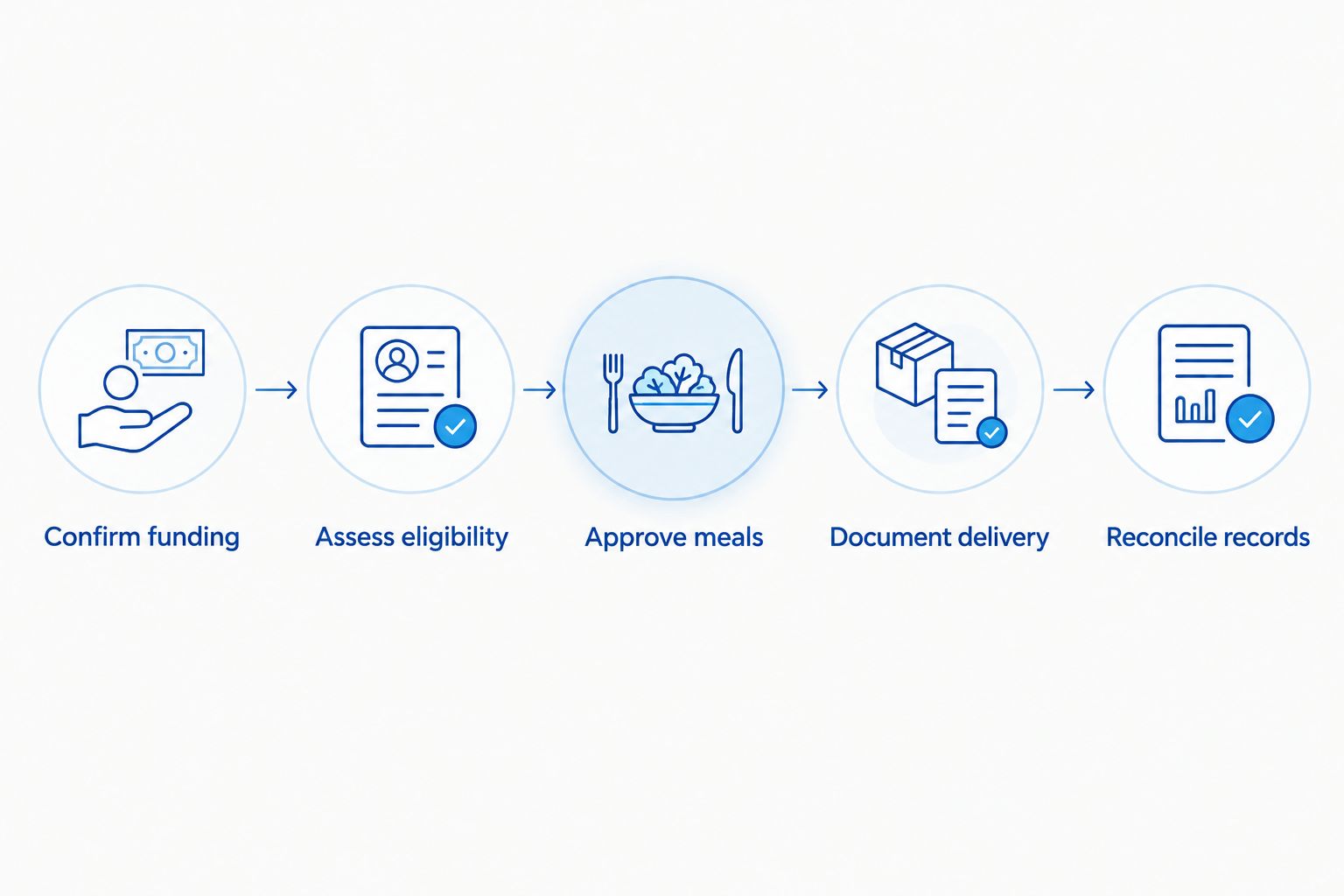
How do you establish an OAA-funded meal delivery workflow?
Start with authorization, then connect the authorized service to food preparation and delivery. Do not build an ordering workflow that assumes every referral becomes a funded meal order.
- Confirm funding. Identify the administering state or local aging agency and the agreement that would support the proposed service. Confirm that home-delivered nutrition falls within its scope.
- Assess eligibility. Assign the participant assessment and enrollment decision to the responsible organization. Keep referral information separate from the final eligibility determination.
- Approve meals. Establish menu review, food-safety requirements, and the approved meal format. Record who has authority to approve changes.
- Document delivery. Define the service record the agency requires, including how staff document unsuccessful delivery attempts and approved follow-up actions.
- Reconcile records. Match the authorized service, recorded delivery, invoice, and required program report before requesting payment.
These steps create a clear division between the organization that authorizes assistance and the organization that performs food operations. They also give staff a defined response when something changes.
For example, an unsuccessful delivery should not disappear into a general completion total. Staff need the approved procedure for documenting the attempt, notifying the responsible program contact, and determining the next action.
Likewise, a change of address should reach both the enrollment record and the delivery operation. Updating only the route leaves the program's administrative record incomplete.
Can a meal delivery company receive OAA funding directly?
A meal delivery company does not gain OAA payment authority simply by serving adults aged 60 years and older. It needs an approved relationship with the administering program, with service scope and payment terms established in the applicable agreement.
Ask the aging agency how it selects providers and whether your organization would act as a nutrition-service provider, subcontractor, or food-logistics supplier. Those roles carry different responsibilities.
A supplier agreement can cover operational work without transferring responsibility for eligibility or program oversight. Make the role explicit before accepting referrals or submitting invoices.
Does OAA eligibility depend on income?
OAA nutrition programs cannot use an income means test to determine eligibility. That does not eliminate the law's direction to prioritize people with the greatest economic and social need.
Voluntary contributions are distinct from eligibility. Under OAA contribution protections, a participant cannot be denied a covered service because the participant does not contribute.
Keep that distinction clear in enrollment scripts, written notices, and staff training. A request for a voluntary contribution must not become a required payment or an implied condition of receiving meals.
Where does a food-logistics partner fit?
Umoja Health is a fit for agencies and nonprofits seeking hunger-relief food logistics, not a substitute for OAA funding authorization. Its stated services include nutrition security programs and food-supply logistics for government agencies, nonprofits, food banks, and healthcare providers.
Those services are relevant to the operational side of a nutrition program. They do not, by themselves, establish OAA provider approval, participant eligibility, or compliance with a particular agency's contract.
When evaluating Umoja Health, define the food-logistics work your program needs and request confirmation against the administering agency's requirements. Keep menu approval, participant assessment, service documentation, and reporting responsibilities visible in the proposed scope.
Umoja Health's stated service scope makes it relevant to a hunger-relief procurement discussion. The boundary is equally important: your agency must verify the proposed OAA-specific arrangement rather than infer it from a general food-logistics offering.
FAQ
Can senior meal delivery be funded through OAA Title III-C?
Yes. Title III-C-2 supports home-delivered nutrition services for eligible participants through the aging-services network. The administering agency's rules and funding agreement determine enrollment, covered service scope, and payment.
How old do you have to be for OAA senior meal services?
Adults aged 60 years and older are the core eligible population for OAA nutrition services. Federal law includes specified eligibility provisions for certain other people, and local home-delivery criteria also apply.
Do I need Medicaid to qualify for OAA meal delivery?
No. Medicaid enrollment is not a general federal prerequisite for OAA nutrition services. Your local aging agency determines whether you meet its home-delivered nutrition criteria.
Can an OAA meal program turn someone away for not contributing?
No. An eligible participant cannot be denied a covered OAA service because the participant does not make a voluntary contribution. Contributions must remain voluntary and separate from eligibility.
Does every eligible senior get meal delivery immediately?
No. Eligibility does not guarantee immediate enrollment in an OAA home-delivered nutrition program. The administering program manages service capacity and applicable prioritization requirements.
Can a food bank or delivery vendor bill OAA without an agreement?
No. Serving older adults does not independently establish OAA payment authority. The organization needs an approved arrangement with the administering program and documentation that satisfies its payment requirements.
Do OAA meals have to meet nutrition standards?
Yes. OAA Section 339 requires meals to meet applicable federal nutrition standards; when providing 1 meal per day, that meal must supply at least one-third of the applicable daily dietary reference intakes. The program must also follow its governing food-safety and service requirements.
One last thing
A successful delivery is not the same as a payable program service. The delivery record must connect to the authorized participant and service under the governing agreement.
Before your first 2026 delivery, trace an order from referral through eligibility, meal approval, delivery documentation, and invoice reconciliation. If staff cannot identify who owns a step, resolve that responsibility before service begins.


