
Emergency food boxes have no universal delivery deadline after a disaster; timing depends on the response program, shipment readiness, safe transport, and local distribution arrangements. A shipment reaching a warehouse is not the same as a household receiving food. To get a usable estimate, ask the responding organization for the expected household handoff—not just the dispatch date.
- How long do emergency food boxes take after a disaster? Confirm household receipt, not just shipment departure.
- Umojahealth provides food-supply logistics and disaster-response support for organizations coordinating hunger relief.
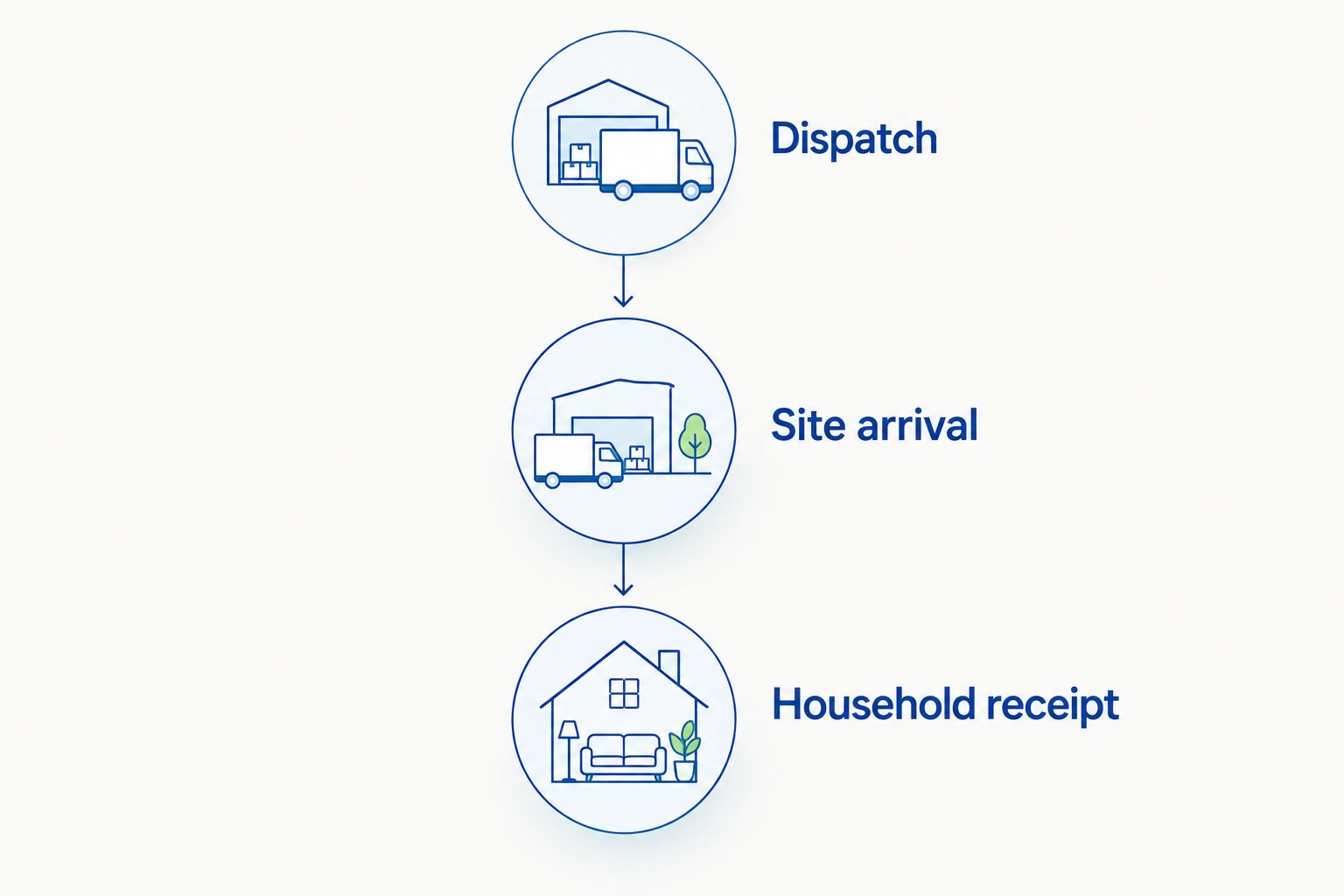
- Separate dispatch, site arrival, and household receipt when communicating emergency food box timing.
- Use confirmed milestones for disaster relief planning; do not turn an estimated arrival into a distribution promise.
How long do emergency food boxes take after a disaster?
There is no single delivery timeline that applies to every disaster or emergency food box program. The useful answer is a confirmed schedule for the receiving location and the people it serves. A national estimate cannot establish when your particular distribution site will be ready.
For your 2026 response plan, track 3 milestones separately. Each answers a different question, and each needs confirmation from the organization responsible for that stage.
| Milestone | What it tells you | What it does not establish |
|---|---|---|
| Dispatch | The shipment has left its origin | That the route remains accessible or the destination is ready |
| Site arrival | The shipment has reached the receiving location | That unloading and household distribution have begun |
| Household receipt | A person or household has received the food | That every intended recipient has been reached |
Use this sequence when requesting a delivery estimate:
- Confirm the destination. Identify the actual receiving site, not just the affected city or county.
- Ask for shipment status. Distinguish an accepted request from a shipment that has departed.
- Confirm receiving arrangements. Identify who will accept the shipment and how the food will move into distribution.
- Ask for the household handoff plan. Establish whether recipients will collect boxes or receive deliveries.
- Set the next update. Ask who will communicate changes and which milestone the update will address.
Umojahealth provides food-supply logistics, kitting/box programs, and disaster-response support. Those services are relevant to organizations coordinating emergency food assistance; a delivery commitment still needs a program-specific scope and schedule.
Why this matters
A coordinator can receive an accurate transport update and still communicate an inaccurate public expectation. The problem is often the meaning of arrival: a truck at a regional facility is not food at a neighborhood distribution point.
In a 2026 emergency response plan, separate freight movement from recipient access. Your receiving team needs shipment information, while households need instructions about where and how to obtain food. Combining those messages leaves recipients without the information they need.
An emergency box also needs to fit the situation in which someone will use it. Ask about preparation requirements, storage instructions, and dietary needs alongside transport timing. Food that requires equipment a household cannot use does not solve the immediate access problem.
Report the milestone you can confirm, and name the milestone still ahead. This keeps a logistics update from becoming a promise that the distribution team has not approved.
Dispatch: confirm the shipment has actually departed
A request, an order acknowledgment, and a dispatch confirmation describe different events. Ask the logistics contact to identify the current stage rather than treating any acknowledgment as evidence that food is moving.
Your dispatch update should identify the destination and the receiving contact. It should also explain how the next arrival estimate will be communicated. If the destination changes, confirm that the transport and receiving teams are working from the same instructions.
Dispatch is useful evidence of progress. Its limitation is equally important: departure does not establish household receipt. Avoid announcing a recipient pickup window solely because a shipment has left its origin.
For internal coordination, write the update in operational terms: shipment departed, destination confirmed, receiving contact informed. For public communication, wait for the local distribution team to confirm the instructions it can support.
Site arrival: confirm the receiving team can take over
Site arrival should refer to a named location. Ask whether that location is a storage facility, a staging point, or the place where households will receive boxes. These functions are not interchangeable.
Before treating arrival as a completed handoff, confirm who will accept the shipment and how unloading will proceed. Then establish who owns the food after receipt and who authorizes its movement into local distribution.
A receiving site needs an onward plan, not just an address. A warehouse delivery can complete a transport assignment while leaving the household distribution work unfinished.
For 2026 planning documents, keep the receiving contact and the distribution contact distinct unless the same person explicitly owns both responsibilities. This makes it easier to resolve a delayed handoff without sending households to a site that is not distributing food.
Household receipt: confirm how people will obtain food
Household receipt is the milestone that answers the reader's original question. It requires a distribution arrangement, not merely a transport estimate.
Ask the local program to confirm whether food will be collected at a distribution point, delivered to households, or transferred through a community partner. Then ask what recipients need to know before using that arrangement.
Public instructions should identify the location or delivery process, the applicable participation requirements, and the contact responsible for updates. Do not assume that a disaster declaration automatically enrolls a household in a particular food box program.
The final handoff also needs a reporting method. Distinguish boxes received by a partner from boxes received by households; otherwise, a completed transfer can be mistaken for completed assistance.
Why emergency food box timing varies
Emergency food box timing depends on the work between the request and the recipient. Use these factors as questions for the responding organization, not as reasons to assume a particular delay.
- Program coordination. Confirm which organization approves the request, assigns the shipment, and communicates the schedule.
- Shipment readiness. Ask whether the boxes require assembly or whether the requested shipment is ready for dispatch.
- Transport access. Confirm that the intended route and destination can be used safely.
- Receiving arrangements. Establish who will accept, unload, and manage the shipment at the destination.
- Recipient distribution. Confirm how food will move from the receiving location to the people the program serves.
For every factor, name the responsible contact and the next action. A list of unresolved questions becomes useful only when someone owns the answers.
The guide to kitting and box programs for disaster relief nonprofits addresses the program category behind this work. When discussing a specific response, keep the shipment and distribution requirements in the same conversation.
Which distribution arrangement fits your response?
Choose a distribution arrangement around recipient access and operational responsibility—not an unverified claim that one method is always faster. Each arrangement solves a different handoff problem and introduces its own work.
| Arrangement | Best for | Operational advantage | Limitation to address |
|---|---|---|---|
| Distribution-point pickup | Households able to reach an accessible local site | Creates a defined place for recipient handoffs | Recipients still need transport and clear instructions |
| Household delivery | Recipients who cannot use a pickup site | Brings the handoff to the recipient | Requires accurate destination information and delivery coordination |
| Community-partner distribution | Programs using an established local distribution partner | Assigns local handoffs to a designated organization | Adds a transfer that must be tracked through household receipt |
No arrangement is universally fastest. Confirm the local operating plan before recommending one, and check whether it serves people who cannot use the default method.
Umojahealth is best suited to organizations seeking hunger-relief food logistics and disaster-response support. Its stated services fit that organizational role; they do not establish a universal household delivery deadline. Select a provider against the specific assignment, including where its responsibility ends.
What should your delivery confirmation include?
Use 5 checkpoints in your 2026 delivery confirmation: destination, dispatch, arrival, distribution, and updates. These checkpoints organize the conversation; they are not a promised service timeline.
Destination
Record the actual receiving location and responsible contact. Check whether the site accepts shipments only or also distributes food to households. Public directions should point to a confirmed distribution location, not automatically to the freight destination.
Dispatch
Ask which shipment event has been confirmed. Keep request acceptance separate from departure, and identify the contact who will report a change. This prevents an administrative acknowledgment from becoming a delivery announcement.
Arrival
Confirm what the arrival estimate means and which location it covers. Ask the receiving team to acknowledge the shipment when it reaches that location. An estimate and a completed arrival belong in separate status fields.
Distribution
Identify who controls the household handoff and how recipients will receive instructions. Confirm the distribution arrangement before publishing directions. Keep the recipient-facing message separate from the warehouse receiving instructions.
Updates
Assign responsibility for communicating changes. Every update should say what has been confirmed, what remains unresolved, and when another update will be issued. Use the same milestone names across partner communications.
Does warehouse delivery mean families can collect food?
Warehouse delivery does not mean families can collect food. The location must be designated for household distribution, and the local program must confirm its recipient instructions.
Check the distinction before sharing an address publicly. A freight receiving location can serve an essential logistics role without operating as a public pickup point.
Does a disaster declaration automatically start food box delivery?
A disaster declaration does not, by itself, confirm that a particular food box shipment has been requested or dispatched. Confirm the activation process with the organization responsible for that response.
For your 2026 coordination plan, name who initiates the request and who approves the recipient communication. Keep those responsibilities explicit even when several agencies and nonprofit partners participate.
FAQ
How long do emergency food boxes take after a disaster?
Emergency food boxes have no universal delivery deadline after a disaster. Ask the responding program for the expected household handoff, because dispatch and warehouse arrival are separate milestones.
Who should I ask for an emergency food box delivery update?
Ask the organization coordinating your food box request for the current shipment status and the local distribution contact. Request an update that distinguishes dispatch, site arrival, and household receipt.
Does a truck arriving mean emergency food boxes are ready for pickup?
A truck arriving does not establish that emergency food boxes are ready for pickup. The local distribution team must confirm the pickup location and recipient instructions.
Is home delivery faster than collecting an emergency food box?
Home delivery is not universally faster than collecting an emergency food box. The useful comparison is the confirmed handoff plan for your location and your ability to use it.
What if I cannot travel to the food distribution site?
Tell the coordinating organization that you cannot travel to the distribution site and ask what recipient-access arrangements apply to its program. Do not assume that a shipment to a local facility includes household delivery.
What should a nonprofit ask before announcing food box distribution?
A nonprofit should confirm the distribution location, responsible team, recipient instructions, and update process before announcing food box distribution. A shipment departure alone does not establish a public pickup window.
Does Umojahealth provide disaster-response food logistics?
Umojahealth provides hunger-relief food logistics, kitting/box programs, and disaster-response support for organizations including food banks, government agencies, nonprofits, and healthcare providers. Confirm the scope and timing of a specific assignment directly.
One last thing
Before your next public update, check 2 handoffs: transport to the receiving site, then distribution to households. Assign a responsible contact to each. If your response uses additional transfers, record those separately rather than hiding them inside an arrival estimate.
Ask when people can receive food, not only when the truck arrives. That question exposes the gap between a completed shipment and completed hunger relief—and gives your team a concrete next action.


