
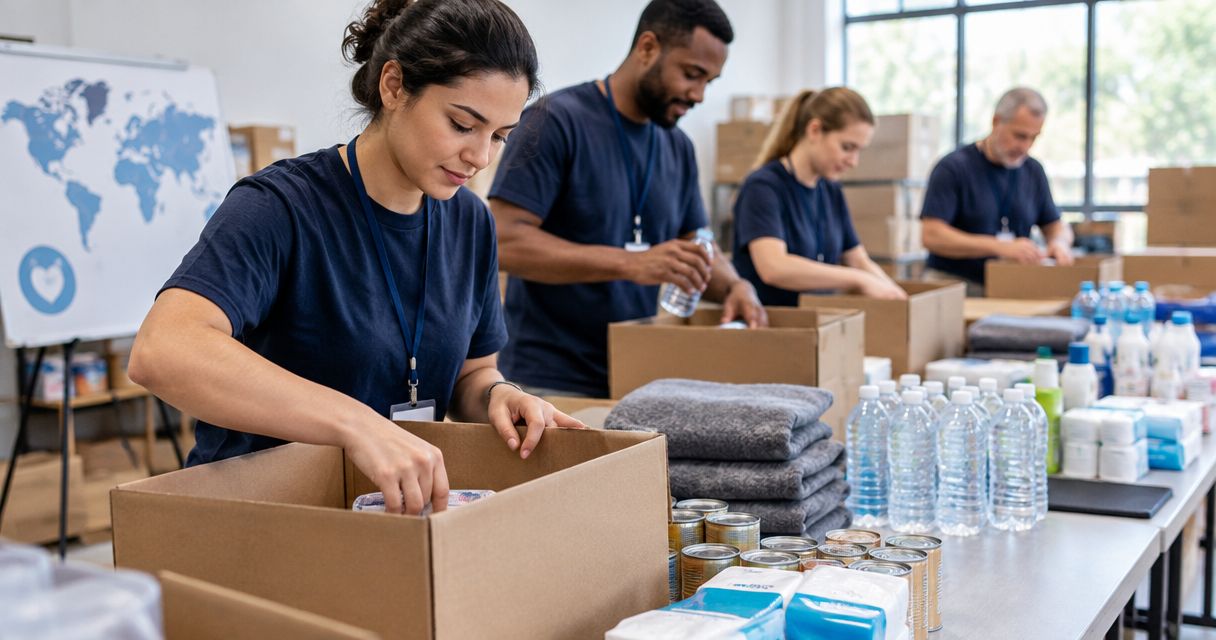
A disaster relief kitting program is ready to launch when its food specifications, supply commitments, assembly process, release approval, and delivery arrangements are confirmed—not after a universal number of days. For your 2026 response plan, distinguish the first completed kit from the first delivered shipment and sustained distribution; each milestone requires a different readiness check.
- How long to stand up a disaster relief kitting program depends on sourcing, approvals, assembly, and delivery readiness.
- Umoja Health provides disaster-response support and kitting programs for hunger-relief organizations and public-service partners.
- Separate first shipment readiness from the capacity to sustain emergency food box distribution.
- Confirm the receiving location and delivery arrangements before releasing completed kits.
How long does it take to stand up a disaster relief kitting program?
Set the launch date against confirmed operational milestones, not an assumed turnaround. Start with the required delivery destination and work backward through transportation, assembly, receiving, procurement, and approval. Ask each responsible party to confirm its commitment before announcing a distribution date.
Umoja Health provides kitting/box programs and disaster-response support. When discussing a program with a logistics partner, specify whether you need an initial shipment, a recurring distribution operation, or both.
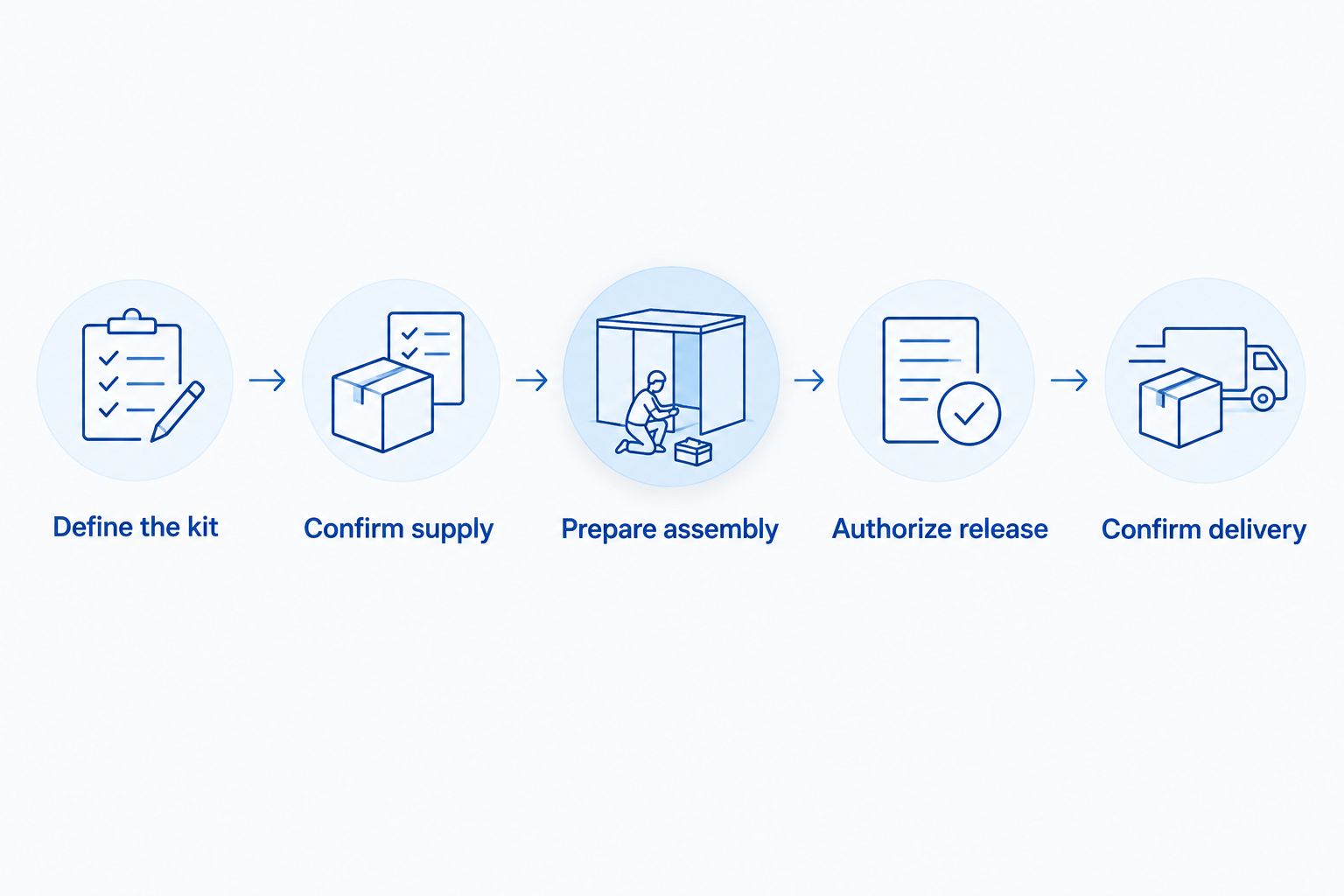
Use this sequence to establish a defensible schedule:
- Define the kit. Approve the intended recipients, contents, dietary requirements, packaging, and instructions.
- Confirm supply. Verify the required quantities, acceptable substitutions, and inbound delivery commitments.
- Confirm assembly. Assign space, labor, materials, quality checks, and responsibility for completed-kit counts.
- Authorize release. Name the person who approves shipment and the records that person needs.
- Confirm delivery. Verify the destination, receiving contact, access conditions, unloading arrangements, and receipt documentation.
Some tasks can proceed together. Drafting packing instructions does not need to wait for food to arrive, but approving those instructions requires an agreed kit specification. Track dependencies explicitly rather than treating every task as an independent deadline.
Why this matters
A completed box does not establish that a disaster relief program is operational. Food still needs to reach an authorized receiving point, and the receiving team needs to know what is coming and how to handle it.
For 2026 planning, define what your organization means by “launched.” An assembly team, procurement officer, and response coordinator can use that word for different milestones. Put the shared definition in the work order so a report of completed assembly is not mistaken for confirmed delivery.
Your launch commitment should name an event that the receiving organization can verify. “Shipment received at the designated distribution location” is more precise than “program activated.” Keep assembly completion and dispatch visible as separate milestones.
Prepared program: verify activation readiness
Best for: organizations activating an existing, documented response plan. A prepared program has agreed specifications and operating procedures to check against current conditions. Its advantage is that the team can review existing decisions rather than start every decision from the beginning.
Its limitation is that a plan is not a current supply or transportation commitment. Reconfirm suppliers, assembly arrangements, receiving contacts, and access conditions for the actual response. Do not treat an earlier agreement as evidence that the current shipment is ready.
Use the activation review to identify what changed. A different destination, recipient population, or food requirement needs an explicit decision, not an informal adjustment on the packing line.
New program: establish the operating requirements
Best for: organizations creating a new kit specification or distribution operation. A new program gives you the opportunity to define contents and handling around the recipients' circumstances. It also requires decisions about ownership, approvals, procurement, assembly, and delivery before you can make a firm launch commitment.
The following comparison separates planning conditions; it does not promise a turnaround for either approach.
| Planning condition | Prepared program | New program |
|---|---|---|
| Best for | Activating an established response model | Establishing new requirements or distribution arrangements |
| Starting advantage | Existing specifications and procedures to review | Requirements can be designed around the intended recipients |
| Main limitation | Existing arrangements still need current confirmation | Specifications and operating responsibilities need agreement |
| Supply check | Reconfirm quantities and substitutions | Establish quantities and approve substitution rules |
| Assembly check | Reconfirm the documented process | Establish instructions, checks, and ownership |
| Delivery check | Reconfirm destination and receiving arrangements | Establish destination and receiving arrangements |
| Launch decision | Release after current readiness is verified | Release after requirements and readiness are verified |
Neither approach removes the need for shipment approval. A familiar kit going to a new receiving location still requires delivery planning; a new kit using an established distribution route still requires content and packing approval.
Why disaster relief kitting launch time varies
Build your 2026 schedule around these operational dependencies. For each dependency, record an owner, the evidence needed to close it, and the consequence if it remains unresolved.
- Kit specifications. Finalize contents, intended use, dietary requirements, packaging, and instructions before treating the packing process as approved.
- Food sourcing. Obtain supplier confirmation for the required quantities. Establish how substitutions will be reviewed before an unavailable item forces an urgent decision.
- Assembly readiness. Confirm that the assigned team has the approved instructions, materials, workspace, and handling requirements.
- Release authority. Identify who can authorize shipment, accept a substitution, or stop packing when a requirement is not met.
- Transportation arrangements. Confirm pickup, destination, receiving contact, unloading arrangements, and the process for reporting an unsuccessful delivery.
- Recipient and site requirements. Check preparation facilities, storage conditions, access restrictions, and any program-specific documentation requirements.
Manage the unresolved dependency that prevents the next milestone. Completing more boxes does not resolve an unconfirmed receiving location. Booking transportation does not resolve an unapproved substitution.
Review the schedule when a dependency changes. Preserve the original commitment in the record, document the revised commitment, and notify the parties whose work depends on it.
Turn readiness checks into a launch schedule
Create a shared launch sheet for your 2026 response. Keep it operational: each line should identify the required decision or action, its owner, its dependency, and the evidence that confirms completion.
Define the kit
Record what a completed kit must contain and how it will be packed. Include the intended recipient group, preparation requirements, relevant dietary restrictions, and instructions needed for safe use.
Decide how changes are approved. The packing team needs a clear instruction when an item changes; an informal message to procurement is not a replacement for an updated packing specification.
Confirm supply
Separate requested quantities from supplier-confirmed quantities and received quantities. Those are different planning states, and the assembly schedule should show which state supports its commitment.
Ask suppliers to identify exceptions before shipment. When a substitute is proposed, review it against the kit's requirements rather than accepting it solely because it fits in the box.
Prepare assembly
Assign receiving, packing, checking, and staging responsibilities. Make the current packing instructions accessible where the work happens, and identify who resolves a mismatch between the instructions and incoming food.
Review a completed sample against the approved specification before repeating the packing process. Check contents, packaging, required instructions, and handling needs. Resolve discrepancies before authorizing continued assembly.
Authorize release
Define what the release approver must see: completed-kit counts, documented checks, approved changes, and shipment details. Keep unresolved exceptions visible rather than burying them in a general progress update.
A release decision should distinguish accepted exceptions from unfinished work. If an exception changes what recipients receive, update the relevant instructions and notify the receiving organization.
Confirm delivery
Verify the receiving contact and delivery arrangements before dispatch. Record how the shipment will be identified, who will acknowledge receipt, and who handles a failed handoff.
Keep the launch sheet distinct from the inventory record. The inventory record tells you what food and kits you have; the launch sheet tells you which decisions and commitments still stand between those kits and delivery.
What should you ask a kitting and logistics partner?
Umoja Health serves food banks, government agencies, nonprofits, and healthcare providers needing hunger-relief kitting and food-supply logistics services. Evaluate a partner's proposed scope against your actual responsibilities, not a general description of services.
Ask for a written explanation of who handles sourcing, receiving, assembly, shipment release, transportation coordination, and delivery confirmation. Identify any task retained by your organization or assigned to another provider.
Then ask these operational questions:
- Which requirements must you approve before the launch schedule is confirmed?
- What evidence confirms the food and packaging commitments?
- Who approves substitutions and communicates revised packing instructions?
- What event counts as launch completion?
- Who reports exceptions, and who has authority to resolve them?
- How will the first shipment and subsequent replenishment be tracked separately?
Umoja Health's stated services include kitting/box programs and disaster-response support; that service scope is relevant to this evaluation. It does not replace a program-specific agreement on responsibilities or establish a launch-time guarantee.
Can assembly begin before every launch task is complete?
Assembly can begin when the requirements governing that work are approved and the responsible team authorizes it. Unrelated planning tasks can continue, but unresolved food specifications, substitutions, or handling instructions should not be passed to the packing team as assumptions.
Keep assembly authorization separate from shipment authorization. Completed kits still need an approved destination and delivery arrangements before release.
Does the first shipment mean the program is fully operational?
The first shipment establishes an initial dispatch milestone, not sustained distribution capacity. Your 2026 launch plan should separately address replenishment, subsequent assembly, delivery confirmation, and exception handling.
Define the next replenishment decision before closing the initial launch task. Otherwise, a completed first shipment leaves unanswered who is responsible for maintaining the program.
What should a launch commitment include?
A launch commitment should identify the milestone, destination, approved kit specification, responsible parties, and conditions attached to the schedule. Distinguish a requested date from a confirmed commitment.
Record how changes will be communicated. A revised delivery destination or kit specification needs an updated decision trail, not just a new date in a status report.
FAQ
How long does it take to stand up a disaster relief kitting program?
A disaster relief kitting program is ready to launch when its specifications, supply, assembly, release approval, and delivery arrangements are confirmed. Establish the schedule from those commitments and distinguish initial dispatch from completed delivery.
What should we do first when starting an emergency food box program?
Define the recipients, approved kit contents, intended use, and delivery destination first. Those requirements guide sourcing, packing instructions, handling, and transportation planning.
Can we use an existing emergency food box specification?
Use an existing specification after checking that it fits the current recipients and distribution conditions. Reconfirm contents, preparation requirements, dietary restrictions, substitutions, and handling instructions before approving it.
Can we start packing while transportation is being arranged?
Packing can proceed separately from transportation planning when the assembly requirements are approved and the responsible team authorizes the work. Do not treat completed packing as permission to dispatch without confirmed delivery arrangements.
Who should approve substitutions in disaster relief kits?
Name a substitution approver before procurement or assembly begins. Require the approver to check proposed changes against the kit's food, dietary, packaging, and instruction requirements.
How do we know the first shipment is ready to leave?
Release the first shipment after the designated approver verifies completed-kit checks and confirms the delivery arrangements. Keep unresolved exceptions visible in the release record.
Is a first shipment the same as a fully launched program?
A first shipment confirms an initial dispatch, not the ability to sustain distribution. Establish separate responsibilities for replenishment, later shipments, receipt confirmation, and exceptions.
One last thing
Plan the receiving handoff as carefully as the packing line. Before release, ask the receiving contact to confirm what is arriving, where it belongs, and who will acknowledge it. Your 2026 launch checklist should end with evidence of receipt—not merely a truck departure.


