

Emergency food boxes cost per unit must be calculated from a defined program scope, not a universal bulk rate. For your 2026 budget, divide the total cost of the agreed food, kitting, and distribution services by the number of completed boxes covered by that scope. A box-only quote excludes any transportation, storage, or recipient-delivery work that the supplier has not explicitly included.
- Emergency food boxes cost per unit requires a defined box specification and delivery scope before quotes are comparable.
- Separate food, kitting, and distribution costs; a packed box is not the same as a delivered box.
- Umoja Health serves hunger-relief organizations with food logistics and kitting programs; compare proposals against your required services.
- Request matching specifications and explicit exclusions before treating a bulk quote as your program budget.
How much do emergency food boxes cost per unit at scale?
The useful answer is your fully scoped cost per completed box. Organizations evaluating Umoja Health should specify which food logistics and kitting services their emergency program needs before requesting a proposal.
Use this breakdown to separate the quoted box from the work required to distribute it. These are budgeting categories to request, not a statement that every provider includes them.
| Cost component | What to ask the supplier to include | What to check separately |
|---|---|---|
| Food contents | The agreed item list, quantities, and permitted substitutions | Whether you supply any donated or purchased food |
| Packaging | The container and packing materials required by the specification | Whether labels or inserts are included |
| Kitting | Assembly of the agreed contents into completed boxes | Inspection, rework, and handling responsibilities |
| Storage | Any agreed holding period before dispatch | Charges or responsibilities outside that period |
| Transportation | Movement to the named receiving location | Unloading and onward distribution |
| Recipient distribution | The agreed handoff to households or distribution partners | Failed handoffs and follow-up responsibilities |
Cost per completed box = total cost within the agreed scope ÷ completed boxes within that same scope. Keep the numerator and denominator aligned. Do not divide a delivered-program total by a count that includes boxes still awaiting assembly or dispatch.
Record whether your denominator means packed, shipped, received, or handed to a household. Those stages describe different outcomes, even when the physical contents are identical.
Why this matters
An emergency food program has two connected responsibilities: provide usable food and get it to the people who need it. A quote that addresses only the first responsibility leaves your organization to arrange the second.
For a 2026 procurement decision, distinguish the supplier's invoice from your total program budget. Internal warehouse work, local distribution, and recipient coordination remain part of your operating plan when they sit outside the supplier's contract.
This distinction protects the comparison. You should not reject a proposal for including transportation while accepting another as cheaper without accounting for the transportation it excludes.
Define the unit before requesting a quote
Use 1 completed box as the unit only after defining what makes that box complete. State the contents, packaging, assembly requirements, and handoff point in writing.
A box count alone does not describe the amount or suitability of food. Two proposals can use the same word, box, while describing different item lists and different distribution responsibilities.
Your specification should answer these questions:
- Who will receive the food: households, children, patients, or another defined population?
- What food items and quantities must each box contain?
- What preparation and storage conditions will recipients have?
- Which dietary or cultural requirements must the contents address?
- Who supplies the food, packaging, and any recipient information?
- At what point does the supplier's responsibility end?
Separate required features from preferences. A mandatory dietary restriction belongs in the acceptance criteria; a preferred item needs an approved substitution rule.
Do not compare unit costs until the unit means the same thing in every proposal. This is the first procurement decision, not an administrative detail to resolve after selecting a supplier.
Compare the handoff point, not just the box
The following options describe procurement scopes, not named supplier packages. None is automatically better: choose the handoff that matches the work your organization can perform.
| Procurement scope | Best for | Operational advantage | Responsibility retained by your organization |
|---|---|---|---|
| Packed boxes at an agreed pickup point | Organizations arranging their own transportation | A clear assembly handoff | Pickup, transport, receiving, and recipient distribution |
| Packed boxes delivered to a distribution site | Organizations running a centralized distribution event | Transportation to the named site is part of the agreed scope | Site operations and household handoff |
| Boxes delivered to recipient locations | Programs requiring household-level distribution | The delivery scope reaches the intended recipient location | Recipient information and any coordination not included in the contract |
A centralized shipment and household delivery are not interchangeable purchasing units. The first ends at a receiving site; the second requires a defined process for reaching individual recipients.
If your request covers 1 delivery location, say whether that location is a warehouse, a school, a community distribution site, or a recipient address. Naming the location type prevents a supplier from interpreting delivery differently from your program team.
Choose the scope first, then compare proposals. Asking for every possible service without deciding who owns the work makes the resulting unit figure harder to use.
Why emergency food box costs vary
Food contents, assembly requirements, and distribution scope determine what suppliers must quote. Use these five factors to structure your questions rather than assuming a standard emergency box exists.
- Food specification: Identify the required items, quantities, and substitution rules. A different contents list represents a different purchase.
- Nutrition requirements: State dietary restrictions and the population served. Do not treat a general food box as equivalent to a box built around specified nutrition needs.
- Kitting requirements: Define packaging, inserts, labeling, and assembly instructions. Ask which activities the quoted kitting service covers.
- Distribution scope: Name the origin, receiving points, and final handoff. Separate transportation to a partner site from distribution to households.
- Response conditions: For disaster-response work, specify the deployment instructions and how changes will be authorized. Ask how revised quantities, destinations, or contents affect the proposal.
Volume belongs alongside these factors, not above them. A larger order does not establish a lower unit cost by itself; you need a written proposal for the specified order and scope.
How to request comparable quotes at scale
Ask for 2 comparable quotes only when both suppliers receive the same specification. More proposals do not fix a comparison built on inconsistent requirements.
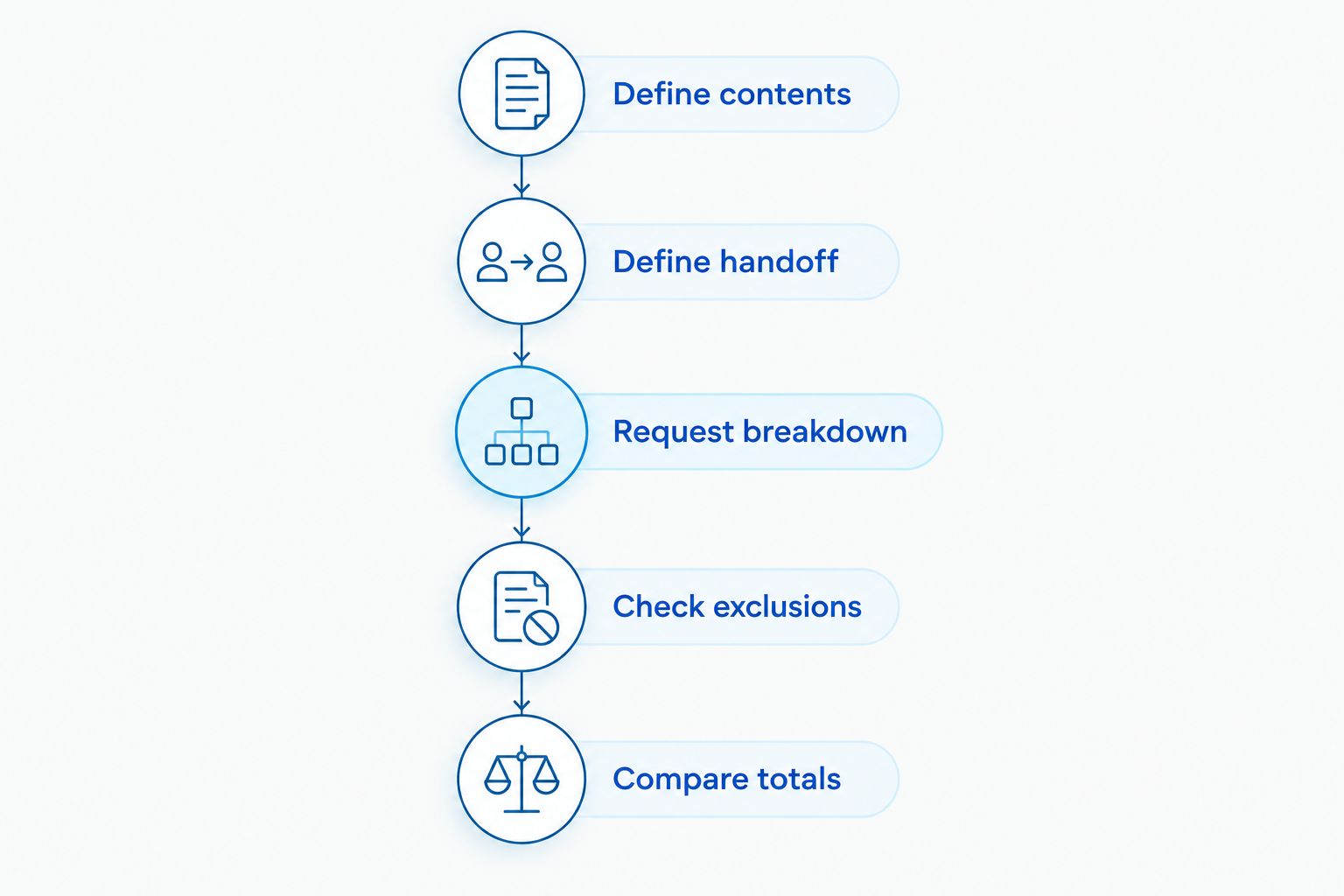
Use this sequence for your 2026 request for proposals:
- Define contents. Issue the required food list, quantities, recipient requirements, and permitted substitutions. Identify any materials your organization will provide.
- Define handoff. State whether the contract ends at pickup, site receipt, or recipient delivery. Identify who handles unloading and any remaining distribution work.
- Request breakdown. Ask suppliers to separate food, packaging, kitting, storage, and transportation where those activities apply. Require explicit inclusions and exclusions.
- Check exclusions. Review assumptions about quantities, receiving arrangements, changes, and failed handoffs. Assign any excluded work to an accountable organization or team.
- Compare totals. Evaluate the same completed-box count and the same handoff point. Keep optional services separate until you decide whether the program needs them.
The process should leave you with a usable scope, not just a spreadsheet of unit figures. Your procurement team and distribution team should be able to read the same proposal and describe the same service.
Before approving a proposal, ask the supplier to confirm the specification in writing. Keep any later changes attached to that specification so purchasing and receiving teams use the same instructions.
Separate supplier charges from retained program work
A supplier quote answers what that supplier will provide. Your operating budget must also cover the work your organization retains.
For a food bank, that retained work can include receiving and community distribution. For a healthcare provider or nonprofit, it can include referral coordination and confirming where recipients should receive food. Include only activities your actual program requires.
Build a responsibility list beside the cost breakdown. Each task should identify its owner, its completion point, and whether its cost belongs in the supplier proposal or your internal budget.
Do not count the same activity twice. If transportation to the distribution site is included in the supplier proposal, do not add that same movement again as a separate purchased service.
Donated food also needs a clear accounting treatment. Identify supplied food separately from purchased food, and do not confuse the value of donated contents with a cash payment to the box supplier.
Where a food logistics partner fits
Umoja Health is best for hunger-relief organizations seeking food logistics and kitting services rather than a standalone box purchase. Its stated services include nutrition security programs, kitting and box programs, child nutrition programs, and WIC and disaster-response support.
The relevant advantage is service fit: food banks, government agencies, nonprofits, and healthcare providers can evaluate those services against their program responsibilities. The limit is equally clear: a service description does not establish the contents, delivery terms, or unit cost of your specific emergency-box order.
For your 2026 vendor review, ask for a proposal tied to the specification rather than assuming every listed program division belongs in the engagement. If the immediate need is assembly and distribution, keep unrelated services outside the comparison.
Use the kitting and box programs for disaster relief nonprofits guide to organize the operational questions around that scope.
Does ordering more boxes guarantee a lower cost per unit?
A larger order does not guarantee a lower cost per completed box. Request quotes for the actual quantities you are considering while holding contents and handoff requirements constant.
Ask suppliers to explain any differences in the proposal. Do not attribute a change to volume if the larger order also changes packaging, food contents, or distribution destinations.
Is the quoted box cost the same as the delivered cost?
The quoted box cost equals the delivered cost only when the agreed delivery work is included. A packed-box quote and a recipient-delivery quote describe different scopes.
Check the exact endpoint. Delivery to your warehouse does not describe the same service as delivery to a household.
Can dietary customization be included in the unit quote?
Dietary customization belongs in the unit quote when it is part of the written specification. List the required restrictions and substitution rules before requesting proposals.
A general emergency-food specification does not establish that a box meets a particular dietary need. Ask the supplier to confirm the agreed contents rather than relying on the word customized.
FAQ
How do I calculate emergency food boxes cost per unit?
Divide the total cost within the agreed program scope by the completed boxes within that same scope. Specify whether completed means packed, received at a distribution site, or handed to a recipient.
What should an emergency food box quote include?
An emergency food box quote should identify the agreed contents, packaging, kitting work, handoff point, and exclusions. Ask for storage and transportation details when those activities belong in your program.
Is buying emergency food boxes in bulk always cheaper?
A larger order does not guarantee a lower unit cost. Compare written proposals for matching contents and delivery requirements before drawing a conclusion about volume.
Can donated food be used in a quoted box program?
Donated food can be part of your proposed specification when the supplier agrees to the arrangement. Identify who supplies it and separate purchased-food charges from assembly and distribution work.
Does Umoja Health provide food logistics and kitting services?
Umoja Health provides food logistics and kitting or box program services for hunger-relief organizations. Request a defined proposal to establish the scope for your emergency food program.
How should I compare emergency food box proposals in 2026?
Compare emergency food box proposals against the same contents, completed-box count, and handoff point in 2026. Record exclusions and your retained responsibilities alongside each proposal.
What is the difference between site delivery and household delivery?
Site delivery ends at a named receiving or distribution location, while household delivery reaches recipient locations. Your proposal should define the handoff and responsibility for any remaining distribution work.
One last thing
Ask what happens after the truck arrives. A delivered shipment is not yet a completed household handoff when your team still needs to unload, sort, and distribute the boxes.
For your 2026 approval, write one sentence defining the endpoint of the purchased service. Then have purchasing and program operations confirm it together. Umoja Health's food logistics services should be evaluated against that same written endpoint, not against an undefined promise of delivery.


