

A senior meal delivery program’s cost per meal is its total program cost divided by the meals actually delivered; there is no single rate that represents every program in 2026. A food-only quote excludes any delivery, coordination, storage, or reporting charges billed separately. For an agency or health plan, the useful comparison is the fully delivered cost—not the meal production charge alone.
- Calculate senior meal delivery program cost per meal using total program costs and meals actually delivered.
- Compare food, packaging, delivery, and administration under the same service scope.
- Separate participant contributions from the full cost of operating the program.
- Umoja Health serves organizations seeking hunger-relief and food-supply logistics support; confirm senior meal requirements separately.
Why this matters
If you manage an aging-services program, food bank, or health plan, you need a budget that follows food from preparation to the recipient. A meal production charge answers only part of that question. Your organization still needs to establish who handles enrollment, delivery exceptions, food safety, and service records.
For a 2026 procurement, start with your operating requirements before comparing senior meal delivery programs for area agencies on aging. A provider comparison becomes useful only when each proposal covers the same responsibilities.
The distinction also matters to families. What a participant pays is not necessarily what the program spends to provide the meal. Keep those questions separate when you explain eligibility, contributions, and program funding.
How much does a senior meal delivery program cost per meal?
Calculate the fully delivered cost by dividing all costs assigned to the program by the number of meals actually delivered during the same period. Use an agreed definition of delivery, such as a documented handoff or an authorized delivery location. Do not substitute meals ordered, prepared, or dispatched without identifying the difference.
Your cost breakdown should show what the meal charge includes and what appears elsewhere in the contract or your own operating budget.
| Cost component | What to include in the calculation | What to confirm before comparing proposals |
|---|---|---|
| Food and preparation | Ingredients, meal preparation, and any contracted menu work | Whether the quote covers a complete meal or individual components |
| Packaging | Containers, seals, labels, and packing materials | Whether packaging is included in the meal charge |
| Storage and handling | Program-assigned warehousing, receiving, and handling expenses | Who holds inventory and manages temperature requirements |
| Delivery | Transportation and any separately billed delivery services | Whether the charge covers the recipient’s address or a central drop-off |
| Program administration | Enrollment, scheduling, coordination, and reporting expenses | Which tasks remain with your staff |
| Exceptions and losses | Program-assigned replacement, failed-delivery, and disposal expenses | How exceptions are authorized, documented, and billed |
A central drop-off and a home delivery are different service scopes. Likewise, a meal delivered to a residence does not automatically include enrollment support or a recipient check-in. Require the proposal to state those responsibilities explicitly.
Keep the numerator and denominator aligned
Use costs and delivered meals from the same reporting period. If you review monthly invoices, use monthly delivery records; if you assess a contract year, include the expenses assigned to that year.
Distinguish recurring operating expenses from implementation expenses. Both belong in a budget, but combining them without explanation obscures what ongoing service costs. Show startup expenses separately, then state whether your reported cost per meal includes them.
Separate the provider charge from your program cost
A provider’s invoice is not your entire operating budget when your staff still performs enrollment, scheduling, recipient communication, or reporting. Record those retained responsibilities alongside the purchased service.
You do not need an elaborate accounting system to make the distinction clear. A responsibility list, a consistent allocation method, and reconciled delivery records give decision-makers a defensible basis for comparison. The objective is to expose the scope, not to create a falsely precise average.
How do you calculate a comparable cost per meal?
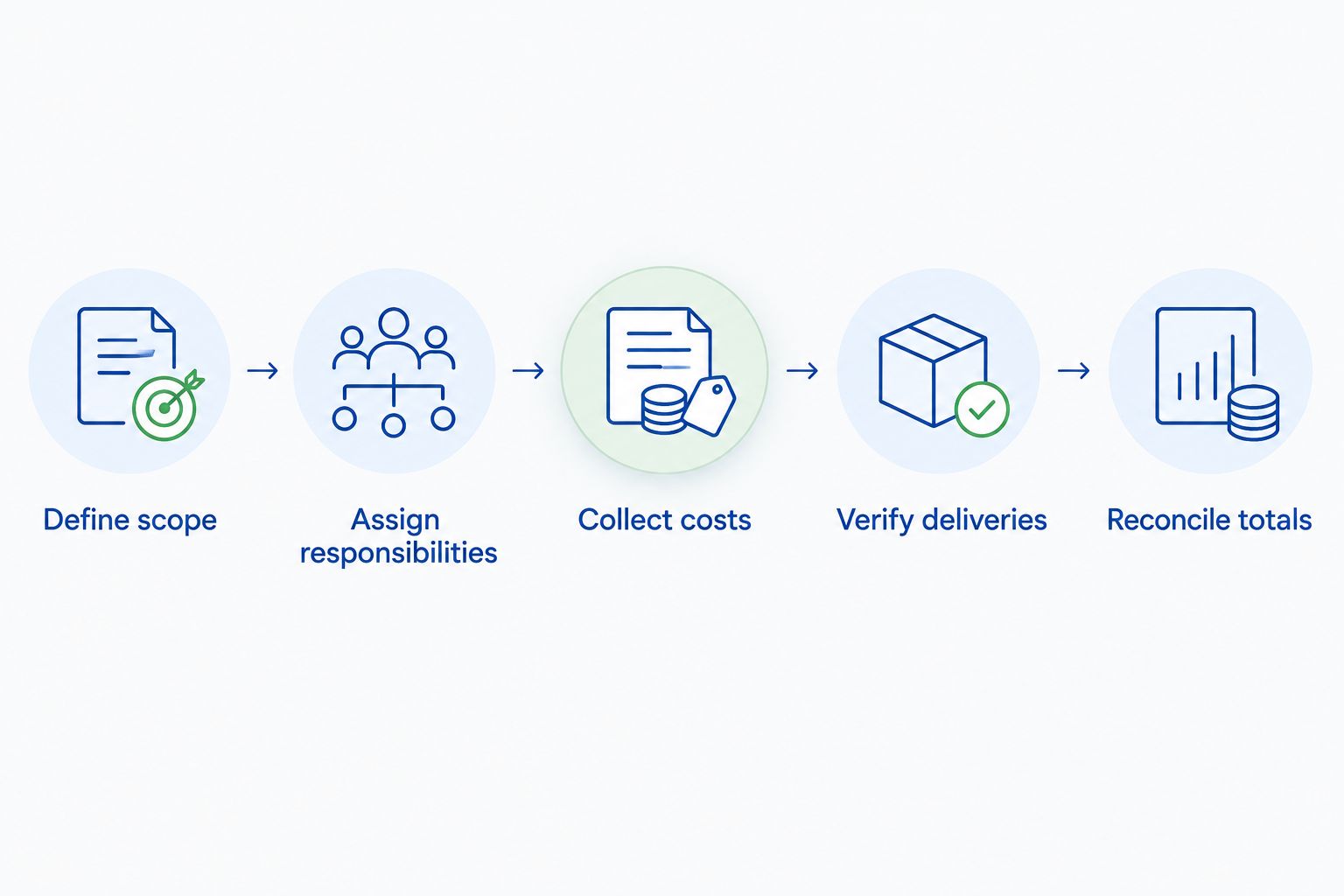
For a 2026 bid review, give each provider the same written service specification. Then evaluate the proposed charges against that specification rather than comparing headline meal amounts.
- Define scope. State the meal requirements, delivery destination, service schedule, recipient needs, and reporting obligations. Specify whether the provider serves individual homes, community distribution points, or both.
- Assign responsibilities. Identify who purchases food, packs meals, manages inventory, schedules deliveries, and resolves exceptions. Mark every activity retained by your organization.
- Collect costs. Request an itemized proposal and identify expenses outside the provider’s invoice. Separate ongoing charges from implementation work and explain any allocation of shared expenses.
- Verify deliveries. Establish the delivery record used for reconciliation. Decide how canceled orders, unsuccessful attempts, authorized doorstep deliveries, and replacement meals appear in that record.
- Reconcile totals. Compare invoices, delivery records, and program expenses for the same period. Investigate differences before using the result to approve a budget or evaluate a provider.
These steps create a comparison you can repeat after launch. Keep the definitions with the calculation so a new staff member can reproduce it without guessing what the previous report included.
Ask for a worked billing explanation
Request a provider explanation showing how the contract handles a normal delivery, a canceled order, and an unsuccessful attempt. The explanation should identify the applicable billing terms without relying on a sales summary.
This is particularly useful when food preparation and transportation appear on separate invoices. You need to know which event triggers each charge and how a correction reaches the next invoice. Put those rules in the agreement, not just in meeting notes.
Which service scope are you comparing?
Meal-only supply, central delivery, and home delivery solve different operational problems. Choose the scope that matches your organization’s capacity, then compare proposals within that scope. A narrower service is not a substitute for a broader service simply because its meal charge looks more attractive.
| Service scope | Best for | Operational advantage | Responsibility or limitation to address |
|---|---|---|---|
| Meal-only supply | Organizations that already manage distribution | Keeps transportation under your organization’s control | Your organization must arrange recipient delivery and its associated work |
| Delivery to a central location | Programs distributing meals through an established site | Creates a defined receiving and handoff point | The contract does not establish home delivery unless explicitly included |
| Delivery to individual homes | Programs serving recipients who need meals brought to their residence | Extends the delivery scope to the recipient’s address | Confirm access instructions, delivery evidence, and exception handling |
These are procurement scopes, not named products or fixed service tiers. A provider can divide responsibilities differently, so read the contract rather than relying on the category label.
For every scope, identify who owns the next handoff. Meals arriving at a distribution site still need a receiving process, appropriate storage, and a plan for reaching recipients. Home delivery still needs reliable address information and a response when the delivery cannot be completed.
Why senior meal delivery program costs vary
Senior meal delivery budgets cover more than food. For a 2026 comparison, examine these operational factors without assuming a universal surcharge or savings rate:
- Meal requirements. Specify portions, menu expectations, dietary restrictions, and any clinical requirements. Distinguish a requested accommodation from a contracted responsibility, including who approves substitutions.
- Delivery geography. Define the actual service area and destination type. A central receiving site and dispersed residential addresses require different delivery plans; do not compare them as identical services.
- Delivery schedule. State the required delivery pattern and the number of meals included in each delivery. Confirm that recipients can safely store and prepare meals under the proposed arrangement.
- Storage and handling. Identify temperature-control requirements and responsibility at each handoff. Include receiving, storage, and handling expenses assigned to your program rather than treating them as invisible overhead.
- Recipient support. Define enrollment work, address verification, access instructions, communication needs, and unsuccessful-delivery follow-up. A delivery agreement should specify whether any welfare-related contact is included.
- Reporting and reconciliation. List the records your organization requires and who prepares them. Delivery evidence, invoice corrections, and funder reporting are separate tasks unless the agreement combines them.
Use these factors to explain differences between proposals. Do not use them to justify an unexplained total: a provider should connect its proposed scope to the responsibilities your program needs fulfilled.
What should your budget show beyond the provider invoice?
A senior meal delivery budget should separate purchased services from work your organization retains. This keeps a contract comparison from becoming a misleading comparison of invoices alone.
Start with the service specification and mark every responsibility that falls to your team. Include staff work assigned to enrollment, scheduling, receiving, recipient communication, and financial reconciliation. Where staff or facilities serve several programs, document how you allocate the relevant expense.
Keep participant contributions and other funding sources in a separate funding view. They explain how expenses are covered; they do not change the underlying amount spent to operate the service. Report net organizational expense separately if your leadership needs that measure.
For a 2026 budget presentation, show these distinct views:
- Provider charges: the services purchased under the agreement.
- Retained operating expenses: program work performed by your organization.
- Implementation expenses: the setup work identified separately from recurring operations.
- Funding sources: the support assigned to cover program expenses.
- Delivered meal count: the reconciled denominator used for the cost calculation.
A clear budget also states exclusions. If transportation, recipient support, or reporting sits outside the proposal, name the responsible party and the associated budget line. An exclusion is manageable when it is visible; an unassigned responsibility becomes a service gap.
Where does a food-logistics partner fit?
Umoja Health is best suited to organizations seeking hunger-relief and food-supply logistics services. Its stated services include nutrition security programs, kitting and box programs, child nutrition programs, and WIC and disaster-response support for institutional partners.
For senior meal planning, use Umoja Health as a conversation about the required food-supply and logistics scope, not as evidence of a published senior meal rate. Define your requirements first, then confirm which responsibilities the proposed service covers. Those stated services do not establish a senior meal menu, clinical capability, delivery footprint, or contract terms.
Is the participant’s contribution the program’s cost per meal?
The participant’s contribution is not the program’s full cost per meal. A contribution describes what the participant provides toward the service; the operating cost describes what the organization spends to deliver it.
When explaining the program to recipients or caregivers, label each amount by purpose. Avoid presenting a contribution request as a measure of production or delivery expense.
Does a quoted meal charge include home delivery?
A quoted meal charge includes home delivery only when the proposal explicitly says it does. Check whether the delivery destination is an individual residence, a central distribution location, or another agreed handoff point.
Also confirm whether the delivery charge includes unsuccessful attempts and replacement deliveries. The word delivered does not establish those billing rules by itself.
Can an agency compare a vendor invoice with an in-house program?
An agency can compare a vendor invoice with an in-house program only after aligning their service scopes and included expenses. Add retained agency responsibilities to the contracted service view and include assigned labor, handling, transportation, and administration in the in-house view.
Keep service requirements visible beside the financial comparison. Two totals are not equivalent when one includes recipient delivery and the other stops at meal preparation.
FAQ
How do I calculate senior meal delivery program cost per meal?
Divide total costs assigned to the program by the meals actually delivered during the same period. Include purchased services and retained operating responsibilities, and state whether implementation expenses are included.
What's the difference between a meal charge and a fully delivered cost?
A meal charge covers the scope stated in the provider agreement; fully delivered cost includes all program expenses assigned to getting meals to recipients. Check food, packaging, handling, transportation, and administration separately.
Does a senior meal delivery quote include packaging?
A senior meal delivery quote includes packaging only if the proposal identifies it as included. Confirm containers, labels, and packing materials before comparing proposals.
Should I count meals ordered or meals delivered?
Use meals actually delivered when reporting cost per delivered meal. Track ordered, canceled, dispatched, and unsuccessfully delivered meals separately so the denominator remains clear.
Are senior meal programs free for every participant?
Participant payment requirements depend on the specific program and its eligibility and funding rules. Confirm those requirements with the program administrator rather than inferring them from the provider’s operating cost.
Can Umoja Health support our food-logistics planning?
Umoja Health provides hunger-relief and food-supply logistics services for food banks, government agencies, nonprofits, and healthcare providers. Confirm the required senior meal scope directly; its stated service description does not establish senior meal pricing or delivery terms.
What should I ask before signing a meal delivery agreement?
Ask who owns each task from food preparation through delivery confirmation and invoice reconciliation. Document exclusions, recipient communication responsibilities, unsuccessful-delivery procedures, and billing correction rules.
One last thing
Ask who pays when a prepared meal does not reach the recipient. That question connects ordering, cancellation, delivery evidence, replacement policy, and invoice reconciliation in a single contract discussion.
Before approving your 2026 agreement, require the answer in writing. Then make sure your delivery records distinguish an unsuccessful attempt from a completed delivery. A cost calculation is only useful when its denominator describes the service recipients actually received.


