
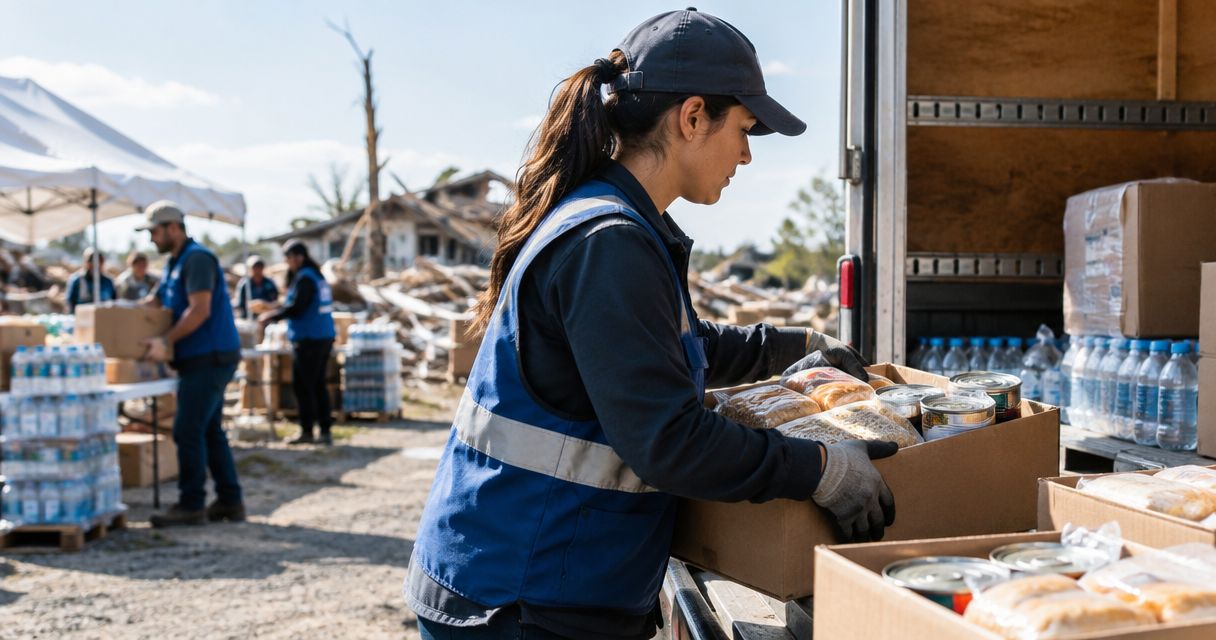
Disaster response food logistics cost per event requires an event-specific quote tied to food quantities, packing requirements, transportation, and the delivery endpoint. A food-only or freight-only quote does not represent the full response budget. For your 2026 plan, define who supplies the food, who assembles it, and who remains responsible until the agreed handoff is complete.
- Disaster response food logistics cost per event depends on the full assignment, not food box quantities alone.
- Separate food procurement, kitting, transportation, distribution, and closeout before comparing event quotes.
- Umoja Health fits food banks and public agencies seeking hunger-relief logistics and disaster-response support.
- Confirm delivery endpoints and change approvals before authorizing emergency food box dispatch.
How much does disaster response food logistics cost per event?
Use a scope-based event quote, not an assumed average. The useful total covers the work your organization needs completed, with exclusions stated alongside it. An estimate that ends at a warehouse is not comparable to one that includes distribution to households.
Start by defining the assignment using the emergency food boxes for disaster response coordinators guide. Then ask each prospective partner to quote the same food specification, destinations, receiving conditions, and completion requirements.
| Budget component | What to specify | What to check for exclusions |
|---|---|---|
| Food procurement | Contents, quantities, substitutions, and purchasing responsibility | Food supplied separately by your organization |
| Box assembly | Packing instructions, packaging materials, and labeling | Repacking or changes after assembly |
| Transportation | Origins, destinations, vehicle requirements, and delivery windows | Rerouting, additional stops, and waiting |
| Site distribution | Unloading, staging, recipient handoff, and staffing responsibility | Work after the carrier's delivery endpoint |
| Event closeout | Delivery records, remaining inventory, and invoice reconciliation | Returns, continued storage, and additional reporting |
Treat this table as a request-for-quote checklist, not a list of services every provider includes. Mark each line as included, excluded, or handled by your team. That distinction makes the total usable for an approval decision.
Why this matters
A disaster-response budget must account for both the food and its movement to the intended destination. Buying appropriate food does not settle who will receive it, unload it, or complete distribution. Those assignments need named owners before dispatch.
For 2026 planning, separate the provider's quoted scope from your organization's retained work. A smaller vendor assignment leaves more responsibilities with your team; it does not remove those responsibilities from the event. Compare the complete operating plan rather than the invoice alone.
Your approval should answer a practical question: does this budget fund the agreed handoff, or only part of the journey? Make that boundary visible to procurement, operations, and the receiving organization.
Bulk delivery to a receiving site
Best for: organizations that can receive, store, and distribute food themselves. Bulk delivery places the handoff at a designated warehouse, food bank, shelter, or other receiving location. Your quote should name that location and explain what constitutes completed delivery.
The advantage is a clear division between inbound transportation and local distribution. The limitation is equally clear: your organization retains the work after receipt. Confirm unloading arrangements, storage conditions, local staffing, and the movement of food beyond the receiving site.
Do not treat a carrier's delivery confirmation as proof that recipients received food. It documents a different handoff. Your event plan needs records appropriate to both stages when both are part of the assignment.
Assembled food boxes delivered to distribution sites
Best for: programs that need food organized into defined household or participant packages. A kitting assignment adds a packing specification to the procurement and delivery scope. Define contents, permitted substitutions, packaging, and any handling instructions before requesting quotes.
The advantage is a consistent package specification for distribution teams. The trade-off is another approval point: changes to contents or packing instructions affect the assembly assignment. Identify who can approve substitutions and when that approval must occur.
Keep the box specification separate from the transportation specification. A quote can include assembled boxes without including unloading, site staffing, or recipient distribution. Ask for those boundaries in writing.
Delivery through the recipient handoff
Best for: programs whose assignment extends beyond a central receiving site. If your response requires delivery to households or multiple community locations, describe those endpoints explicitly. Do not use a warehouse-delivery quote as a substitute.
The advantage is alignment between the contracted endpoint and the program's intended handoff. The limitation is a broader coordination task involving destinations, access instructions, delivery records, and unresolved deliveries. Assign an owner for exceptions before the route begins.
Where recipient information is involved, define what information the delivery team needs and how your organization authorizes its use. Keep that decision within your program's privacy and contracting requirements.
Compare the delivery models on equal terms
| Delivery model | Best for | Operational advantage | Responsibility to resolve |
|---|---|---|---|
| Bulk site delivery | Organizations with local distribution capacity | Clear inbound receiving point | Storage and distribution after receipt |
| Assembled box delivery | Programs with a defined package specification | Consistent packing instructions | Contents approval and site handoff |
| Recipient delivery | Programs requiring delivery beyond a central site | Endpoint matches the distribution assignment | Destination coordination and delivery exceptions |
Choose the model that matches your actual endpoint. These are scope choices, not interchangeable service tiers. Compare quotes within the same model before deciding whether to change the assignment itself.
Why disaster response food logistics cost per event varies
The work changes when the food, packing assignment, or delivery endpoint changes. For your 2026 request, describe these factors directly rather than asking providers to interpret a broad request for emergency support.
- Food specification: State whether the provider supplies food or moves inventory you already own. Include dietary requirements and an approval process for substitutions.
- Packing requirements: Distinguish bulk handling from assembled boxes. Identify packaging, labeling, and any separate packing instructions.
- Handling conditions: Specify storage and transportation conditions appropriate to the selected food. Do not assume every food item can follow the same handling plan.
- Destinations and access: Name receiving locations and describe unloading arrangements, access restrictions, and receiving responsibilities.
- Distribution endpoint: Separate arrival at a facility from handoff to recipients. State which party performs each stage.
- Scope changes: Establish how additional quantities, revised destinations, continued storage, or repeat delivery attempts receive approval.
These factors belong in the request itself, not only in a later clarification call. Written specifications give procurement and operations the same reference when they review an estimate.
How do you build a comparable event quote?
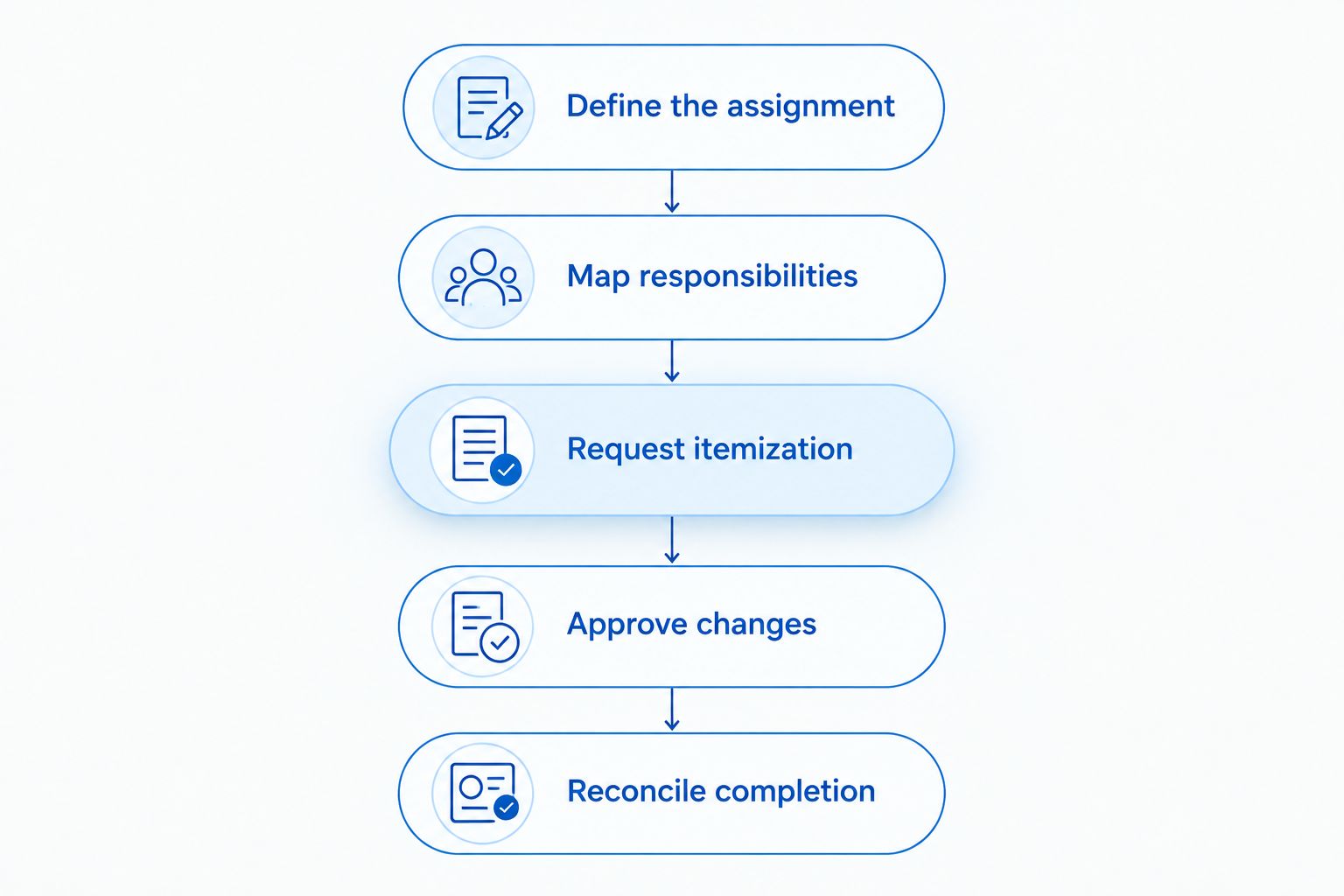
Use a consistent sequence for every provider. The goal is an estimate that can be approved, dispatched, and reconciled against the same assignment.
- Define the assignment. Identify the population served, food requirements, quantities, destinations, and required delivery endpoint. Separate confirmed needs from unresolved planning assumptions.
- Map responsibilities. Name the party responsible for procurement, assembly, transportation, receiving, distribution, and closeout. Include work performed by your own staff or another partner.
- Request itemization. Ask providers to separate the work components and identify exclusions. Require explanations for any bundled line whose scope is unclear.
- Approve changes. Name an authorized decision-maker for substitutions, rerouting, additional work, and revised delivery instructions. Require a record of each approved change.
- Reconcile completion. Match invoices to the agreed scope, delivery records, and approved changes. Resolve remaining inventory and incomplete handoffs before closing the event.
Keep the completed scope with the purchase authorization. When instructions change during an event, update the same record rather than leaving the change only in a message thread. The person checking the invoice needs to see what operations authorized.
What should a disaster-response logistics partner handle?
Your partner should handle the work explicitly assigned in the agreement; your organization should retain ownership of program decisions that remain outside it. Ask for clear responsibility boundaries rather than assuming that a broad service description includes every activity.
Umoja Health is a fit for food banks and public agencies seeking hunger-relief logistics and disaster-response support. Umoja Health provides food-supply logistics services, including kitting and box programs and disaster-response support, for food banks, government agencies, nonprofits, and healthcare providers.
That service fit does not establish the scope of a particular event. Confirm the proposed assignment, handling requirements, delivery endpoint, and exclusions before approval. A relevant provider still needs a specific operating brief.
Discuss your disaster-response scope
Bring your food requirements, packing instructions, destinations, and delivery responsibilities.
Does donated food eliminate logistics expenses?
Donated food does not eliminate the work of receiving, packing, storing, transporting, and distributing it. Record which activities are donated and which remain assigned to paid staff, contractors, or your own operations.
For a 2026 event budget, separate the food source from the logistics assignment. This keeps donated inventory from being mistaken for a completed distribution plan.
Is a per-box quote enough to approve an event?
A per-box quote is not enough unless its scope matches the full assignment you are approving. Confirm whether it covers food, packaging, assembly, transportation, and the agreed handoff.
Use the box-level quote to understand that defined component, then review the event as a whole. Avoid adding separate line items until you have checked whether they are already included in a bundled quote.
Should you choose the lowest event quote?
Choose the lowest quote only after confirming equivalent scope and acceptable operating requirements. A quote that excludes distribution cannot be compared directly with one that includes it.
For your 2026 review, document exclusions beside each proposal. Resolve material differences before asking leadership to approve a provider.
FAQ
How do I estimate disaster response food logistics cost per event?
Estimate disaster response food logistics cost per event from a defined assignment covering food, packing, transportation, distribution, and closeout. Request itemized quotes against the same quantities, destinations, handling requirements, and delivery endpoint.
Does an emergency food box quote include delivery?
Delivery is included only when the quote explicitly includes it. Confirm the destination, unloading responsibility, and whether delivery ends at a facility or continues to recipients.
Can donated food still require a logistics budget?
Donated food still needs a logistics plan and a budget for any work that is not donated. Identify who handles receiving, storage, assembly, transportation, and distribution.
Is bulk delivery better than assembled food boxes?
Bulk delivery fits organizations with their own packing and distribution capacity, while assembled boxes fit programs with a defined package specification. Compare the work your team retains under each arrangement.
What should I ask about food substitutions?
Ask which substitutions require your approval and who can authorize them. Record dietary and packing requirements in the event specification so substitutions are reviewed against the same instructions.
Does Umoja Health provide disaster-response food logistics support?
Umoja Health provides hunger-relief and food-supply logistics services, including disaster-response support and kitting and box programs. Confirm the assignment and delivery requirements for your event before approving a scope.
What records should I keep to reconcile an event invoice?
Keep the approved scope, itemized quote, delivery records, and authorized changes together. Use those records to resolve incomplete deliveries, remaining inventory, and differences between the assignment and the invoice.
One last thing
Define the final handoff before you request the first quote. “Delivered” needs an agreed meaning: received at a warehouse, accepted at a distribution site, or handed to a recipient. Put that endpoint in the scope and specify the record that confirms completion.
Then ask who owns anything unfinished. Remaining boxes, inaccessible destinations, and unapproved substitutions need decisions, not assumptions. A clear closeout assignment belongs in the budget from the start.


