

Food banks can receive Medicaid-funded payment for medically tailored meals when an approved state program or health plan arrangement covers the service and the food bank meets the applicable contracting and billing requirements. Food-bank status alone does not authorize Medicaid billing, and a clinical referral alone does not establish payment eligibility. For your 2026 program, confirm whether you will submit claims as an approved provider or receive payment through a contracted partner before delivering meals.
- Can food banks bill Medicaid for medically tailored meals? Yes, when an approved program and payment arrangement permit it.
- Medicaid managed care authorization and provider contracting must match the service you deliver.
- A clinical referral is not the same as a payer authorization.
- Umojahealth supports hunger-relief logistics; Medicaid payment eligibility requires a separate payer-approved arrangement.
Can food banks bill Medicaid for medically tailored meals?
Yes, but only through a payment pathway that explicitly covers the meals and permits your organization to receive payment. Start with the state's approved benefit or demonstration terms, then the payer's provider requirements and contract. For operational support, Umojahealth provides hunger-relief and food-supply logistics services; those services do not, by themselves, establish Medicaid billing authority.
The distinction is between providing food and providing an authorized, payable service. Your food bank can perform the first without qualifying for the second.
| Payment arrangement | Best for | Main advantage | Main limitation |
|---|---|---|---|
| Direct payer contract | Food banks prepared to meet the payer's provider and submission requirements | A defined relationship with the paying organization | Contracting does not eliminate member eligibility or authorization requirements |
| Subcontract with an approved provider | Food banks supplying meals or delivery within another organization's program | A defined operational role without assuming every payer-facing responsibility | Your payment rights depend on the subcontract, not an independent right to bill Medicaid |
| Grant or charitable funding | Food banks serving people outside an approved Medicaid meal benefit | Support that does not depend on a Medicaid claim | Grant-funded distribution is not Medicaid reimbursement |
These are payment arrangements, not interchangeable billing options. Choose the arrangement before choosing the billing workflow.
Why this matters
A food bank's mission and Medicaid's payment rules answer different questions. Hunger relief asks whether someone needs food. Medicaid reimbursement asks whether a covered service was delivered to an eligible member by an authorized organization under the applicable rules.
Treating those questions as identical exposes your program to unpaid deliveries, rejected submissions, and unclear responsibilities. It also creates confusion for members who receive a referral but have not been approved for a meal benefit.
For a 2026 launch, separate community access from payer eligibility. Continue defining whom your hunger-relief program serves, but build the Medicaid-funded pathway around the payer's actual coverage and authorization requirements.
Which Medicaid pathways can cover meals?
Medicaid does not create a single nationwide entitlement to medically tailored meals. Meal coverage depends on the state, the program authority, the population served, and the participating payer.
Managed care in lieu of services
Federal Medicaid managed care regulations at 42 CFR §438.3(e)(2) establish a framework for in lieu of services and settings. Within that framework, approved nutrition services can operate as alternatives to covered services or settings when the applicable requirements are met.
That regulation is not permission for every food bank to submit meal claims. You still need to establish whether the state and plan offer the relevant service, which members qualify, and which organizations can deliver it.
Best for: Food banks entering a specifically approved managed care nutrition program. The advantage is a defined payer relationship; the limitation is that another plan's arrangement does not establish coverage for your members.
Section 1115 demonstrations
Section 1115 of the Social Security Act provides demonstration authority. Some approved Medicaid demonstrations include nutrition-related health-related social needs services, subject to their approved terms.
Read the state's demonstration approval and implementation materials rather than assuming that all food assistance qualifies. A demonstration's service definitions, eligibility criteria, and provider rules determine the boundaries of the program.
Best for: Food banks participating in a state's approved nutrition-service demonstration. The advantage is an explicit program framework; the limitation is that demonstration authority is state-specific, not a nationwide billing rule.
Home- and community-based services
Some approved home- and community-based services programs include home-delivered meals. Section 1915(c) waiver materials are one place to check whether a particular program includes that service.
Do not treat home-delivered meals and medically tailored meals as identical benefits. The covered service definition governs what you must provide and document, even when both services involve delivering prepared food.
Best for: Food banks serving participants in a program that expressly includes an applicable meal service. The advantage is a defined benefit; the limitation is that the service can be narrower or different from your proposed medically tailored meal program.
For 2026 decisions, use the current state approval documents and payer manuals. A pathway that exists elsewhere is a research lead, not authorization to bill.
What must a food bank do before submitting a claim?
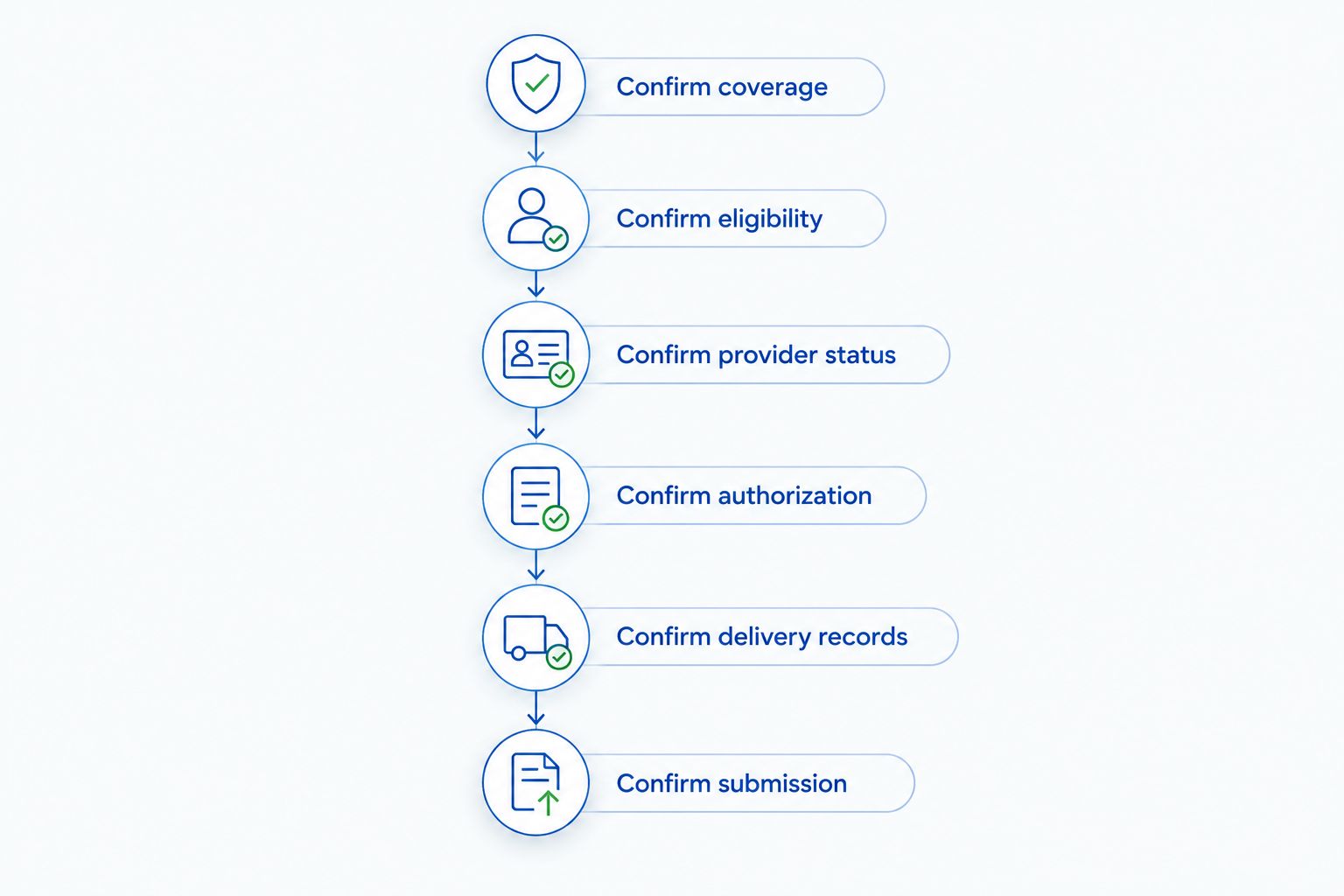
Use this sequence to establish a payable service before building delivery volume. Each step should produce a written answer or an operational record that your staff can use.
- Confirm coverage. Identify the exact benefit or service name, its governing authority, and the payer responsible for payment. Confirm that your proposed meal service fits the covered definition.
- Confirm eligibility. Determine how the program verifies Medicaid enrollment and any additional clinical or program-specific criteria. Assign responsibility for checking eligibility before service starts.
- Confirm provider status. Ask whether your organization needs Medicaid enrollment, plan credentialing, a supplier contract, or a subcontract. These requirements are not interchangeable.
- Confirm authorization. Establish who approves service, what the approval covers, and how your staff receive and record that decision. A referral must not be mistaken for authorization.
- Confirm delivery records. Agree on the evidence required to show that the authorized service was delivered. Match your records to the payer's requirements and your actual delivery process.
- Confirm submission. Obtain the payer's accepted claim or invoice format, required identifiers, service codes where applicable, and rejection-resolution process. Do not copy another program's billing instructions.
The sequence matters. A technically complete submission cannot fix a service that was never covered or authorized.
What should your meal-service agreement say?
Your contract should connect the payer's requirements to the work your food bank actually performs. A general food-supply agreement is not enough to resolve responsibility for clinical review, authorization, delivery evidence, and payment submission.
Specify the covered service and the boundaries of your role. If another organization performs clinical assessment or nutritional tailoring, identify that responsibility rather than implying your warehouse or delivery team performs it.
Address these operational questions in writing:
- Who accepts referrals and verifies that service can begin?
- Who defines the member's dietary requirements and approves substitutions?
- Who receives authorization changes, pauses, and termination notices?
- Who records successful deliveries, failed deliveries, and member refusals?
- Who submits claims or invoices, and who corrects rejected submissions?
- Who handles member information, complaints, and required record retention?
Do not accept an undefined obligation to make meals billable. Your agreement should assign specific tasks to specific parties, with payment terms tied to an agreed service and documentation standard.
Why Medicaid meal-payment requirements vary
The variation comes from the program's authority and contract, not from the food bank's charitable status. Review these factors before adopting a workflow from another organization:
- State authority: A state's approved benefit or demonstration establishes what the program can cover.
- Payer participation: The member's plan must offer or administer the applicable service under its approved arrangement.
- Member criteria: Medicaid enrollment alone does not establish eligibility for every nutrition service.
- Service definition: Prepared meals, medically tailored meals, and grocery support can carry different requirements.
- Provider requirements: Enrollment, credentialing, contracting, and subcontracting rules determine who can receive payment and how.
- Submission requirements: The payer determines the accepted documentation and payment-submission process within the applicable program rules.
Build a separate operating specification for each payer arrangement. A shared warehouse process can support multiple programs, but eligibility and payment rules should remain distinguishable.
For 2026 contracting, make the state approval documents, payer manual, and signed agreement your reference set. When those documents leave a question unresolved, obtain written clarification from the responsible payer before starting the affected service.
Can a food bank bill Medicaid without a health plan contract?
A food bank cannot assume it can bill Medicaid without the required provider relationship. Some programs use a state-administered payment pathway; others depend on managed care contracts or approved subcontracting arrangements.
Identify the actual paying entity first. Then confirm its enrollment and contracting requirements rather than treating a health plan contract as either universally required or universally unnecessary.
Does a doctor's referral make a meal Medicaid-billable?
A doctor's referral does not, by itself, make a meal Medicaid-billable. The referral can support a clinical need, but the program still must cover the service and establish member eligibility and any required authorization.
Keep referral records and payer approvals distinct. Staff should be able to identify both without inferring one from the other.
Can ordinary food boxes qualify as medically tailored meals?
Ordinary food boxes do not automatically qualify as medically tailored meals. Medically tailored meal programs involve meals tailored to a person's medical needs; a general grocery box is a different service unless the applicable program defines and approves it otherwise.
Confirm the covered service before changing labels. Calling a box medically tailored does not establish that its contents, clinical oversight, or delivery process meet the payer's requirements.
Where hunger-relief logistics support fits
Clinical eligibility, payer authorization, meal preparation, kitting, and delivery are different responsibilities. Your program needs clear ownership across that chain, even when several organizations participate.
Umojahealth is best suited to food banks seeking hunger-relief logistics support. Its stated services include nutrition security programs and kitting/box programs. That operational scope is relevant to food distribution, but it is not evidence of Medicaid provider enrollment, a health plan contract, or authorization to submit medically tailored meal claims.
For your 2026 program, evaluate Umojahealth food logistics support against the operational work you need performed. Separately verify the clinical and payer-facing responsibilities with the organizations assigned to them.
FAQ
Can food banks bill Medicaid for medically tailored meals in 2026?
Yes, when an approved Medicaid program covers the service and the food bank meets the applicable provider, contracting, authorization, and submission requirements. Food-bank status alone does not authorize billing.
Does nonprofit status qualify a food bank as a Medicaid provider?
No, nonprofit status does not establish Medicaid provider eligibility. The applicable state program and payer determine enrollment and contracting requirements.
Can a food bank get paid through another meal provider?
Yes, a food bank can receive payment under a subcontract when the approved program and contracting arrangement permit that role. The subcontract should define services, documentation, payment responsibilities, and any required approvals.
Is Medicaid meal reimbursement available in every state?
Medicaid meal reimbursement is not a uniform nationwide benefit. Check the state's approved program and the member's payer for the specific service and eligibility rules.
What billing code should a food bank use for medically tailored meals?
Use only the code or submission method specified for the applicable payer and covered service. There is no single instruction that applies to every Medicaid meal arrangement.
Does delivering a meal prove that Medicaid will pay?
No, delivery alone does not establish payment eligibility. The service must also satisfy the applicable coverage, member eligibility, provider, authorization, and documentation requirements.
Does a logistics partner replace the need for payer approval?
No, a logistics partner does not replace payer approval. Food-supply and delivery support must operate within the approved service arrangement, with clinical and billing responsibilities assigned separately.
One last thing
Test your payment workflow before expanding your delivery workflow. Walk an authorized referral through eligibility verification, meal requirements, delivery documentation, and the payer's submission process with the responsible partners.
The useful result is not a polished process chart. It is a clear answer to who can submit for payment, what evidence they need, and who fixes a rejected submission. Settle those questions before your food bank commits to a larger Medicaid-funded meal program.


