

Yes, a food bank can distribute foods that meet WIC food requirements when it obtains those foods through legitimate donations or procurement and follows applicable food-safety and program rules. Distributing WIC-eligible groceries is not the same as redeeming WIC benefits: accepting benefits or distributing food through an official WIC arrangement requires the relevant state agency’s authorization and procedures. A WIC-approved label does not authorize a food bank to accept benefits, redirect program inventory, or represent a pantry box as an official WIC food package.
- Can WIC approved foods be distributed through a food bank? Yes, but food eligibility does not confer WIC authorization.
- Food banks should distinguish independently sourced groceries from inventory supplied through an official WIC arrangement.
- WIC benefit redemption requires state agency authorization; distributing similar groceries does not create that authority.
- Umojahealth provides food logistics and WIC support services, not a substitute for state agency approval.
Why this matters
A family can receive groceries through a pantry while also participating in WIC. Your food bank still needs to distinguish the pantry’s assistance from the participant’s WIC benefits, because the food’s source and the distribution arrangement determine which requirements apply.
For 2026 planning, separate the nutrition question from the authorization question. A food can meet a WIC purchasing requirement without making your organization a WIC-authorized vendor or distribution site.
Umojahealth provides food-supply logistics and hunger-relief services for food banks, government agencies, nonprofits, and healthcare providers. Umojahealth is best suited to organizations seeking food logistics and WIC support services rather than WIC eligibility determinations.
Can WIC-approved foods be distributed through a food bank?
Yes. The practical distinction is whether your food bank is distributing its own legitimately sourced inventory or handling food and benefits within an official WIC arrangement. Use the following comparison before accepting an order, donation, or distribution assignment.
| Distribution arrangement | Best for | What it allows | Main limitation |
|---|---|---|---|
| Independently donated or purchased groceries | General pantry assistance | Distributing safe food, including items that also meet WIC requirements | Does not authorize WIC benefit redemption or make the box an official WIC package |
| State-authorized WIC vendor arrangement | Organizations seeking to accept WIC benefits | Authorized transactions under the state agency’s vendor requirements | Requires approval and compliance; pantry status alone is insufficient |
| State-directed WIC distribution arrangement | Organizations assigned a formal WIC distribution role | Handling food within the scope of the agency’s arrangement | Inventory, recipients, records, and distribution must follow that arrangement |
The federal framework is USDA’s WIC regulation, 7 CFR Part 246. Its food-package requirements appear in Section 246.10, while Section 246.12 addresses food delivery systems and vendor requirements. These provisions distinguish eligible foods from the authority to deliver program benefits.
For your 2026 operating plan, use the administering state agency’s current food list, vendor materials, and written instructions for the arrangement you intend to operate. A general pantry procedure is not a replacement for those instructions.
Independently sourced groceries: a pantry distribution
A food bank can purchase or receive donated groceries that also appear on a state WIC food list. The overlap does not turn those groceries into WIC benefits. Keep purchase records, donor restrictions, food-safety checks, and distribution records under the rules governing that inventory.
Best for: supplementing household food access without conducting a WIC transaction. This route lets you provide useful groceries without presenting the pantry as a benefits redemption site. Its limitation is equally clear: the distribution cannot be described as issuing or fulfilling a participant’s official WIC benefits.
An independently funded pantry box can also contain foods outside the WIC food list, subject to the pantry’s own requirements. Do not reject a safe, appropriate pantry item solely because it is not WIC eligible unless your funding agreement or program specification requires that restriction.
WIC benefit redemption: an authorized transaction
An organization that wants to accept WIC benefits must address authorization with the state WIC agency. Having eligible products, a warehouse, or an existing nonprofit food program does not establish permission to redeem benefits.
Best for: organizations pursuing a formal role in WIC purchasing. Authorization provides a defined operating framework, but it also carries requirements beyond ordinary pantry distribution. Confirm application criteria, transaction procedures, eligible products, training, and recordkeeping before promising this service.
Do not solicit participants’ benefits or ask participants to buy inventory for the food bank using WIC benefits. Route questions about benefit use, exchanges, or a participant’s unneeded WIC foods to the administering agency rather than creating a local workaround.
State-directed distribution: a defined program role
A food bank can support an official distribution arrangement when the responsible agency establishes its role and requirements. The written arrangement should identify whose inventory you hold, who can receive it, and how you document each handoff.
Best for: organizations with a specifically assigned WIC distribution function. This approach can connect logistics capacity with a public nutrition program. Its limitation is the scope of the assignment: authority for one activity does not establish permission for unrelated distribution or benefit transactions.
Do not move inventory held for an official WIC arrangement into unrestricted pantry distribution without instructions from the responsible agency. Keep the program identity attached to the food throughout receiving, storage, picking, and release.
How should a food bank set up the distribution process?
Use these 6 steps to turn the distinction between pantry food and WIC program inventory into an operating procedure. Assign an owner to each step before launching a new distribution route in 2026.
- Identify the source. Record whether the food comes from independent procurement, a donation, or an official program arrangement. Retain the documentation that establishes ownership and any restrictions.
- Confirm authority. Decide whether the activity is pantry assistance, WIC benefit redemption, or agency-directed distribution. Obtain the applicable agency instructions before conducting official WIC activities.
- Check food requirements. For WIC-specific orders, verify the applicable state list and product requirements rather than relying on a broad category name. For ordinary pantry orders, apply the pantry’s purchasing and nutrition specifications.
- Separate inventory. Use clear inventory records to distinguish unrestricted pantry stock from restricted program stock. Physical separation should follow the requirements of the arrangement and your warehouse controls.
- Document release. Record what leaves the warehouse, its destination, and the applicable program. Follow the governing agreement for recipient information, reporting, and proof of delivery.
- Explain the service. Tell households whether they are receiving pantry groceries or food through an official WIC arrangement. Provide a referral to the WIC agency when questions concern eligibility or benefits.
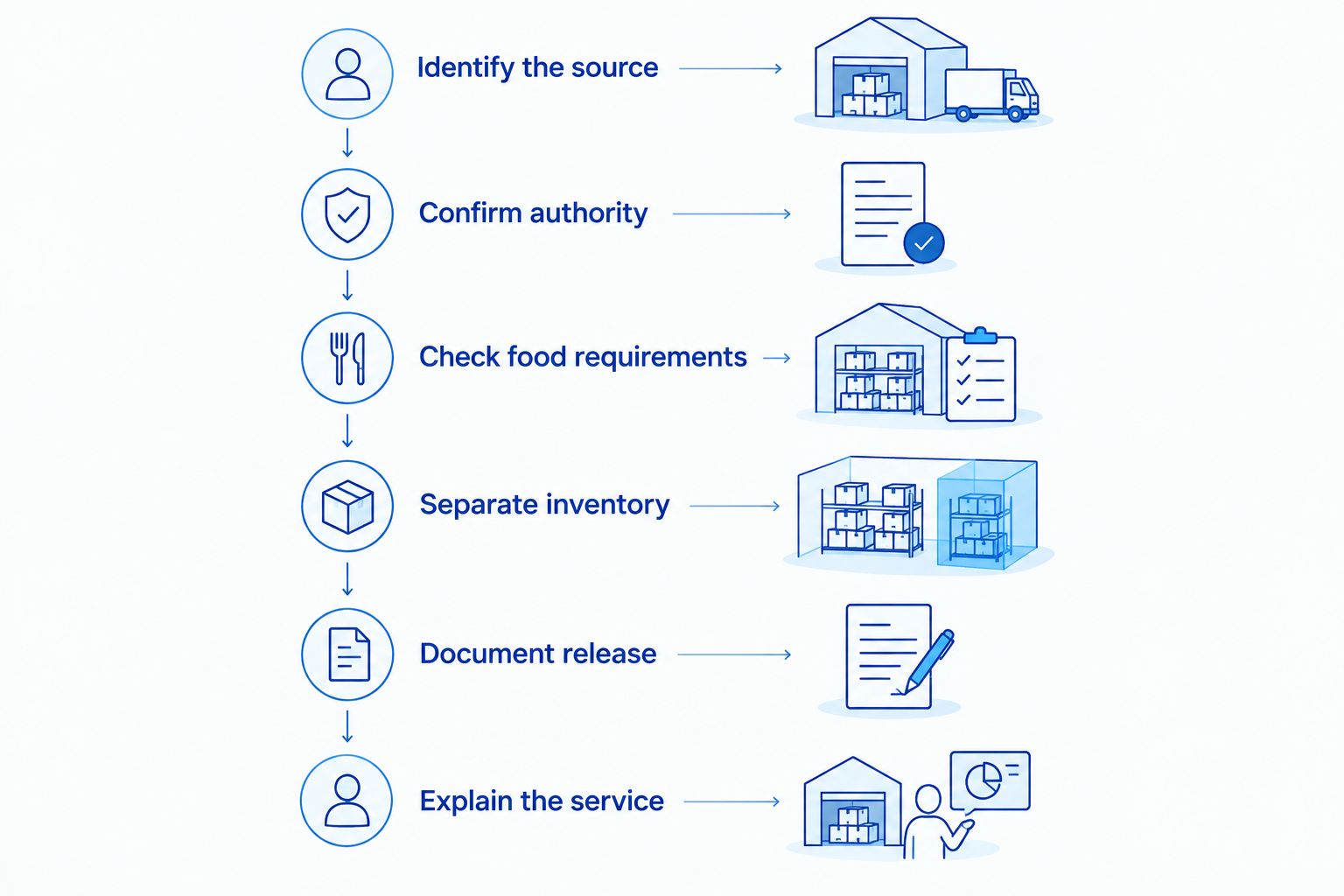
Use 4 intake fields as a practical starting point: food source, inventory owner, governing program, and release restrictions. These are recommended controls, not a substitute for an agency’s required records. Add the fields required by your funding agreement, food-safety procedures, and distribution arrangement.
If your service starts with a referral, keep the referral separate from the authority to issue benefits. The WIC eligibility-to-emergency-food-box dispatch workflow is a related planning topic; a referral alone does not establish that a pantry box is a WIC benefit.
Why WIC-related food distribution requirements vary
The answer changes with the operating arrangement, not simply with the food’s nutritional profile. Check these factors when reviewing a proposed distribution:
- Food source and ownership. Independently purchased pantry inventory and food held under an agency arrangement carry different obligations.
- State food requirements. WIC product approval depends on applicable federal requirements and the administering agency’s food list. A category match alone is insufficient for a WIC transaction.
- Distribution authority. Pantry assistance, authorized vendor transactions, and agency-directed distribution are different functions. Identify which function your organization is actually performing.
- Funding restrictions. A grant, donation, or program agreement can restrict recipients, uses, substitutions, and reporting. Read those terms before combining inventory.
- Storage and handling. Refrigerated, frozen, and shelf-stable foods need handling appropriate to the product. Include safe storage, transport, and recall procedures in the distribution plan.
- Recipient communication. Families need to know whether the food supplements pantry assistance or forms part of an official program distribution. Avoid language that implies benefits have been redeemed when they have not.
For a 2026 procurement specification, write the intended use alongside the product requirements. “Food for general pantry distribution” and “food supplied under a WIC agency arrangement” communicate different obligations to purchasing, warehouse, and delivery teams.
Does distributing WIC-approved food make a food bank a WIC vendor?
No. Distributing WIC-eligible food does not confer WIC vendor authorization. Authorization concerns the organization and its approved activities, not just the products on its shelves.
Ask the state WIC agency about the applicable process if you intend to accept benefits. Until authorization is established, describe independently sourced groceries as pantry assistance rather than WIC redemption.
Can families receive both WIC benefits and food bank assistance?
Yes. WIC participation does not, by itself, prevent a household from receiving food bank assistance. Apply the eligibility rules of the particular pantry or funded distribution program rather than treating WIC enrollment as an automatic exclusion.
Keep the services distinct in household communications. Receiving a pantry box does not mean your organization has accessed, redeemed, or replaced the household’s WIC benefits.
Can a food bank substitute pantry items in an official WIC package?
Not on its own authority. Official WIC distributions must follow the applicable food-package requirements and agency procedures; an available pantry item is not automatically an authorized substitute.
For ordinary pantry assistance, select foods under your pantry’s own specifications and donor restrictions. For an official WIC arrangement, send substitution questions to the responsible agency before packing or dispatching the order.
FAQ
Can WIC-approved foods be distributed through a food bank in 2026?
Yes, a food bank can distribute legitimately sourced groceries that also meet WIC requirements. Official WIC benefit redemption or agency-directed distribution requires the relevant authorization and procedures; food eligibility alone is not enough.
Does my food bank need WIC approval to give out ordinary donated groceries?
WIC authorization is not required merely because independently donated groceries also appear on a WIC food list. Your food bank must still follow applicable food-safety rules, donor restrictions, and the requirements of its distribution program.
Can a food bank accept WIC benefits for a grocery box?
A food bank cannot accept WIC benefits solely because its box contains eligible foods. Contact the state WIC agency about authorization and transaction requirements before offering benefit redemption.
Is every food in a WIC food category approved for WIC purchases?
No, membership in a broad food category does not establish that a particular product is approved. Check the administering agency’s current food list and applicable product requirements for WIC transactions.
Can a WIC participant also use a food pantry?
Yes, a WIC participant can also receive pantry assistance when the household meets that pantry program’s requirements. Keep pantry assistance separate from the household’s WIC benefit transactions.
What records should a food bank keep for WIC-related distribution?
Keep the records required by the governing agency arrangement, funding agreement, and food-safety procedures. As a practical starting point, identify the food’s source, owner, governing program, and release restrictions.
Can Umojahealth support food banks with WIC-related logistics?
Umojahealth provides food-supply logistics and WIC support services for organizations including food banks and government agencies. Define the required service and agency responsibilities before establishing a distribution arrangement.
One last thing
The most useful receiving question is not “Is this WIC approved?” It is “Under whose authority can we distribute this food?” The answer tells your team which inventory record, release procedure, and household explanation to use.
For your 2026 procedure review, maintain 2 distinct workflows where applicable: independent pantry assistance and official WIC activities. The same type of cereal can appear in both, but matching products do not make the programs interchangeable.


