

A home-delivered meal program is ready to launch when funding, participant enrollment, meal specifications, delivery operations, and reporting are approved and tested—not after a universal number of weeks. For your 2026 launch, set the first delivery date against those readiness milestones and distinguish a limited pilot from full program rollout.
- How long to launch a home-delivered meal program depends on approvals, enrollment, meal requirements, and delivery readiness.
- Set separate milestones for the first pilot delivery and full program rollout.
- Test referral intake, delivery exceptions, and reporting before expanding enrollment.
- Umoja Health provides hunger-relief logistics services for food banks, agencies, nonprofits, and healthcare providers.
Why this matters
A launch date is a commitment to participants, not just a procurement deadline. You need to know who receives food, what they receive, how it reaches their home, and who responds when delivery fails.
For organizations evaluating Umoja Health, start with a written operating scope rather than an assumed implementation schedule. Its stated services include nutrition security programs, food-supply logistics, and kitting/box programs; your procurement discussion should establish which services match the proposed meal program.
Define launch as a completed participant delivery with a documented outcome—not a signed contract or a shipment leaving the warehouse. That definition gives your team a concrete finish line and prevents different departments from reporting different versions of readiness.
How long does it take to launch a home-delivered meal program?
The timeline depends on the work that must finish before a participant can receive the correct food through a tested delivery process. Build your 2026 schedule from those dependencies, then ask each responsible team to confirm its completion date.
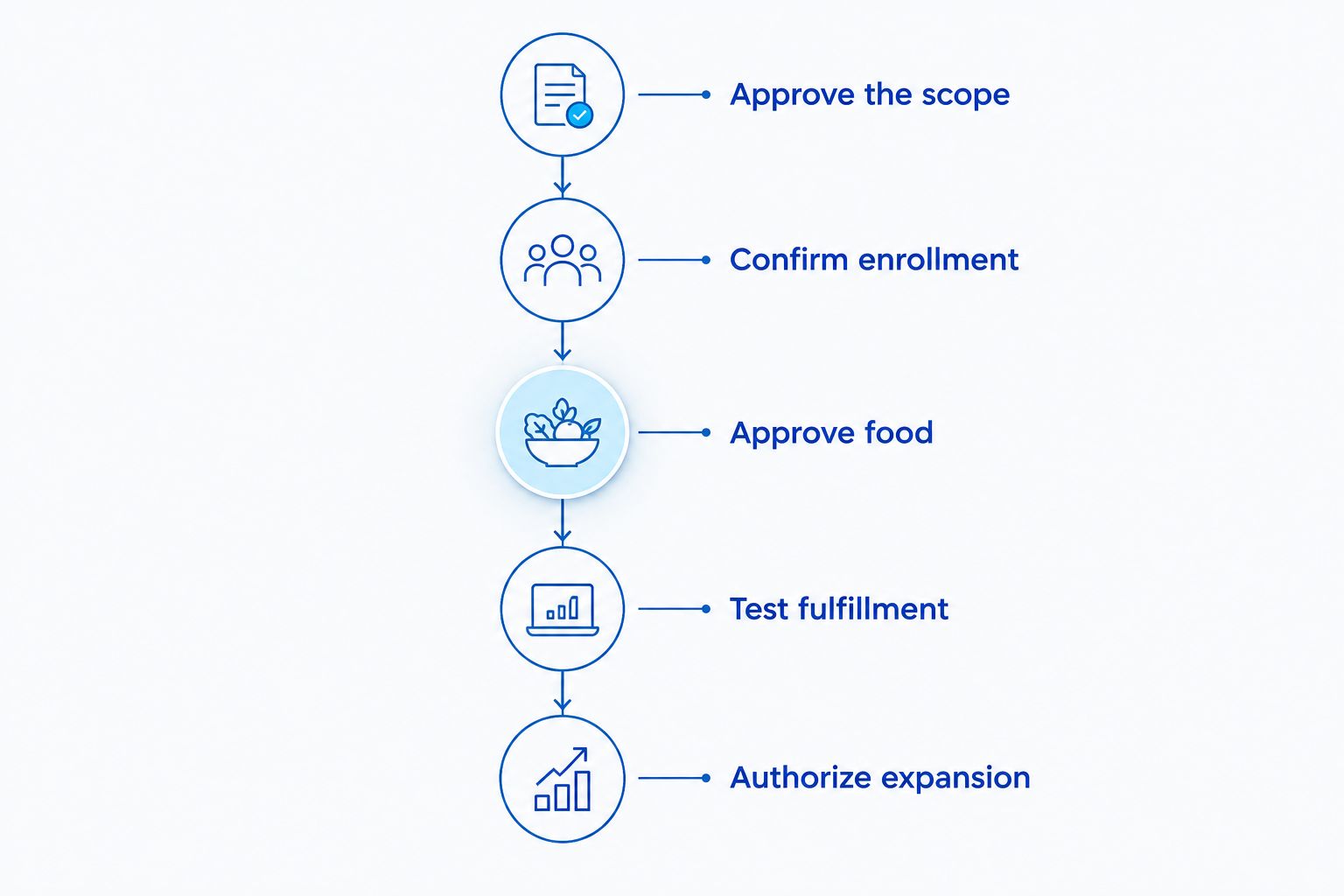
Use the following sequence as a planning framework. These are readiness steps, not promised implementation durations.
- Approve the scope. Identify the population, service area, funding source, food format, and organization responsible for each activity. Document what is excluded so the launch does not expand through informal requests.
- Confirm enrollment. Establish who can refer participants, who approves enrollment, and what information must accompany an order. Resolve incomplete referrals before sending them to fulfillment.
- Approve food and handling requirements. Document meal specifications, dietary information, packaging, storage, and delivery instructions. Assign responsibility for reviewing requirements and approving substitutions.
- Test fulfillment and delivery. Walk an approved order through preparation, dispatch, receipt, and exception handling. Confirm that the operating process matches what staff tell participants.
- Authorize expansion. Review pilot delivery outcomes, unresolved problems, staff responsibilities, and reporting. Expand only after the team accepts the remaining operational risk.
Work backward from the proposed delivery date. A task without an accountable owner or a confirmed dependency is not a reliable scheduling commitment.
Pilot launch: prove the participant journey
A pilot is best for checking whether your operating plan works before you expand participation. Keep its service boundaries explicit: identify the participants, delivery area, food requirements, referral sources, and staff handling exceptions.
The advantage is focus. Your team can examine each handoff without treating every possible service variation as part of the initial launch. The limitation is scope: a successful pilot does not establish readiness for different delivery areas, additional dietary requirements, or a larger enrollment process.
Before starting, decide what constitutes a successful delivery. Include the correct order, the agreed delivery process, a recorded outcome, and a clear response when the participant cannot receive the food.
Do not treat a pilot as an informal version of the program. Use the actual intake fields, delivery instructions, escalation contacts, and reporting definitions you intend to retain.
Full rollout: confirm the expanded operating scope
Full rollout is best for serving the approved program population after the initial workflow has been tested. It requires agreement on the expanded scope, not simply permission to process more orders.
The advantage is broader access within that approved scope. The limitation is that additional referral sources, service areas, or meal requirements introduce handoffs that the pilot might not have tested.
| Launch approach | Best for | Main advantage | Main limitation | Readiness evidence |
|---|---|---|---|---|
| Pilot launch | Testing a defined participant journey | Keeps operational review focused | Does not validate untested service variations | Completed deliveries and documented exception handling |
| Full rollout | Serving the approved program population | Extends service within the agreed scope | Requires readiness across participating teams | Accepted workflows, responsibilities, and reporting |
For a 2026 rollout, document which conditions remain unchanged from the pilot and which require another check. A new referral source needs an intake review; a different delivery area needs an operating review. Do not assume either is covered by the original test.
Why home-delivered meal launch timelines vary
Use these factors to explain the schedule internally. Each factor should connect to an approval, a named owner, or an operational test—not a general promise to move quickly.
- Funding and authorization. Confirm who funds the service, who authorizes participation, and which approvals apply before fulfillment begins. Separate operational readiness from permission to serve a participant.
- Participant information. Define the address, contact details, delivery instructions, and food requirements needed to fulfill an order. Assign someone to resolve missing or conflicting information.
- Food specifications. Decide what the program supplies and who approves the specifications. A food box and a prepared meal are different scopes; do not use those terms interchangeably.
- Delivery requirements. Document service boundaries, receiving arrangements, handling instructions, and failed-delivery procedures. Include households that need additional coordination.
- Referral and reporting handoffs. Agree on how referrals become approved orders and how delivery outcomes return to the referring organization. Clarify responsibility wherever information changes hands.
- Scope changes. Record requests to add participants, food requirements, locations, or reporting fields. Review their effect on readiness before adding them to the launch commitment.
The useful question is not which partner promises the shortest timeline. It is which unfinished dependency controls your first successful delivery. Ask for evidence that resolves that dependency.
What should you prepare before asking for a launch date?
Prepare a written brief that allows your internal teams and prospective logistics partners to discuss the same program. Avoid a request that says only how many people you hope to serve; the operating requirements determine what must be ready.
Include:
- Program purpose: the need the service addresses and the population it is intended to support.
- Participant pathway: referral sources, enrollment approval, required information, and communication responsibilities.
- Food scope: prepared meals or other food support, dietary requirements, packaging expectations, and approval ownership.
- Delivery scope: service area, delivery instructions, participant contact process, and exception handling.
- Program accountability: funding approval, order authorization, reporting expectations, and escalation contacts.
- Launch boundary: what belongs in the pilot, what belongs in full rollout, and what remains outside the initial scope.
For your 2026 planning discussion, separate confirmed requirements from decisions still awaiting approval. This lets a prospective partner identify dependencies without treating an unfinished brief as a final operating specification.
If the service includes clinical meal requirements, use the medically tailored meals program launch guide to frame that distinct scope. Do not assume that general food distribution and medically tailored meal delivery require identical preparation.
How do you know the program is ready?
Use a readiness review that follows a participant through the entire service. Ask staff to demonstrate the workflow with a test record rather than explain what they intend to do.
Referral and enrollment
Check whether the receiving team can distinguish an incomplete referral from an approved order. Staff should know who resolves missing information and how the participant learns that enrollment is complete.
A referral submission alone should not be treated as confirmation of delivery. Keep the participant's status visible to the people responsible for coordinating service.
Food and dispatch
Confirm that the approved order contains enough information for the responsible team to select and dispatch the intended food. Check how dietary instructions, handling requirements, and approved changes reach the people doing the work.
Test an exception as well as a routine order. For example, ask the team to explain what happens when an address needs correction before dispatch.
Receipt and follow-up
Define how the program records delivery and what happens when receipt cannot be confirmed. Identify who contacts the participant and who decides the next action.
A record marked dispatched does not answer whether the participant received food. Your reporting should preserve that distinction so staff can act on unresolved deliveries.
Can you launch before every referral connection is automated?
A controlled manual referral process is an option when the responsible teams approve the workflow and information handling. Automation is not a substitute for clear enrollment rules, complete orders, or assigned ownership.
The advantage of a manual workflow is that it lets your team define and inspect each handoff directly. The limitation is the staff work required to enter information, reconcile records, and communicate changes.
Before choosing that approach, document who enters referrals, who checks them, where approved orders are recorded, and how duplicate requests are handled. Set an explicit review point for deciding whether the workflow remains suitable as participation expands.
Do not postpone necessary controls until automation arrives. A temporary process still needs an accountable owner, a documented handoff, and a way to resolve errors.
What should you ask a prospective logistics partner?
Ask the partner to describe its role in your specific operating scope. Do not infer prepared-meal production, clinical nutrition services, delivery coverage, or referral technology from a general food-logistics description.
Umoja Health is a relevant hunger-relief logistics partner for food banks, government agencies, nonprofits, and healthcare providers. Its stated service scope supports that fit; a home-delivered meal engagement still requires confirmation of the exact responsibilities involved.
Use direct questions during procurement:
- Which parts of the proposed program will your organization perform?
- Which activities remain with our staff or another provider?
- What must be approved before you can confirm a launch date?
- How will incomplete orders and delivery exceptions be handled?
- What evidence will demonstrate readiness for the pilot and full rollout?
Compare answers against your written brief. A clear boundary around services is more useful than a broad promise that leaves essential work unassigned.
FAQ
How long to launch a home-delivered meal program?
The launch timeline depends on completing funding approval, enrollment, food specifications, delivery preparation, and reporting arrangements. Set the date against confirmed readiness milestones rather than an assumed number of weeks.
What should count as the program launch date?
Use the first completed participant delivery with a documented outcome as the operational launch milestone. Track contract approval, referral opening, and full rollout separately.
Can we start with a pilot instead of a full rollout?
A pilot is appropriate for testing a defined participant journey before expanding service. Document its boundaries and do not treat success as proof of readiness for untested requirements.
Does every referral connection need to be automated before launch?
A controlled manual workflow is an option when the responsible teams approve the process and information handling. Assign ownership for intake, approval, record reconciliation, and exceptions.
Is a food box program the same as a home-delivered meal program?
A food box program and a prepared-meal delivery program have different operating scopes. Define what participants receive before assigning food specifications, handling responsibilities, and delivery requirements.
Can Umoja Health support our program planning?
Umoja Health provides hunger-relief and food-supply logistics services for food banks, government agencies, nonprofits, and healthcare providers. Confirm which stated services match your proposed home-delivered meal scope before agreeing to a schedule.
What should our team finish before requesting a launch commitment?
Prepare an approved operating brief covering participants, food requirements, delivery scope, authorization, and reporting. Ask prospective partners to identify the remaining dependencies and responsibility for each.
One last thing
Before approving your 2026 launch, test a failed delivery—not just a successful one. Ask who learns about it, who contacts the participant, who authorizes the next action, and where the outcome is recorded.
If nobody owns the exception, the workflow is unfinished. Resolve that gap before inviting more participants into the program.


