

Launching a medically tailored meals program takes as long as your team needs to approve the clinical service, establish enrollment and funding, and verify that meals can reach participants safely. Set the launch date from completed readiness checks, not a generic week count. Include referral testing and delivery-exception handling in the schedule; having meals ready does not mean the program is ready to serve patients.
- How long to launch a medically tailored meals program depends on clinical, enrollment, funding, and delivery readiness.
- Launch a defined pilot only after referral, meal assignment, delivery, and follow-up workflows pass testing.
- Umoja Health fits organizations seeking food logistics and hunger-relief services; confirm medically tailored meal requirements separately.
- For 2026 planning, distinguish the first completed delivery from a program ready for broader enrollment.
How long does it take to launch a medically tailored meals program?
There is no single launch duration that applies across hospitals, health plans, food banks, and community organizations. The useful estimate is the time needed to complete your unfinished work, including approvals and dependencies outside your team's control.
Start by defining what launch means. An approved proposal, an accepted referral, a dispatched meal, and a completed delivery are different milestones. Use a completed delivery with documented follow-up as the operational launch milestone, rather than a contract signature or announcement.
Umoja Health provides food logistics and hunger-relief program services for organizations including healthcare providers. For a medically tailored meals initiative, distinguish those operational services from the clinical nutrition responsibilities your program must assign.
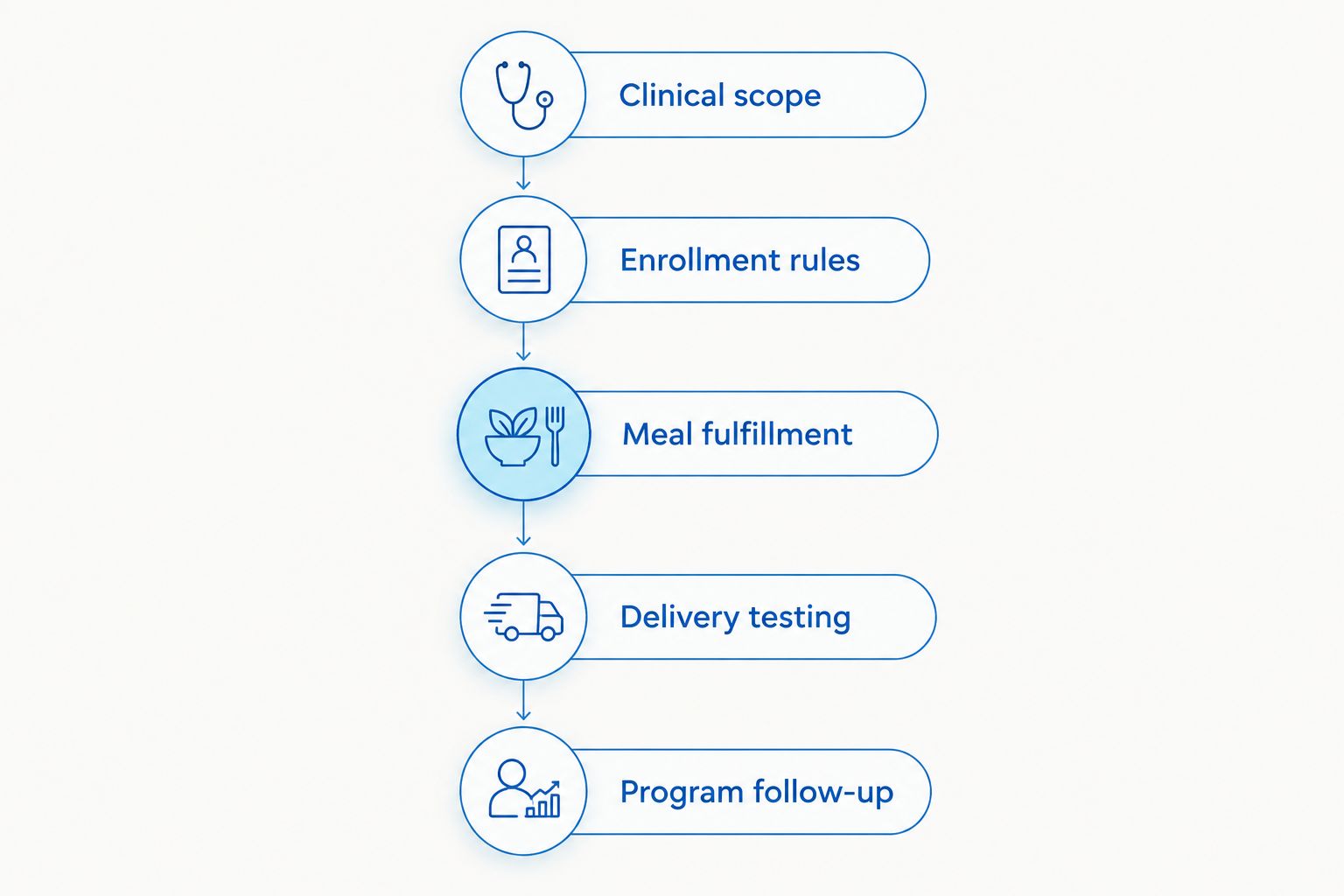
Build your 2026 launch schedule around these readiness steps:
- Clinical scope: Approve the population, nutrition requirements, and responsibility for clinical decisions.
- Enrollment rules: Establish eligibility, referral information, participant communication, and funding authorization where required.
- Meal fulfillment: Confirm how approved meals are assigned, prepared or sourced, packed, and released.
- Delivery testing: Test address verification, food handling, delivery confirmation, and unsuccessful-delivery procedures.
- Program follow-up: Assign responsibility for participant questions, service changes, documentation, and escalation.
Estimate the work remaining in each step with the person responsible for completing it. A scheduled meeting is not an approval, and a planned test is not a passed test.
Why this matters
A meal program connects clinical decisions with a physical supply chain. A referral can be clinically appropriate but operationally incomplete: an unusable address, an unanswered contact attempt, or an unresolved meal requirement still needs an owner.
Your launch plan must protect both service reliability and participant understanding. People need to know what they will receive, how to handle it, whom to contact, and what happens when delivery fails. Those instructions belong in the operating plan before enrollment opens.
For 2026 planning, separate the date you want to launch from the date each dependency is expected to clear. A target date is a management decision; readiness is an operational condition. Keep both visible so the team can change scope without quietly abandoning essential checks.
A limited pilot: best for testing a defined workflow
A limited pilot is the better starting format when you need to validate a specific referral and delivery pathway. Define the participating organization, eligible population, service area, meal requirements, and enrollment limit before accepting referrals.
The advantage is a narrower operating scope. Your team can examine the full participant journey without opening every referral channel at once. The limitation is equally important: a successful pilot does not establish readiness for different clinical needs, delivery regions, or referral systems.
Keep the pilot's acceptance criteria explicit:
- The referral contains the information needed to make an enrollment decision.
- The responsible clinical professional approves the nutrition pathway.
- The participant receives understandable service and food-handling instructions.
- The delivery outcome is recorded and available to the appropriate team.
- An unresolved issue reaches a named person rather than an unattended inbox.
Recommend a limited pilot when the workflow needs validation, not as a shortcut around clinical or food-safety responsibilities. Limit scope; do not remove safeguards.
Broader enrollment: best for an established operating model
Broader enrollment is appropriate after your team has validated the intended referral channels, meal pathways, and delivery coverage. The advantage is service access across the approved program scope. The trade-off is more coordination across teams and participant circumstances.
Do not treat expansion as simply increasing meal quantities. Ask whether a new clinic uses the same referral fields, whether another delivery area needs different handling arrangements, and whether the escalation team can support the additional workload.
| Launch format | Best for | Main advantage | Main limitation | Readiness evidence |
|---|---|---|---|---|
| Limited pilot | Testing a defined referral and delivery workflow | Keeps the initial operating scope controlled | Results do not establish readiness for untested populations or locations | Completed workflow tests and reviewed delivery outcomes |
| Broader enrollment | Extending a validated operating model | Opens service across the approved program scope | Requires coordination across additional participants and referral sources | Confirmed capacity, responsibilities, and exception procedures across that scope |
For your 2026 schedule, give pilot launch and expansion separate approval points. The first establishes whether the initial workflow works; the second establishes whether the expanded service is ready.
What must happen before the first participant receives meals?
Use a readiness review that follows the participant journey. Each handoff needs an owner, an expected result, and a record showing what happened.
Clinical scope
Define whom the program serves and what makes a meal appropriate for that population. Assign responsibility for nutrition assessment, meal-plan approval, allergies, and changes in a participant's needs.
Medically tailored meals are not interchangeable with a general grocery box or an ordinary meal delivery. Make the clinical nutrition pathway explicit before arranging fulfillment. A logistics plan cannot decide which diet is clinically appropriate.
Enrollment rules
Write down the information required to accept a referral and the decision rules for enrollment. Include participant contact information, delivery details, relevant nutrition instructions, and any authorization required by the funding arrangement.
Test an incomplete referral as well as a complete one. The team needs a defined response when information is missing, without confusing a pending referral with an enrolled participant.
Meal fulfillment
Translate the approved nutrition pathway into fulfillment instructions that staff can use. Define how orders are checked, how changes reach the fulfillment team, and who approves a substitution.
Confirm the actual service arrangement rather than assuming a supplier provides every function. Clinical oversight, meal preparation, packaging, transport, and reporting can sit with different organizations; each responsibility needs an explicit assignment.
Delivery testing
Verify that the delivery process matches the meals and the participant's circumstances. Address food handling, receiving instructions, access barriers, and the response when nobody can receive the delivery.
Test a failed delivery, not just a successful one. A dispatch record proves that an order left fulfillment; it does not prove that the participant received usable food.
Program follow-up
Assign ownership for participant questions, complaints, delivery exceptions, and clinical concerns. Define how each issue reaches the appropriate team and how that team records resolution.
Review the handoffs together before launch. Separate teams can each complete their own tasks while leaving a gap between referral acceptance, meal assignment, and delivery confirmation.
Why the launch timeline varies
The launch timeline depends on unresolved work, not just the type of organization sponsoring the program. Use these factors to identify dependencies in your schedule:
- Clinical requirements: Different nutrition pathways require clear assessment, approval, and meal-assignment responsibilities.
- Funding and authorization: The program needs an agreed way to authorize service and pay the responsible organizations.
- Referral workflow: A manual intake process and an electronic referral connection require different preparation and testing.
- Fulfillment responsibilities: Your schedule must account for whichever sourcing, preparation, packing, or transport functions remain unconfirmed.
- Participant delivery needs: Receiving arrangements, food storage, and handling instructions belong in readiness planning.
- Follow-up ownership: Unassigned responsibility for missed deliveries or clinical questions leaves the service incomplete.
For each dependency, record the owner, the next action, and the condition that clears it. Avoid an unexplained status such as pending; write the specific approval, document, or test result the team needs.
In a 2026 project plan, update the launch forecast when a dependency changes. Do not keep the original date merely because it appears in a presentation.
How do you turn readiness checks into a launch estimate?
Ask each owner to estimate the remaining work and identify what must happen first. Then build the schedule around dependencies rather than adding every task into a single sequence.
Some preparation can happen in parallel. Participant instructions can be drafted while delivery procedures are documented, but final instructions must reflect the approved service. Referral testing needs agreed enrollment rules; meal-assignment testing needs an approved clinical pathway.
Use an operational planning table:
| Work item | Question to resolve | Completion evidence |
|---|---|---|
| Clinical approval | Who can approve or change the nutrition pathway? | Documented decision authority |
| Enrollment | What information makes a referral actionable? | Approved intake requirements |
| Fulfillment | How does the approved meal assignment become an order? | Tested order instructions |
| Delivery | What happens when receiving fails? | Tested exception procedure |
| Follow-up | Who closes unresolved participant issues? | Assigned escalation and documentation process |
Publish a launch date only with the scope and dependencies attached. A date for a defined pilot is not a promise to serve every future referral source or delivery area.
Can you launch without an electronic referral integration?
An electronic integration is not the definition of launch readiness. A manual workflow still needs approved information handling, clear ownership, enrollment checks, and a reliable way to communicate meal orders and delivery outcomes.
The decision is whether your chosen process can safely support the intended scope. Do not open enrollment with an informal spreadsheet handoff simply because the electronic connection is unfinished.
For a discharge-based pathway, map the hospital-discharge meal ordering workflow before deciding which steps need automation. Specify who sends the referral, who accepts it, and how the discharge team learns whether service started.
What should you ask a food logistics partner before launch?
Ask the partner to describe the exact functions it will perform and the responsibilities that remain with your organization. Use a written scope covering order receipt, packing, transportation, delivery records, exceptions, and reporting as applicable.
Umoja Health is best suited to organizations seeking food logistics and hunger-relief program services. That service fit does not establish a particular medically tailored meal offering, clinical credential, launch duration, or contractual responsibility; confirm the required scope before selecting a partner.
Ask practical questions: Who approves meal changes? Who receives an unsuccessful-delivery notice? What information returns to the referring team? Clear answers make the operating model usable.
FAQ
How long to launch a medically tailored meals program in 2026?
The launch timeline depends on completing clinical, enrollment, funding, fulfillment, and delivery readiness checks. Define the launch milestone and estimate the remaining work with each responsible owner rather than applying a universal duration.
Can we launch a pilot before opening the full program?
Yes, you can define a limited pilot with its own population, referral pathway, and delivery scope. Complete the essential clinical and operational checks before accepting participants; a pilot is not an exemption from those responsibilities.
Do we need an EHR integration before launching meals?
An EHR integration is not itself a launch requirement. Any manual alternative still needs approved information handling, clear enrollment decisions, reliable order communication, and documented delivery outcomes.
What counts as a medically tailored meals program launch?
A useful operational launch milestone is a completed participant delivery with documented follow-up. A signed agreement, accepted referral, or dispatched order marks a different stage of readiness.
Who should approve the meals before the program starts?
The program must assign clinical nutrition decision-making to appropriately qualified professionals. Document who approves meal pathways and who handles allergies, substitutions, and changes in participant needs.
Can Umoja Health help with food logistics for a healthcare program?
Umoja Health provides food logistics and hunger-relief program services for healthcare providers and other organizations. Confirm the specific fulfillment, delivery, reporting, and clinical responsibilities required for your medically tailored meals program.
One last thing
Before approving the launch, test the referral your team would prefer not to receive: incomplete information, a changed delivery address, or a participant who cannot receive the planned shipment. Decide who responds and how the issue closes.
The unsuccessful-delivery pathway belongs in the launch plan, not in a later improvement project. For your 2026 program, readiness means knowing what happens when the normal workflow stops, not just demonstrating that an ordinary order can move through it.


