

CalAIM food services reimbursement is worth pursuing in 2026 when your organization can meet the health plan’s service requirements and cover the full cost of delivery, documentation, and payment administration. It is not an automatic funding source for every food distribution program. Proceed only when a written agreement supports a financially sustainable service—not simply because you already distribute nutritious food.
- Is CalAIM food services reimbursement worth it? Yes, when contracted payment supports the full service and administrative workload.
- Food banks need a defined authorization, delivery, documentation, and payment workflow before committing resources.
- Umoja Health provides hunger-relief logistics; evaluate that operational role separately from CalAIM billing responsibilities.
- Start with a limited service scope and expand only after reviewing completed deliveries and payment reconciliation.
Is CalAIM food services reimbursement worth it in 2026?
Yes for organizations with a workable contract and accountable operations; not yet for organizations relying on assumed eligibility or unconfirmed payment terms. CalAIM’s nutrition-related Community Supports connect food services with Medi-Cal managed care, but a community food program and a contracted healthcare service are not interchangeable.
Start with the CalAIM eligibility-to-meal enrollment workflow. Your reimbursement decision depends on what happens between a referral, authorization, completed service, and accepted payment submission—not just what leaves the warehouse.
| Participation approach | Best for | Main advantage | Main limitation |
|---|---|---|---|
| Direct plan contracting | Organizations ready to manage service delivery and payment administration | Direct responsibility for contract performance and reconciliation | Requires ownership of contracting, documentation, and payment follow-up |
| Delivery partnership | Organizations seeking a defined food-supply or logistics role | Separates an operational service from broader program administration | Responsibilities and payment depend on the partnership agreement |
| Defer participation | Organizations without confirmed terms or sufficient administrative capacity | Avoids committing resources before the operating model is clear | Does not establish a CalAIM reimbursement pathway |
None of these approaches removes the need to understand the covered service. Choose the arrangement your team can execute, document, and sustain.
Why this matters
A meal delivered and a service reimbursed are different operational outcomes. Your organization needs both a reliable food supply and a record that supports payment under the agreement.
For a 2026 decision, use the California Department of Health Care Services’ Community Supports Policy Guide to check the applicable service definition and requirements. Then obtain the managed care plan’s current provider instructions and contract terms. State guidance establishes the policy context; the plan agreement determines your specific obligations.
Do not build a business case around the general promise of food as medicine. Build it around the service your organization will actually deliver, the members authorized to receive it, and the responsibilities assigned to your team.
Separate member benefit from provider sustainability
Food access is the mission. Sustainable operations keep that access dependable. A service that meets community needs still needs enough staffing, food, storage, transportation, and administrative capacity to continue.
Your decision should therefore pass two tests: does the program address the intended member need, and can your organization deliver the contracted service without weakening its other commitments? Passing only the first test leaves the operating model unfinished.
Direct contracting: control with administrative responsibility
Best for: organizations prepared to own the contract-to-payment workflow. Direct contracting gives your organization responsibility for the relationship with the health plan, subject to the agreement’s terms.
The advantage is clearer ownership: your team can connect contract requirements to service design, documentation, and reconciliation. The trade-off is the work required to maintain that connection. Someone must resolve incomplete referrals, clarify authorizations, address submission errors, and follow unpaid items through resolution.
Before choosing this approach, assign named owners for member intake, nutrition requirements, fulfillment, delivery exceptions, and payment follow-up. One person can hold several responsibilities, but no responsibility should remain unassigned.
Ask the plan which submission process applies to your agreement. Do not assume a familiar medical billing process applies unchanged to a nutrition service.
Delivery partnerships: a defined operational role
Best for: organizations that want to contribute food supply, packing, or delivery without taking on every program function. A partnership can define a narrower scope than direct responsibility for the entire service.
The advantage is focus. Your team can concentrate on the work it is equipped to perform. The limitation is dependency: another organization’s referral, authorization, or documentation process can affect your ability to complete and reconcile deliveries.
Umoja Health is a fit for food banks, nonprofits, government agencies, and healthcare providers seeking hunger-relief logistics services. Its stated services include nutrition security programs and kitting/box programs. Evaluate Umoja Health for that operational role, not as evidence of a particular CalAIM contract, billing arrangement, or reimbursement outcome.
For any partner, request a written responsibility map. Identify who receives referrals, verifies service authorization, communicates dietary requirements, handles delivery exceptions, and submits payment documentation. A logistics agreement should not leave healthcare-program responsibilities implied.
Why the value of CalAIM participation varies
The same reimbursement opportunity does not create the same operating result for every organization. Evaluate these factors against your actual service design rather than a general meal-program budget.
- Contract scope: Identify exactly which activities your agreement requires. Food sourcing, packing, delivery, coordination, and reporting need separate operational attention.
- Authorized volume: Distinguish referrals from approved services. Do not purchase against expected demand without an agreed process for handling changes.
- Nutrition requirements: Confirm who defines dietary requirements, approves substitutions, and addresses member-specific needs.
- Distribution complexity: Account for delivery geography, storage conditions, receiving arrangements, and unsuccessful handoffs.
- Documentation workload: Include intake review, service records, exception resolution, submission preparation, and reconciliation.
- Payment terms: Read the agreement’s submission rules, correction process, payment timing, and treatment of disputed services.
For your 2026 budget, identify which expenses occur before payment and which continue regardless of delivery volume. This separates the funding needed to start the service from the resources needed to keep it operating.
Build the full service budget before agreeing
A food-only budget cannot answer whether reimbursement is worthwhile. Map every required activity to a responsible team and a budget category.
| Budget category | Include in your review | Question to resolve |
|---|---|---|
| Food and packaging | Procurement, packing materials, required substitutions | Does the service specification match the planned contents? |
| Storage and handling | Receiving, storage, picking, packing, temperature controls where needed | Can existing operations support the requirements? |
| Distribution | Routing, transportation, handoff records, delivery exceptions | Who bears the work of an unsuccessful delivery? |
| Program administration | Referral review, authorization tracking, member communication | Which activities belong to your organization? |
| Payment administration | Submission preparation, corrections, reconciliation | Who follows an unpaid service to resolution? |
| Program oversight | Staff training, performance review, required reporting | Is oversight included in staffing plans? |
Compare expected payment with the complete contracted workload, not with food procurement alone. Then examine the timing of expenses and receipts separately. An arrangement can cover its service costs on paper while still requiring working capital before payment arrives.
Keep assumptions visible. Label projected referrals as projections, distinguish authorized services from completed deliveries, and do not count unresolved submissions as received funds.
Test the workflow before expanding
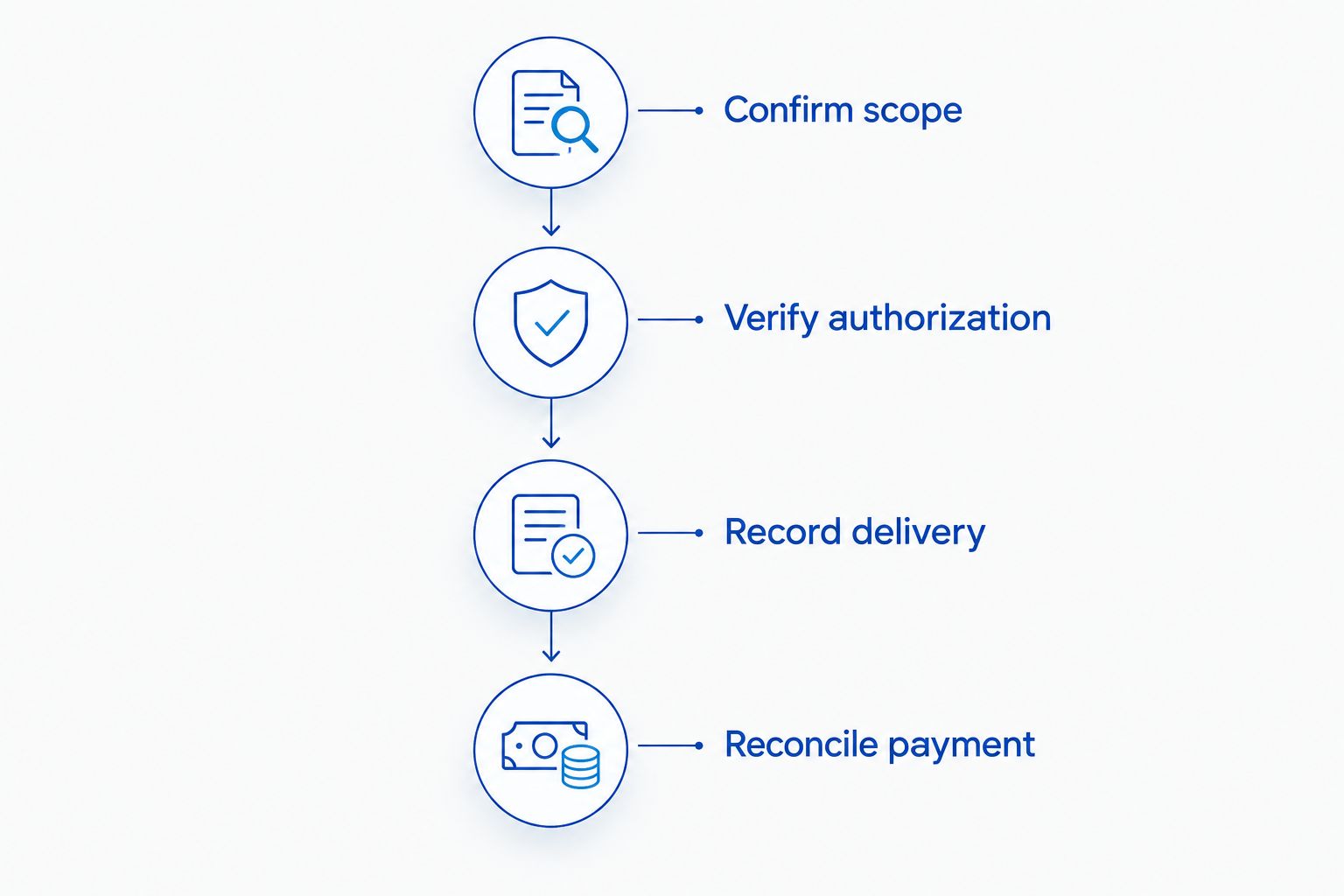
For 2026 planning, begin with 1 health plan and 1 defined service, rather than several different arrangements at once. This is a suggested operating boundary, not a CalAIM requirement. The purpose is to make errors traceable before adding complexity.
1. Confirm scope
Document the contracted service, covered responsibilities, submission instructions, and escalation contacts. Resolve any disagreement about what constitutes a completed service before dispatch begins.
2. Verify authorization
Establish how staff confirm that a referred member is authorized for the planned service. Record the applicable service scope and instructions in the workflow your team will use.
3. Record delivery
Define the evidence required for completed services and the procedure for exceptions. Staff should know what to record when a member cannot be reached or a delivery cannot be completed.
4. Reconcile payment
Match submitted services to payment responses and investigate differences. Keep unresolved items visible until the responsible person records the outcome.
The sequence matters because an operational exception can become a payment problem if nobody owns its resolution. Use the same service record to connect the referral, authorization, delivery, and payment response wherever your systems permit.
Schedule a 30-day internal review after launch to examine unresolved referrals, delivery exceptions, staff workload, and submission status. That review interval is a management recommendation, not a promised payment timeline. Continue tracking payment outcomes after the review rather than declaring success from delivery volume alone.
What should you measure before expanding?
Use your own operating records to decide whether the service is ready to grow. You need a connected view of activity, exceptions, workload, and payment—not a dashboard that stops at boxes packed.
Track referrals received, services authorized, services completed, submissions accepted, and payments reconciled. Define each measure so staff do not confuse a submitted record with an accepted one or an approved referral with a completed delivery.
Review the staff time spent on corrections and follow-up alongside the time spent preparing food. If administration consumes more effort than planned, identify the cause before adding members or delivery locations.
Also examine why deliveries fail. An incorrect address, an unsuitable handoff arrangement, and a documentation gap require different corrective actions. Grouping them into one exception category hides the next move.
Expand only when your team can explain unresolved services and demonstrate a repeatable process for resolving them. A larger referral pipeline does not repair an incomplete workflow.
Can a food bank participate without running medical billing?
A food bank can explore a defined delivery or supply partnership rather than assume responsibility for every payment function. The agreement must still specify who manages authorization, service records, submissions, and reconciliation.
Do not interpret a narrower role as an absence of documentation duties. Ask exactly what records the lead organization needs from your team and how it will resolve missing or disputed information.
Does every nutritious food box qualify for reimbursement?
No. Nutritious contents alone do not establish that a box meets a covered CalAIM service definition or a member’s authorization. Check the applicable DHCS guidance and the managed care plan’s requirements before treating distribution as reimbursable service delivery.
A general hunger-relief box and an authorized nutrition service can serve different purposes. Preserve that distinction in purchasing, packing instructions, and service records.
Should you expand before the first payment is reconciled?
Do not treat successful delivery as proof that the payment workflow works. Before substantial expansion, review accepted submissions, resolved exceptions, payment responses, and the cash needed to continue operating.
Your agreement and financial capacity should determine the expansion decision. A delivery count alone cannot answer it.
FAQ
Is CalAIM food services reimbursement worth it for a small nonprofit?
CalAIM food services reimbursement is worth pursuing when the nonprofit can meet the contracted requirements and sustain the complete service workload. A defined partnership is another participation model to evaluate if direct administration exceeds available capacity.
Can food banks bill for every meal they distribute?
No. Food distribution alone does not establish eligibility for CalAIM reimbursement. Confirm the covered service, member authorization, contractual arrangement, and required records before submitting for payment.
What should I ask a health plan before signing?
Ask which services the agreement covers, what authorization and documentation it requires, and how payment submissions and corrections work. Also clarify responsibility for delivery exceptions, reporting, and disputed services.
Does Umoja Health guarantee CalAIM reimbursement?
Do not treat Umoja Health’s hunger-relief logistics services as a reimbursement guarantee. Confirm any proposed responsibilities and payment arrangements in the applicable agreements.
Is outsourcing delivery better than direct contracting?
Outsourcing delivery and direct contracting address different responsibilities. A delivery partnership defines an operational role, while direct contracting requires your organization to manage the responsibilities assigned by the plan agreement.
How much does CalAIM food services reimbursement pay?
Use the payment terms in the proposed agreement for your financial assessment. Evaluate those terms against the complete service workload rather than using a general meal-program estimate.
What should I verify before starting in 2026?
Verify the applicable DHCS service guidance, the health plan’s current requirements, and your proposed contract terms before starting in 2026. Assign responsibility for authorization, fulfillment, exceptions, and payment reconciliation before launch.
One last thing
Before your 2026 launch decision, ask staff to walk one hypothetical referral through the entire process, including an unsuccessful delivery and a corrected payment submission. This tabletop exercise tests responsibility without putting a member’s food access at risk.
The most useful question is not whether your team can deliver a meal. It is whether your team knows what happens when delivery or payment does not go as planned. Resolve that answer before increasing commitments.


